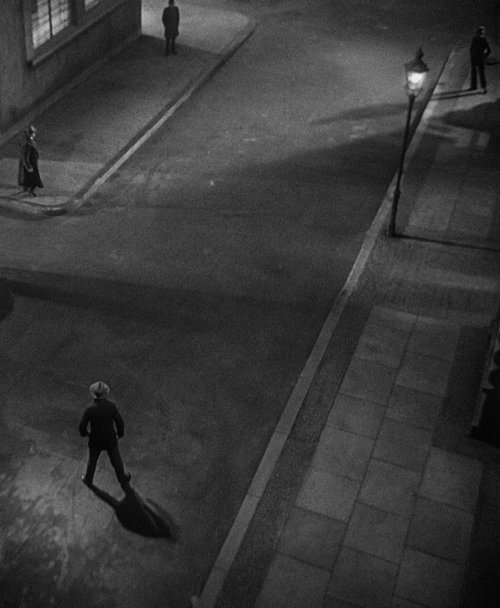
Showing posts with label Alfred Hitchcock. Show all posts

Friday, 25 October 2019

Young and Innocent (1937)

In 1990 a new TV channel started in Sweden, TV4, and for a while in the early 1990s they were showing Hitchcock's films of the 1930s regularly in the afternoons. I watched them all and recorded them on VHS tapes, so I could watch them whenever I wanted. And I wanted to a lot. I watched them so many times that the colourful logo of TV4 has become part of my memories of these films. While The 39 Steps (1935) and The Lady Vanishes (1938) were the best ones, it was another one I re-watched the most: Young and Innocent (1937). It is not a terribly exciting story but it has such generosity and charm, perhaps like no other film by Hitchcock, that I immediately developed a crush on it.

It has a typical Hitchcockian story, a man on the run after having been falsely accused of murder and himself searching for the real criminal. It is also a sort of road movie in the British countryside, interspersed with typical Hitchcockian set pieces. There is for example a children's party which is a feast of looks, mistaken identities and sly wit. There is also an accident in an abandoned mine and the celebrated long take in the end of the film, starting high up in a hotel lobby, moving down across a restaurant, over a band playing, and into the eyes of the drummer.

Children in Hitchcock's films are usually eccentric.

While anybody watching it would instantly recognise the man behind it, the tone is different. There is no darkness or neuroses, or paranoia; instead it is a lovely tale of the growing romance and love between the two young leads: Derrick de Marney as the fugitive and Nova Pilbeam as the chief constable's daughter who helps him. Their banter and flirting are what keeps the film together, and gives it its charm. That most of the people they encounter are distinct characters also adds to the overall sense of bonhomie. Despite the seriousness of the situation, nobody seems to take things too seriously, and the real murderer is not a threat or a menace but only appears briefly in the beginning and for a few minutes in the end (where he is only a threat to himself).

According to Patrick McGilligan's book Alfred Hitchcock: A Life in Darkness and Light, Hitchcock was under a lot of stress and in a bad mood when he made the film because of his economic situation and contractual reasons (it was about to expire): he had gained a lot of weight, he was tired, and used humour and sarcasm as a defence mechanism. Maybe he wanted to make something light and playful to counter his inner turmoil.

The film is based on a book, but they have little in common other than that there is a murder in the countryside. Instead Hitchcock completely re-imagined it, working with a lot of people on the script, including his recurring partners Joan Harrison, Charles Bennett and Angus MacPhail. Another key collaborator was, as always, his wife Alma Reville.

The set designer was Alfred Junge, otherwise known for his work on the films of Michael Powell and Emeric Pressburger, and it is particularly the mine that stands out. It is a good, effective scene. Perhaps the only scene in the film of real danger, shot almost like it was a silent film.

Doing the complicated long take.

It is often said that Hitchcock was discovered by the French in the 1950s, but this claim is undermined by the fact that he was celebrated as an important filmmaker on both sides of the Atlantic early on, and in the mid-30s some leading critics, including Otis Ferguson, suggested that he was one of the greatest directors currently working. Young and Innocent is not a work of greatness but it has great charm, and it shows how even under stress and difficult working conditions, and without the financial resources he would later have, he could, seemingly effortless, pull off a fully accomplished and recognisable film of pure Hitch.

-------------------------------------------------
A good analysis of the film is by Charles Barr in his book English Hitchcock (1999), drawing out the connections with later films like Vertigo (1958) and The Birds (1963), and emphasising the importance of Charles Bennett in Hitchcock's development.

Friday, 31 May 2019

Laura Mulvey's Visual Pleasure and Narrative Cinema

Writing about The Nun's Story (Fred Zinnemann 1959) recently reminded me of Laura Mulvey's article "Visual Pleasure and Narrative Cinema" and how incompatible the two are, the film and the article. Mulvey's article denies the possibility of such a film, so I decided to return to Mulvey's piece and discuss it here. Her article is important as it is probably the most read and cited article in the history of film studies. In the big anthologies about film theory, Mulvey's text is one of the very few that appears in all I have seen. Likewise, it is the only one that has been mandatory reading for all film students at all the universities with which I have been associated in some form.

This is perplexing because it is not a good text and its flaws are obvious. While it has been criticised from a few angles ever since it was published, usually from within a psychoanalytic frame-work (such as Joan Copjec, Gaylyn Studlar, Carol J. Clover, Richard Allen and Todd McGowan) or from philosophers like Noël Carroll, it is still treated as a serious and important work of film theory even though there is nothing in the text that can justify this. Mulvey herself has moved beyond it and has on occasions expressed her ambivalence about its canonical place within film studies. In 1989, in the introduction to the book Visual and Other Pleasures, she wrote this about her article: "Written in 1973, polemically and without regard for context and nuances of argument, published in 1975, after many references and quotations in the following year, it has acquired a balloon-like, free-floating quality." and that is one of several times she has commented on it in similar ways. Mulvey is more critical of her own article than many other scholars who believe it is a great piece of scholarly insight into how films and humans function. It is not, and it was never Mulvey's intention for it to be, so while I will be using expressions like "Mulvey says" or "Mulvey's argument" it is not to criticise her per se today, as she has moved beyond the article, but just the article when it was written. But let me go through it step by step, and point out what I consider are its major flaws.

***

Particularly important for Mulvey is Jacques Lacan and his "mirror stage" or "mirror phase". Lacan's belief (which he had taken from the psychologist Henri Wallon) is usually summarised something like this: children's perception of themselves as individuals is formed when, somewhere between the age of six and 18 months, they for the first time see themselves in the mirror, but that what they see is an idealised version of themselves. This is how Mulvey portrays it but when her article was published, Lacan had reconsidered the theory. It was not specifically a mirror that had to be involved and he was emphasising that it was not a decisive moment, not a formulation of an ego, but part of a process. So Mulvey's version of Lacan is not exactly right, or at least incomplete. This is perhaps understandable as Lacanians have argued for decades over the exact meaning of the mirror phase, and brief summaries of it are usually different from one another in some significant way. What she primarily takes from the idea of the mirror stage is the concept of identification with an ideal. She argues that when the audience see a film they identify with the male main character and see him as an idealised version of themselves. But her basic argument is a giant leap of faith. Lacan claims (according to her) that all children have a mirror experience and therefore, Mulvey claims, the members of the audience identify with the male lead and through his actions overcome their own castration anxiety. Even if Lacan's original theory had been correct though there is nothing similar between a mirror image of yourself and a film. As an example, the point of the mirror stage in Mulvey's telling is that the child does recognise the image as itself. This is not what we do when watching a film; we do not think "That is me." when we see the face of Tom Cruise on the screen as we do when we see the face of ourselves in the mirror. Further, there is no reason to assume that every audience member would react the same way. Mulvey's assumption that all audience members identify with the same character in a given film is one of the things that many have criticised her for.

Another obvious flaw is that the theory, although she speaks of Hollywood as a whole, only works when there is a male lead. Sometimes there is none, sometimes there are more than one. Do we identify with each lead equally much or subconsciously choose one, so some identify with Laurel and others with Hardy? In many thrillers the male lead is a criminal or murderer or in one way or another a bad character, and the female lead is a victim of his aggressions. The purpose of such films is for the audience to be scared and concerned for the health and well-being of the woman, but if we all identified with the man we would not be worried about the woman. If we, according to Mulvey's argument, identified with the man we would presumably hope that he (us) managed to kill the woman. But we do not. A small minority might, but not the average person.

milk glass in Suspicion (Alfred Hitchcock 1941)

Another question is what in the first place it means to identify with a character and to what extent we do that. When I watch a James Bond film I do not identify with Bond, partly because we have nothing in common. His Girl Friday (Howard Hawks 1940) is one of my favourite films but I do not identify with any of the characters there, and I would say that this is true for most films. When I identify with anything it is primarily with specific feelings or reactions in specific situations, regardless of the gender of the character (or even species, such as the terrified dog in David Lean's Oliver Twist (1949)). I do not think I am alone in this.

mirrors in The Little Foxes (William Wyler 1941)

Mulvey writes about Freudian ideas such as penis envy (according to Mulvey, women have a "desire to possess a penis"), castration complex and other related concepts, but those concepts are dubious at best, are impossible to prove, have been criticised ever since Freud first wrote about them and are rarely taken seriously today. Freud's theory, which Mulvey seems to agree with, was that these concepts were common to all humans at all times throughout history, even though Freud's empirical material consisted of a few people in fin de siècle Vienna and not a representative sample of humanity as a whole.

Mulvey combines her psychoanalysis with apparatus theory, based around the idea that the way we watch films and the way films are made, make the audience especially susceptible to their sexist and ideological message. We, the claim is, sit in the dark, cut off from the real world and instead come to believe that the world of the film is the real world, due to the film's use of realism and invisible editing ("conditions of screening and narrative conventions give the spectator an illusion of looking in on a private world"). This is as unsatisfying and peculiar as the psychoanalysis. For one thing, most people do not experience film by watching it in a dark movie theatre. They watch films at home. This was true in the 1970s and remains true today. We also watch films outdoors or on the in-flight entertainment system. Even when people go to the cinema it is to experience the film in a variety of ways. The quiet and dark movie theatre setting on which apparatus theory is based is just one way of many of watching a film in the cinema, from the habit of having the audience come and go at will, and not see a film from beginning to end, to singalong experiences of musicals. Cinema-going habits vary between different eras and between different cultures, and Mulvey and apparatus theory in general ignore this. This alone makes the theory unsustainable.

If invisible editing and the pretence of realism are inherently suspect you would expect neorealism and the films of Ken Loach to be among the main targets of apparatus theory rather than Hollywood at large, since a lot of Hollywood cinema is extravagant escapism and adventures which do not aim for realism. Two other popular kinds of films from the era Mulvey is primarily focused on are musicals and film noir and they frequently foreground stylistic achievements and artificiality. The idea that Hollywood films as a rule rely on invisible editing is also contradicted by the evidence. Some films try to keep the editing smooth and unnoticeable (even though almost any given film have cuts and edits that are highly visible) and others do not. Alfred Hitchcock, one of Mulvey's examples, is fond of shock editing and artificiality, although on a different level than Mulvey's other main example, Josef von Sternberg, whose films are all about form; the antithesis to the realism Mulvey claims is an essential part of the problem with Hollywood. This is an example of the incoherence of her arguments.

***

While Mulvey's article is theory-dense, she did not have to spend so much time on Freud and Lacan. Pointing out sexism in cinema is perfectly possible without invoking castration anxiety or a mirror stage. The sexism is real and obvious (just look at Bus Stop (Joshua Logan 1956)), and in need of no theory to highlight. Yet her arguments about the way men and women are depicted in films are weak too, whatever your views are of Freud and Lacan.

She makes several general statements about the differences between men and women on films, and key is how the man has the look and the woman is being looked at, how the man controls the gaze, and how the woman is always sexualised. She quotes Budd Boetticher saying that in herself, the woman has not meaning for the film, only as an instigator. This might be true for some of Boetticher's own films which are about a man avenging the death of his wife, but it is not a general truth for cinema at large. It never has been. Having women as central characters that drive the narrative has been a constant factor since the early days of cinema. That is what I meant when I said that The Nun's Story and Mulvey's article are incompatible. It is probably more common to have male characters as the ones driving the narrative, rather than women, but far from always. Screwball comedies usually have one man and one woman in the lead, equally driving the narrative. Musicals, such as Meet Me in St Louis (Vincente Minnelli 1944), often have women as leading characters, and the men play second fiddle. But it is not only specific genres. A crime thriller like Appointment with Danger (Lewis Allen 1951) has a nun and a postal inspector as the crime-fighting team. (Films with nuns as central characters should present a problem for Mulvey.) The films of Spencer Tracy and Katherine Hepburn. The films of Doris Day, or Lucille Ball. But I will not go on any further, the list is long enough. You might counter that Mulvey is perhaps not talking about all of Hollywood cinema, that she is merely pointing at a certain kind of sexist cinema. But since she is using Lacan and apparatus theory, all-encompassing theories, and speaks of Hollywood cinema in singular, she does not leave any room for alternatives or minority cases. She is talking of the whole of Hollywood cinema "and of all the cinema which fell within its sphere of influence" by which she seems to mean "the narrative fiction film."

***

At one point Mulvey says that "the male figure cannot bear the burden of sexual objectification." This is not true. Just think of singers such as Elvis Presley or Tom Jones. Cinema is filled with scenes of men looking at other men and women looking at men in a sexualised way. When male film stars were referred to as hunks and beefcakes, it was because they were objectified and the beauty of their bodies underlined. That is self-evident and Mulvey's apparently belief is belied by film history and audiences. I am sure that she was aware of women looking at William Holden or Burt Lancaster with lust in their eyes. Some genres were particularly good at providing eye candy for those who like to look at the male body, such as biblical epics and sword-and-sandals films. There is a delicious moment in Esther and the King (Raoul Walsh 1960), when Esther (played by Joan Collins) and some ladies come across the king, dressed only in little more than a loincloth, and they gasp with delight at the sight of his strong, sweaty body. But it is not genre-specific. In The More the Merrier (George Stevens 1944) Joel McCrea's character is a young and good-looking man in New York when most young and good-looking men are away overseas fighting the war, so the women stare at him and undress him with their eyes. In one scene he undresses himself and goes sunbathing in a pair of shorts. In Hands Across the Table (Mitchell Leisen 1935), another romantic comedy, Fred MacMurray, the male lead, is half-naked most of the film unlike Carole Lombard, the female lead, who is properly dressed.

William Holden in Picnic (Joshua Logan 1955)

From Here to Eternity (Fred Zinnemann 1953)

We can accept Mulvey's argument and settle for the idea that when the audience see Burt Lancaster and Deborah Kerr on the beach, all of them look at Kerr and nobody look at Lancaster. Or we can question whether this is plausible. I think it is not, and that her general arguments about men and women on films, and how they are viewed, are inaccurate. (There is also a Queer subtext in From Here to Eternity, which sometimes moves from subtext to text; yet another complication in Hollywood cinema that Mulvey cannot acknowledge.)

Burt Reynolds in Cosmopolitan, 1972

What about when she speaks of specific films? There too she is sometimes objectively wrong and sometimes interpret what is happening in a peculiar way. She mentions eight films by name in her article: Morocco (Josef von Sternberg 1930), Dishonored (Josef von Sternberg 1931), Only Angels Have Wings (Howard Hawks 1939), To Have and Have Not (Howard Hawks 1944), Rear Window (Alfred Hitchcock 1954), The River of No Return (Otto Preminger 1954), Vertigo (Alfred Hitchcock 1958) and Marnie (Alfred Hitchcock 1958). Of those she claims that in the two films by Hawks, the woman is initially a show girl, "isolated, glamorous, on display, sexualised", but as the film progresses she becomes the property of the man and stops appearing in front of others. This is not what happens in the films. Bonnie in Only Angels Have Wings performs once, in the beginning, but this is a group performance with most of the main characters including the male lead, Geoff, and through this performance she is initiated into the group. She and Geoff become a couple (sort of) in the end of the film, but she does not change in appearance or become de-glamourized. She was never put on display or sexualised in the first place, and she never becomes his property. (An offensive idea.) But the most important thing is that in the film Bonnie is the audience's surrogate. She arrives at Barranca in the opening sequence, a stranger to this place where all the others know each other, and we follow her. The other characters spend the beginning of the film explaining to her (and us) who is who and what they do and why. If the audience identify with anyone in the film it is probably with her. Mulvey's argumentation has very little to do with what happens in the film.

Slim in To Have and Have Not does not change in appearance or character either during the film and it is after she has fallen in love with Steve that she starts to perform, so the opposite of what Mulvey claims. It is also more a case of her chasing him, being the active one and he more passive. This matters because if what Mulvey claims is happening in Hawks's two films is meant to prove her theory, such as it is, then it suggests that if the opposite happens it would disprove her theory, and it is the opposite that happens.

To Have and Have Not

About Rear Window, Mulvey says that Lisa has "an obsessive interest in dress and style," is "a passive image of visual perfection" and that she is saved in the end by Jeff. It is puzzling that she would call Lisa "a passive image" because she clearly is not. She is the most active character in the film, and supremely confident and driven. She works in fashion but is, among other things, organising photo sessions, doing fund-raising and having meetings. So neither professionally or privately can you reasonably describe Lisa is passive, and while it is possible that Jeff thinks her interest in dress and style is obsessive, there is no indication that Hitchcock, or the film, takes this view. According to Mulvey, it is when Jeff sees Lisa being threatened by another man that his desire for her is aroused. But this is getting things backwards. Jeff is dismissive of Lisa at first, when he considers her just as "a passive image of visual perfection" as Mulvey claims she is. But it is when he understands that she is intelligent, brave and resourceful that his love for her grows and takes charge of him. This is one of the major themes of the film, that Jeff is taught a lesson, he realises that he had the wrong idea of her. He is wrong about most women. He might have a male gaze but he has at first little understanding of what he sees.

Concerning Vertigo, Marnie and the Sternberg films, it is not entirely clear whether Mulvey's discussions of them strengthen or weaken her general argument. About von Sternberg's films she makes this observation: "the most important absence is that of the controlling male gaze" and this is confusing considering her article is primarily famous for its introduction of the concept of the male gaze and its ubiquitousness within Hollywood cinema. But in one of her two prime case studies it does not appear. Does she think that von Sternberg's films are the only exception to the rule, and should not this have been emphasised if they were?

What Mulvey says about Vertigo is not much more than a plot summary, so she is not uncovering something hidden beneath but only follows Hitchcock, who is upfront with what he is doing and what the film is about. Hitchcock might be said to make arguments that are similar to Mulvey's, which is perhaps why she is not criticising the film but merely describing it. She is not actually doing any kind of analysis. But she is calling James Stewart's character "a hero" and I do not think many would agree with her about that. Mulvey says about the end that "His curiosity wins through and she is punished." but that is incomplete. To call him "curious" is questionable and he too is punished. It would be a rare audience to come away from the film thinking that Stewart is a hero who has won. And here, like in Rear Window, he might have the gaze but he does not understand what he sees. In Rear Window he is also punished, but the woman, Lisa, is not. In the end it is she who gets what she wanted.

It is worth asking why, in an article which partly aims to expose the male gaze, Mulvey has chosen to focus on von Sternberg and Hitchcock of all filmmakers since within von Sternberg's films with Marlene Dietrich there is no such gaze while the Hitchcock's films she brings up are explicitly about that gaze, from a critical perspective. You do not need psychoanalytic theory to "discover" something that the characters are already explicitly discussing in the films. It is not even the subtext. It should be added that there is more than one woman in both Vertigo and Rear Window, but their presence go unacknowledged by Mulvey despite their importance for the films and their narratives. They too look. You could argue that the male gaze in these films is exposed by Hitchcock, shown to be incomplete and untrustworthy, and that it is women who see more clearly.

Stella and Jeff gazing in Rear Window

Mulvey ends the article with a call for a new cinema, one that is against giving pleasure, but it is unclear to what end. Why make films at all? Will her new counter-cinema make the older films disappear? Would it not be better, for example, to make narrative feature films which give women as much pleasure as films previously, according to Mulvey, could only give the men? And what about already existing alternatives to Hollywood. If there was a need for a whole new kind of cinema it would seem to suggest that Chantal Akerman was not good enough for Mulvey, nor were Agnès Varda, Shirley Clarke, Barbara Loden or Mai Zetterling to mention some of her contemporaries. In any event, the form in which a film is made is not what decides whether it is sexist or not. Avant-garde and art cinema are frequently sexist, regardless of how much they break the fourth wall or draw attention to themselves as constructs, just as there are many mainstream Hollywood films from the classical era that are not sexist. And quite a lot of them draw attention to their form, and break the fourth wall.

***

Does "Visual Pleasure and Narrative Cinema" have no value at all? It does, as an example of a historical moment in film theory. But that is all. Almost all her examples are muddled and frequently disprove her arguments. As a theory about films and about humans the article is too flawed, incoherent and factually wrong, to be of any use. The best way of looking at it is as a statement within the movement of which she was a part, cinephiles with an auteurist emphasis and with a connection with Edinburgh International Film Festival and the British Film Institute. This probably explains why her examples are not contemporary with the time of writing, but much older. The films she is talking about are the films that were particularly popular among her friends and associates, and her piece was aimed at that crowd, many of whom would, like Mulvey, be writing in Screen. It was not aimed to be on the mandatory reading lists for students across the world in 2019. I think treating it like something other than what it is, is doing a disservice to students and to Mulvey.


--------------------------------------------------------
For two examples of later pieces by Mulvey that are related to "Visual Pleasure and Narrative Cinema" but much better are "Thoughts on the Young Modern Woman of the 1920s and Feminist Film Theory" from 2009, to be found in the second edition of Visual and Other Pleasures, and "Pandora's Box: Topographies of Curiosity," to be found in Fetishism and Curiosity from 2006, where she talks about the woman's gaze in for example Hitchcock's Notorious (1946) and Psycho (1960).

A Ngram search on Google books for the frequency of the term "castration anxiety" results in a bell curve, which says something about how Mulvey's article really was of the moment.


Mulvey's article is sometimes called the first example of feminist film theory and criticism but it was not. Naomi Wise "The Hawksian Woman" (1971), Claire Johnston's "Women's Cinema as Counter-Cinema (1973) and Molly Haskell's From Reverence to Rape (1974) are three contemporary examples.

Some of the anthologies I referred to above: 
Movies and Methods Volume II (1985), edited by Bill Nichols
Film and Theory: An Anthology (2000), edited by Robert Stam and Toby Miller
Film Theory and Criticism - Introductory Readings (2009, 7th Edition), edited by Leo Braudy and Marshall Cohen
Critical Visions in Film Theory: Classic and Contemporary Readings (2011), edited by Timothy Corrigan, Patricia White, with Meta Mazaj

Casino Royale (Martin Campbell 2006)

Friday, 25 January 2019

Late work and last films

In Adventures in the Screen Trade, William Goldman argues that after Psycho (1960) Hitchcock lost his creative touch and began making bad film and that this was due to the lavish praise he had received during the 1950s, particularly by French critics, which had gone to his head. I do not buy this as all. It is true that his films in the late 1960s are not as good as before, but he had been highly praised already in the 1930s and should be used to it, and his two films after Psycho, The Birds (1963) and Marnie (1964) are not the films of a director in decline. Whatever happened after Marnie is related to other things; personal issues, changes within the film industry, changing tastes and so on. And he did get back on his creative feet with Frenzy (1972). Besides, Hitchcock made only two films between Marnie and Frenzy: Torn Curtain (1966) and Topaz (1969), and they have their merits. They are not worse than some of his earlier films, like Stage Fright (1950).

This is about a topic that interests me a lot, that of late films, or a "late phase", in a filmmaker's career. These films are often dismissed or unacknowledged and in general it is earlier works that are the focus of peoples' and critics' attention. Sometimes, as with Satyajit Ray, it is only the very first films that are talked about at any length. I remember a discussion I once had with a student about Billy Wilder being a filmmaker who (the student claimed) lost it completely in his later stage, and the student is not alone in this belief. But Wilder in the late 1960s/early 1970s is to me as good and interesting as he was in the 1940s, there is no decline there.

The first thing to wonder about is at what stage in a career it becomes appropriate to talk about a late phase. When does it begin? How should it be measured? Obviously the career itself must be of some length, spanning a couple of decades at best. And what is meant by it? There has to be a distinct change in the films for there to be a point of talking about a late phase. With Hitchcock it seems possible to see Psycho as the beginning of such a late phase. With Howard Hawks I would like to suggest Rio Bravo (1959) as the first film of his late, and glorious, phase. It was made after a longer pause, and it and his later films are looser, more meandering and even less concerned with plot than before. While thematically consistent with his films of the 1930s and 1940s, they have a different tone, mood and pace.

What about John Ford? Is there a late phase beginning with Sergeant Rutledge (1960) maybe? When he, as is sometimes suggested, began make films that deliberately questions assumptions and ideas from earlier days. (Although he had already done that too, in the late 1940s for example.) Does Vincente Minnelli's late phase begin with The Four Horsemen of the Apocalypse (1962)? David Lean's late phase, when he ventured abroad and made long epics, began with Bridge of the River Kwai (1957); a phase which, with the exception of Lawrence of Arabia (1962), is also often disparaged. Michael Powell's late phase began after the thrashing Peeping Tom (1960) got by British critics. After The Queen's Guard (1961) he did some TV-work, two fine films in Australia and an adaptation of Béla Bartók's opera Bluebeard's Castle.

Some filmmakers move around and this might make it easier to distinguish phases. Luis Buñuel's late phase might be said to begin when he began making films in France, with The Diary of a Chambermaid (1964), or perhaps better to push it forward to 1967 and Belle de Jour. Jean Renoir, who also did a version of The Diary of a Chambermaid (1946), could be said to having inaugurated his late phase when he left the US, first for The River (1951) in India, and then his last films in France. Max Ophüls is another filmmaker who moved around, and could be said to have three phases, first a European, then in the 1940s an American and then in the 1950s a French phase, although in his case the last phase is too similar to the earlier ones for it to be meaningful to talk about it as a distinct "late phase". This is also his most celebrated phase; much like Yasujiro Ozu, the later films are the ones most people talk about. Buñuel is a similar case. They are exceptions to an otherwise strong rule.

Vittorio De Sica and Ophüls on the set of The Earrings of Madame de... (1953).

But is there any value of talking about a late phase? Or argue about when it might have begun? I think there is, if you are interested in film as art, and in the artists who make them. The conventional response is to focus on the earlier work, or some alleged golden age, and then ignore or belittle the later work, but often only because the later films are in one way or another (or more ways) different from the earlier ones. Sometimes this can be put down to an inability among critics and people at large to appreciate change and development, and often it comes from an unwillingness to look beyond the usual classics and established "masterpieces". Another reason might be that a late phase is often not in tune with the prevailing styles and themes of the younger contemporary filmmakers' work, and is therefore not considered hip and trendy and consequently dismissed as old and conservative. This is often unfair though and leads to dismissals on shallow grounds. But these aspects are still interesting to discuss. To follow a filmmaker's long and winding career can be very rewarding, and lead to insights about not just personal developments and creativity but also to discussions about how filmmakers navigate changing societal and industrial contexts and circumstances, and also to discussions about how we evaluate films. Another aspect is to consider how artists deals with ageing and mortality, including their own, in their later years. Many filmmakers have done this, from Hawks to Ozu, and some not yet mentioned here such as Ingmar Bergman and Akira Kurosawa.

Sometimes it is in their late phase that filmmakers really burrow deep, get personal and sometimes reach for the sublime. I think Fred Zinnemann began to blossom in his late phase, which began with The Nun's Story (1959).

***

Related to this, and particularly poignant to me, is a filmmaker's very last film, and even the very last image of them. I am not talking about the solution to the story but the very last thing we see, the final image. Here are five last images that have always struck me as being particularly suitable or poignant, from the last films of Buñuel, Lean, Hitchcock, Minnelli and Ozu.

Buñuel's That Obscure Object of Desire (1977) ends with a sudden and unexplained explosion, a fabulous end to an explosive and surreal style of filmmaking. Lean's A Passage to India (1984) ends with Judy Davis's main character turning away from a window, on which it is raining. A temperamental person trapped in a damp English apartment which is too small for her outreaching personality. Hitchcock's Family Plot (1976) ends with the main character, played by Barbara Harris, looking directly into the camera and wink to us, as if it has all been one big joke and Hitch wants to let us know. Minnelli's last film, the flawed but marvellous A Matter of Time (1976), ends with a freeze frame of the face of his daughter Liza Minnelli, who plays the lead. But most moving of all is the last shot of Ozu's last film An Autumn Afternoon (1962). Chishu Ryu who had played the male lead in Ozu's films ever since the 1930s, sits alone in a small room, now old and tired, looking away from the camera and us, faced with his own loneliness and approaching death. It is the end scene to end all end scenes.


--------------------------------------------------
The meaning of a last image might change, or deepen, depending on whether you know if the filmmaker knew that this was the last film they would make. That is a topic worthy of a book...

And speaking about books, Goldman says a lot of dumb things in his book, but I shall have to come back to that another day.

Friday, 24 August 2018

Victor Saville and Dark Journey (1937)

British cinema of the 1930s is naturally completely overshadowed by Alfred Hitchcock, but there is more to it than that. There were hundreds of films made, in various genres and various stages of professionalism. Both Michael Powell and Carol Reed were making their first efforts. But there were several others too, much less known, who should be subjects for further research. Previously I have written about Anthony Asquith. Two other filmmakers that interest me are Robert Stevenson and Victor Saville. They have in common that they were both prolific in various genres in the 1930s and then went to Hollywood when the war came. There Stevenson ended up working for Walt Disney and directing some of the biggest box office hits of all time. He will get a post later on.

Saville was born in 1895 I think, there is conflicted information on this. On BFI's profile it says both 1897 and 1896 and on IMDb and Wikipedia it says 1895. Early on he met Michael Balcon and produced a film with him in 1923, Woman to Woman, directed by Graham Cutts. (It was co-written by Hitchcock, who was also the art director and assistant director. Alma Reville was editor.) They then went their separate ways as producers during the 1920s but joined forces again in the early 1930s when Saville began directing films at Gaumont-British where Balcon was head of production. Later in the decade Saville became an independent producer/director (with a deal with Alexander Korda) and that is when he made Dark Journey (1937).

Saville claimed that he did not consider himself a great director and was more interested in producing, and this is what he primarily did when he moved to the US, where he became a producer first at MGM, and with a high profile. The transition from British to American films began with him producing two of MGM's British productions, The Citadel (King Vidor 1938) and Goodbye Mr. Chips (Sam Wood 1939). He then moved to the US where he first produced the great The Mortal Storm (Frank Borzage 1940), which, together with Mervyn LeRoy's Escape from the same year, angered the Germans enough for them to ban all MGM's films. It also upset some people in Washington who called Saville in for a congressional hearing. (Borzage and the cast were also angry because Saville more or less argued he directed most of the film. A weird story which I do not understand.) He would then alternate between producing and directing (both for MGM and Columbia) until he returned to Britain in the late 1950s. His penultimate film as director was Paul Newman's first film, The Silver Chalice (1954), a film Newman famously hated. Saville had also required the rights to the books by Mickey Spillane so he was involved in the production of Robert Aldrich's incredible Kiss Me Deadly (1955). The last film on which he had a director's credit (as Phil Victor) was for the Spillane-based My Gun is Quick (1957), also directed by George White, otherwise an editor.


But those films are a far cry from the films he made in the 1930s, several with the musical actress Jessie Matthews. Musicals like Evergreen (1934), with music by Rodgers and Hart, and Evensong (1934), The Good Companions (1933) after J.B. Priestley's novel, an adaption of the German cross-dressing comedy Viktor und Viktoria (Reinhold Schünzel 1933) called First a Girl (1935), spy thrillers like I Was a Spy (1933) and Dark Journey and the drama about council politics, South Riding (1937). One thing they and many others of Saville's films have in common is that they have a strong female character in the lead. (His 1950 adaptation of Kipling's Indian spy adventure Kim is an exception.)

Dark Journey is set in Stockholm of 1918 (the Swedish title was Spioncentral Stockholm) and Vivien Leigh, exceptionally stylish and glamorous, plays the lead as a French spy posing as a Swiss owner of a fashionable clothes store in Stockholm while also posing as a German spy. She has two gentlemen callers, a British spy played by Anthony Bushell and a German spy played by Conrad Veidt, the latter of which is a more complicated love interest as he, being German, is an enemy. But the story in itself is not particularly interesting. More impressive is the production itself, an expensive one with impressive sets. The set designer for several of Saville's films was Alfred Junge, otherwise known for his work with Powell and Pressburger, but not here. Instead the sets were designed by Ferdinand Bellan and Andrej Andrejew, and there were three cinematographers working with Saville, Georges Périnal, Harry Stradling and Jack Cardiff (still only as camera operator). There is plenty of talent involved and it shows.


The film on the whole is rather luxurious and sometimes witty and could at times be mistaken for a Paramount production. The screenplay is by Lajos Biró, an Hungarian who wrote the scripts for a lot of exotic British films of the 1930s, as well as the play on which Mauritz Stiller's Hotel Imperial (1927) and Billy Wilder's Five Graves to Cairo (1943) are based. He also wrote the story for Josef von Sternberg's The Last Command (1928). It may or may not be a coincidence that all those three films were produced by Paramount. But while being impressive looking and with an attractive mood Dark Journey still falls short, and this is due to Saville I would suggest. The actors could have been better directed, to be made livelier and more passionate. They are a bit too reticent for my taste. In addition, the staging of individual scenes is often rather unimaginative or too plain.


Despite those concerns Dark Journey is still an accomplished film, and one that need not be cast aside. There are other films by Saville of interest too, such as South Riding, which is peculiar but I like it, or Evergreen or the drama Friday the Thirteenth (1933), showing a day in the life of a cross-section of English society. (The acting in them is not as reticent as in Dark Journey.) Even if Saville was not a great director he had an interesting career with many different stages and above all he was a key player in British cinema, leading up to the glorious 1940s when British cinema was at the height of what the art form can do.

The Mortal Storm. One decent couple in a room full of Nazis.
A link to my earlier article about Borzage.

Friday, 29 July 2016

Theory readings #3 - Film as Film by Victor Perkins

The first piece in the series "Theory readings" was a general introduction and the second one was about Robert Warshow and "The Gangster as Tragic Hero". The next was about "The Death of the Author." Those were about articles but in this post a book is covered, due to the recent death of its writer Victor Perkins, critic and film scholar at the University of Warwick.

***

Fabulous cover design on the second edition.

Victor Perkins began writing Film as Film in the late 1960s and it was first published in 1972. Before that he had been an editorial member of the influential journal Movie and written film criticism in various other journals and newspapers, and Penguin Books invited him to write a whole book.

In the first chapter Perkins criticises early (1920s and 1930s) film theory for often being too focused on one single aspect of cinema, such as obsessing over "pure cinema" or editing, and the suspicion of reality; that real art was that which was far remove from the ordinary or realistic. "As a result, the theory is most emphatic where it should be most cautious, in imposing obligations on the artist; it is least helpful where it should be most relevant, in developing the disciplines of criticism." (pp. 26-27)

He then follows with a chapter on André Bazin and Siegfried Kracauer, pointing out how they too suffer from the same problem: too much emphasis on one aspect, although now it is the opposite of the earlier theorists. The new generation celebrates the long take as opposed to editing, and thinks great art is that which is as close to reality as possible.
Both theories discriminate in favor of certain kinds of cinematic effects, in other words certain kinds of attitudes given cinematic form. The image dogma would assess quality in terms of the artist's imposition of order on the chaotic and meaningless surface of reality. Object dogma would derive its verdict from his discovery of significance and order in reality. Each of these positions presupposes a philosophy, a temperament, a vision - terrain which the theorist should leave open for the film-maker to explore and present. (p. 39, italics in original)
Perkins instead wants to emphasis the complexity of the medium of film, and that it should not be narrowed down to be about one thing in particular. He is against analysing and evaluating a film from a priori positions, instead the art work should be engaged with from a neutral position and discussed on its own terms. The film is apparently trying to do X but how does the filmmaker go about getting X across and is the filmmaker successful in this endeavour? That is the kind of approach Perkins argued for. "The critical problem is to arrive at descriptions which are both specific and comprehensive enough to be useful. The critic cannot require a movie to fit his definitions; it's his task to find the description which best fits the movie." (p. 62) Instead he emphasises the fact that film is a hybrid medium: part reality, part magic or, if you will, part Lumière, part Méliès. He criticises the charge that films are only about escapism and he is also against the distinction between art films and commercial films. "In its crudest form it amounts to the belief that the quality of a film is inversely proportional to the size of its audience." (p. 162)

But even though Perkins says that he is against preconceived ideas about how a film should be, he still has his own idea. He favours coherence and unity, and an organic aesthetic in which everything works together to form that unity. Synthesis is another word he uses. "I believe a synthetic theory, a theory of balance, coherence and complexity, does carry us towards this goal" (p. 189), the goal being a successful way of discussion subtlety.

Jean Simmons in Elmer Gantry

One key aspect of the successful film for Perkins is one in which meaning and symbolism grow naturally out of the sequence or the imagery. He for example talks about Richard Brooks's use of colour in Elmer Gantry (1960), and compare it favourably with Michelangelo Antonioni's use of colour in Red Desert (1964). In both cases it is highly symbolic but in Elmer Gantry it is all done organically with what is already in the shot, clothes, wall paper and such, whereas in Red Desert the symbolic colours are added afterwards, they do not naturally appear in the actual shot. For Perkins, using what is a natural part of the film is a more impressive achievement than adding stuff that has no place in the shot for no other reason than that the filmmaker wanted it to be there. This is not subtlety, as we cannot fail to see it, whereas in Elmer Gantry we may or we may not notice the symbolism. Another example he uses is the rising stone lions in Battleship Potemkin (1925), in the famous sequence at the Odessa steps. The symbolism is just in Eisenstein's head, when seen in the film they could mean anything. It is, as Perkins put it, "an extreme imprecision of effect." (p. 104)

Another way of expressing this coherence and unity that is so important for Perkins is to talk about connections, that "significance, emotional and intellectual, arises rather from the creation of significant relationships than from the presentation of things significant in themselves." (pp. 106-107), thus the failure of the lions in Potemkin. He stresses that the value of a film comes from the skills with which it is put together, not from the moral of the story or from any intellectual references to "the philosophy of Hegel or the poetry of Goethe." (p. 118)

Although perhaps not an auteurist like Andrew Sarris, the key figure for Perkins is still the director. She or he is the person responsible for the whole film, its very unity and coherence that is so important. Even when the director has not written the script, what matters is still the way a written scene is shot and the meaning that comes from acting, setting, decor and camera angles. There is a long description of a kitchen scene in Vincente Minnelli's The Courtship of Eddie's Father (1963), how it is the setting and the props such as chairs and the cutlery that give meaning and pathos to the scene. He also makes this point when taking about the films that Harold Pinter wrote and Joseph Losey directed, such as The Servant (1963), which is "dominated by the tensions between two creative minds, two styles, two personalities and two attitudes. But it is Losey's version of the Pinter script; and if we are concerned with film as film it is the realization that must claim our interest and judgement." (p. 178, italics in original). Among Perkins's favourites are Otto Preminger and Alfred Hitchcock, and he discusses the way in which they are fundamentally different, such as this: "The contrast between their methods is further reflected in narrative style. Hitchcock tells stories as if he knows how they end, Preminger gives the impression of witnessing them as they unfold." (p. 130)

Courtship of Eddie's Father

Perkins demands from his own and others' writings on cinema what he demands of the films. Coherence and clarity. "We have a duty to ourselves to ensure that our standards are as clear and consistent, as perceptively applied, as we can make them." (p. 192), and in this he succeeded. His writing is so good that it is a source of pleasure in itself, regardless of what he is writing about. But this does not mean that he is free from weaknesses or contradictions. For example, through the book he talks about various films from Hollywood and from around Europe, comparing and contrasting them, such as Elmer Gantry and Red Desert. Then suddenly he says at the very end, on page 190, that Godard's Les Carabiniers (1963) should not be analysed in the same way or by using the same approach as for example Rope (Alfred Hitchcock 1948) or Johnny Guitar (Nicholas Ray 1954). But why not, if Red Desert and Battleship Potemkin should be. What is the difference there? When he is criticising Antonioni's use of colour in Red Desert it would have been good if he had something to say about Hitchcock's use of colour in, say, Marnie (1964). Does he disapprove of it, even though he otherwise holds Hitchcock as being one of the best, or is it somehow different from the Red Desert. To remain with Hitchcock; Perkins has a discussion about the difference between the characters played by James Stewart (dark and ambiguous) and those played by Cary Grant (light and playful), but in this discussion he conveniently leaves out Notorious (1946), starring Grant, presumably since it would undermine his distinction between the two actors. I also happen to disagree with his interpretation of The Bridge on the River Kwai (David Lean 1957). "War was said to be futile and experienced as glorious, victory was said to be empty and felt to be magnificent." (p. 149) Perkins says but as I see it there is no victory in the film, only various degrees of failure and futility. I do not see the alleged contradictions Perkins dislikes. (Perkins described it as a friction between the script by Carl Foreman and the direction of Lean, but Foreman had only written an early draft and the actual script was by Lean himself and Michael Wilson.)

But Perkins liked other films, Lean was not for him. This is how he describes his favourites:
The great film approaches an intensity of cohesion such that its elements do not operate solely to maintain or further the reality of the fictional world, nor solely to decorative, affective or rhetorical effect. Of course this is a counsel of perfection, even though it is derived from existing movies. Exodus, Johnny Guitar, Letter from an Unknown Woman, Psycho, La Règle du jeu, Rio Bravo, Wild River: these are the films which I recall as approaching this condition most closely. (p. 131)
***

During my years as a student in cinema studies I never actually came across Perkins or Film as Film in class or on reading lists. He is one of the many I had to discover on my own. I do not remember exactly when, but I was immediately impressed and delighted, and his writing has been a companion for many years. When he died last week it therefore gave me great pleasure to see the amount of love and affection for him and his life's work that flooded my Twitter and Facebook accounts. If you want to experience more of his work, and tributes to him, please visit the tribute page on Katie Grant's Film Studies for Free: https://filmstudiesforfree.blogspot.se/2016/07/for-all-to-see-and-to-see-sense-of-in.html

If you want to read just one article by him I can recommend "Moments of Choice" from 1981, republished on Rouge.

As a side note, or final note, I love The Courtship of Eddie's Father. It is close to perfection, and incredibly moving at times. I think of the goldfish scene at least once every week.

Friday, 18 December 2015

Bergman on Hitchcock

In March of 1949, Ingmar Bergman's new film Prison / Fängelse had its premiere and he wrote about one inspiration he had, Hitchcock's Rope (1948), in an article in the newspaper Stockholms-Tidningen. This is what he had to say, in my translation.
Hitchcock has made a weighty contribution when it comes to revolutionising film technology towards a rational and more compressed process. For my part I think that his performance in this area will eventually be recognised by film theorists and they will rank him as being among the greatest of pioneers, which he rightfully deserves.
   Thus has he recently finished a movie called Rope that of itself concentrates the sum of a long time of patiently doing technical experimentations. (Which those who are interested can see develop from film to film.)
   The procedure does not sound so remarkable in itself: He does long takes. But: He does long takes where the length is not noticeable.
(Bergman's language is somewhat ornate but I did my best to stay true to his rhythm yet make it comprehensible.)


There are times when I think this is my favourite Hitchcock.

Friday, 12 December 2014

Five faces in Psycho


------------------------------
Janet Leigh
Mort Mills
Martin Balsam

Anthony Perkins
Alfred Hitchcock (1960)

Wednesday, 5 November 2014

Ministers of Fear - on Lang and Hobbes

There are several filmmakers who have made conspiracy their particular niche, a kind of films I like to call "urban paranoia". Among the key directors are Alan J. Pakula and especially John Frankenheimer. But the most essential filmmaker here, and one of the definitive artists of the 20th century, is Fritz Lang. From the late 1910s until the early 1960s, in several countries and continents, he used his camera (with sharp, cool, clinical images) to tell us that the world was a crazy and scary place where we are all victims of the forces of evil. The threat can come from criminals, or the state, or the Nazis, or your friends and neighbours, but it does not really matter who they are; what matters is the existential fear. Thomas Hobbes had said in his book Leviathan from 1651 that we once lived in "worst of all, continuall feare, and danger of violent death; And the life of man, solitary, poore, nasty, brutish, and short.", and there is a feeling that Lang believed that this was still the case. Like Lang, Hobbes was no stranger to fear. He was born prematurely in 1588 because his mother got so scarred when she heard the Spanish Armada was gathering outside England's coast that she went into labour. "At that point my mother was filled with such fear that she bore twins, me and together with me fear." Hobbes later wrote in his autobiography.

The bleakness of Lang's vision is sometimes staggering, just look at the ending of Scarlet Street (1945), and repeatedly in his films the audience are being fooled and deceived. People we think are dead are really alive, people we think are alive are really dead, the person we thought was guilty turns out to be innocent and the innocent turns out to be guilty; frequently what we think we see happening is a lie, a fraud. Nobody can be trusted, least of all the filmmaker himself.


Occasionally people say that when Lang left Germany in the 1930s and went to the US he lost his touch, and the films faltered, but this is a peculiar view that is not at all backed up by the actual films. There are more things that unite than separate the German and the American Lang, just consider such films as Dr Mabuse Der Spieler (1922), M (1931), You Only Live Once (1937), The Big Heat (1953), Beyond a Reasonable Doubt (1956) and The Thousand Eyes of Dr Mabuse (1960). Regardless of what kind of films he made they are usually all as pessimistic.

The Big Heat

Although not his best film, Ministry of Fear (1944) has the best title and is perhaps the one where the rampant paranoia is given its most extraordinary expression. The first ten minutes or so in particular are like nothing else, almost incomprehensible, and sound and image are so controlled and so unsettling it is like a horror film by Samuel Beckett. It is set in England and based on Graham Greene's novel with the same title, a book Lang loved and really wanted to adapt. Unfortunately Lang and Seton I. Miller, who wrote the script and was also the producer, did not get along, and Lang hated the finished film. That is unfair, the only major weakness is the obvious fake last scene but that can easily be disregarded. Seton I. Miller should not be disregarded though, he was involved in writing many great films in the 1930s in particular and was once a writing partner of Howard Hawks. Ministry of Fear have not much in common with Hawks's films, but it is especially close to Lang's earlier Spies (1928).

Ministry of Fear is easy to find, and below is a fine celebration of it; a collection of scenes cut together without apparent coherence, which is exactly in keeping with the tone of the film itself. It is very good.


It should perhaps be mentioned that Lang's work was prefigured by serials such as those by Louis Feuillade, for example Les Vampires (1915) and Tih Minh (1918). It was a popular kind of film in early cinema, and Feuillade's work is almost as paranoid and haunted as Lang's films would be. But maybe paranoia is not the right word here. As Andrew Sarris wrote: "Lang might argue that in a century that has spawned Hitler and Hiroshima, no artist can be called paranoiac; he is being persecuted." or, as they say in Catch-22 (Mike Nichols 1970), "Just because you're paranoid doesn't mean they aren't after you."

Joe Wilson in Fury (1936) was not paranoid, and this is what the town did to him:


-------------------
There are visual links between Lang and Michael Curtiz, whom I wrote about last week. Seton I. Miller is also a link. The links between Lang and Alfred Hitchcock are more important, and plentiful. In the 1920s and early 1930s Hitchcock aspired to be like Lang, but then the roles were switched. Lang was envious of Hitchcock and wanted to be more like him, and made some films with that in mind. Together they mapped the 20th century from a Freudian angle, bringing forward its neuroses and fears. But whereas Hitchcock was more interested in guilt Lang was more interested in punishment.

This post is yet another of those challenges among Swedish-based bloggers to write something around a set theme, the theme this time was "conspiracies". Here are the other contributors.

In English: The Velvet Café

In Swedish: Rörliga bilder och tryckta ord, Jojjenito, Fiffis filmtajm, The Nerd Bird, Mackans film, Har du inte sett den (pod), Filmitch, Fripps filmrevyer, Flmr filmblogg, Absurd Cinema.

M

Monday, 16 December 2013

Joan Fontaine

"Last year I dreamt I went to Manderley again" are the first words spoken in Hitchcock's Rebecca (1940), in one of the more enigmatic opening sequences in film history. The words are spoken in voice-over by a woman whose name will never be known in the film, even though she is the leading character. But the name of the woman who plays that character is well-known. Joan Fontaine, or, originally Joan de Beauvoir de Havilland. She was born in Japan to English parents and she died yesterday in California, and in her sleep, 96 years old. She is one of the greatest of actresses, particularly in a number of haunting films of the 1940s where she combined fragility and stubbornness. Hitchcock's first films made in Hollywood are to some extent still British, Rebecca and Suspicion (1941), and Fontaine stars in both of them, wonderful and distressed. She was also in Jane Eyre (Robert Stevenson 1943) and the excellent Ivy (Sam Wood 1947), both also set in England. But great as they were, it is Letter From an Unknown Woman (1948) that is the sublime high point of her career, one of the best films ever made, a perfect art work with director Max Ophüls and Fontaine a match made in heaven. (I wrote about it here.)

I have seen less of her later work, which was mostly on TV from the 1950s and onwards. Among the films I have seen are The Bigamist (Ida Lupino 1953), Beyond a Reasonable Doubt (Fritz Lang 1956) and Until They Sail (Robert Wise 1957), this time playing a New Zealand woman, one of four sisters during World War 2. The films are all good, but of these three I have a particularly weak spot for Until They Sail.

Here are two clips, the first is from Letter From an Unknown Woman, the second from Suspicion, although admittedly it has more of Hitchcock than Fontaine in it. She did win an Oscar for that part though, the only time anybody won an acting award from being directed by Hitch.


And here is the whole of The Bigamist:


---------------------------------------
(Hitchcock's first really American film is the odd one out in his career, Mr and Mrs Smith (1942), the not very good screwball comedy.)

Monday, 24 September 2012

From Fanfaren to St Andrews

Last week I had my Viva/defence of my thesis and it made me somewhat nostalgic over my life in film. So this blog post is more personal than usual.

I grew up in a suburb in the south of Stockholm called Farsta, and it had a cinema called Fanfaren (the Fanfare) and that is were I began my life is a cineasté, as soon as I was young enough to go alone. Because that is what I did, even in my pre-teens. While my friends wanted to go to the cinema because they wanted to do something fun together, I went to the cinema on my own because I wanted to see the films. Among the first that I saw by myself were English film versions of Enid Blyton's books about The Famous Five and, of course, Herbie Goes Bananas (1980), which I adored and discussed in some depth with my father when I came home. Not the fact that there was a mischievous cool boy of my own age in the film, instead I wanted to talk about the visual aspects of the film, and how the movie made me feel, and made me feel like I was in Mexico. (I have written about this before, here.)

Then later the "moviebox" entered my life. We did not have a VCR but at video stores you could borrow a moviebox, a VCR without the ability to record, it could only play recorded tapes, the ones you would borrow in the store. And in the afternoons and on lunch breaks I would go home to a friend and watch James Bond films because his parents had a VCR. Eventually we got one too. Then I immediately became a fixture at the two local video stores. There was one big and one small, and I probably knew where everything was in the smaller one better than those actually who worked there. As I mentioned in my recent blog post about Tony Scott, Beverly Hills Cop II (1987) had a big impact on me, and I vividly remember the sense of intoxication with the images, the rhythmic editing and the expressive use of colours. I saw it many times.

Then there was a major shift in my life. Due to rights issues five of Hitchcock's films had been unavailable for many years, until they were suddenly released in the mid-1980s, in the cinemas, on VHS, and on TV. In the autumn of 1989 Swedish Television did a retrospective of these five films. Rope (1948) was first, but I missed that one. The second one, the week after, was Rear Window (1954) and I did not miss that one. I wonder where I would have been today had I missed it because watching it immediately changed my life. It did not take long for me to realise that this was the best thing I had ever seen. Nothing came even remotely close. I was swept away, hypnotised, and in awe. It was witty, thrilling, sexy, had a marvellous soundtrack and felt like it was otherworldly. After having seen it I could not let it go. I had to write down some thoughts, and I was thinking "Who is this Hitchcock? I need to know more about him." The next day I went to the local library and investigated their selection of film books. They were very few, but among the handful was François Truffaut's interview book with Hitch. I borrowed it on the spot and read it from cover to cover. (I read all the other books on film they had as well, but they did me no favours.)

The next week's Hitchcock was The Trouble With Harry (1955), which, like Rear Window, did not feel like an ordinary film, and I loved it too. Particularly Shirley MacLaine and the extraordinary autumn leaves lovingly captured by Robert Burks's camera. The next film was The Man Who Knew too Much (1956), which I liked almost as much as Rear Window, even though it felt like a more ordinary film. But then it became complicated because the last film in the five week retro was Vertigo (1958). I did not like it at all. I was just puzzled and unsettled. My mother came in while I was watching and asked whether I liked this one too. "No. I don't understand what is happening." I said without shame. (A few years later me and my brother was watching Marnie (1964) on VCR and again my mother came into the room. It was during the flashback at the end went Marnie is re-living her childhood trauma, a brutal and bloody scene, and my mother got upset. "What ARE you watching!? Is all this violence really suitable for you?" But we were allowed to watch the rest of the film.)

After these four films everything was settled. I began exploring the classics. There was not much available, but John Ford's The Searchers (1956) was, and a few films by Akira Kurosawa, and Richard Brooks's version of Cat on a Hot Tin Roof (1958). The one I liked best of those was Cat on a Hot Tin Roof, to the extent that I asked if I could buy it from the store. Alas, that was not allowed. I also read all film books I could get my hands on. An invaluable resource was TV3, a Swedish TV channel based in the UK which during a period in the early 1990s showed a British film from the 1940s and 1950s every weekday afternoon. I watched as many as I could, and loved almost all of them (an experience almost equal in importance to the Hitchcock retrospective in 1989). I stayed up late one night to watch Samba Traoré (1992) by Idrissa Ouedraogo, because I had never seen a film from Africa, and was eager to do so. I started going to film festivals, and I decided that when it was time to go to university I would study film history. (I was delayed one year in my plans, for complicated reasons. Suffice to say that in my first year at university I studied Czech language and literature.) I had toyed with the idea of becoming an architect, but now a career in film took over. I began working at a cinema whilst studying at university, and I also began writing for journals and such. The first piece that got published was 15 years ago in the Swedish film journal Filmrutan. The article was about Alexander Mackendrick, and I have been writing for Filmrutan ever since. And over the last decade I have worked as a film journalist, in a DVD store, at the Bergman Archives, as Bergman co-ordinator at the Swedish Institute, as tutor, as editor, as essayist, and last year also as an actor (in a Swedish film which opens for general release in January 2013). And now I have written a thesis.

Looking back over the years it is remarkable how consistent I have been in my approach to film. I have always been more interested in aesthetics than story, the how rather than the what, and I have always been on the lookout for new things, new films, new filmmakers, new countries. I have also always been amazed by the discrepancy between the large number of fascinating films and filmmakers that exist, and the much smaller number of films and filmmakers that actually get proper attention. It was not a coincidence that my first published article was about Sandy Mackendrick rather than Hitch or Kurosawa or Bergman, or that my thesis is about Hasse. Even though I owe Hitch almost everything I have never felt that he was by default superior or more interesting than any other filmmaker.

And now, what happens next? I do not know, but I do know that there is a wealth of unknown films and filmmakers to seek out. As Calvin says to Hobbes, "It's a magical world ol' buddy, let's go exploring!"

Friday, 18 May 2012

A few thoughts about Hitchcock

This week it is the Hitchcock blogathon, with the aim of raising money for the National Film Preservation (look here for further details), and I had intended to write a solid post, but alas time was too short, and hence the post will be short too.

I thought I just embed a clip here, from the second version of The Man Who Knew Too Much (1956), because it is pure Hitchcock.  It is a sequence that shows an ordinary man walking on an ordinary street, yet the tension and paranoia is running amok. Almost everything here is in the camera movements (and sound), more so than the movement of James Stewart. We are seeing Stewart, not Hitch, but we can still feel Hitch, walking in front of Stewart, or beside him, or behind him. It is a rare feeling, the overwhelming, tangible, foreboding presence of the filmmaker.


This is all I had time for this week, but I will post a more substantial piece on Hitchcock soon, possible in the autumn. But, since no film by Hitchcock made it into my top ten list of last week, here is a list of my six favourite films by him:

The Lady Vanishes (1938)
Notorious (1946)
Rope (1948)
Strangers on a Train (1951)
Rear Window (1954)
The Wrong Man (1956)

Painful list to make, since I had to leave out other great films, by which I mean The Ring (1927), The 39 Steps (1935), Young and Innocent (1937), Rebecca (1940), Suspicion (1941), Shadow of a Doubt (1943), The Trouble With Harry (1955), Vertigo (1958), North By Northwest (1959), Psycho (1960), The Birds (1963), Marnie (1964) and Family Plot (1976).

(I have written about Hitchcock before on this blog, for example about Alfred Hitchcock Presents (here) and Hitchcock and kangaroos (here). Have a look.)

Sunday, 4 September 2011

Screenplays and screenwriters

I've written short stories, poems, a theatre play and I've been working on film scripts, not least together with Lisa James Larsson, so I know that scripts are important and meaningful. But I'm still sceptical about the primacy often given to the script. It is sometimes said, not least by writers, that it is impossible to make a good film without a good script, but I'd like to challenge that. For one thing how do you compare, say, the script and the casting? The quality of the acting has nothing to do with the script and theatre actors have been known to move the audience to tears just by reading from the phone book. (For what it is worth I have publicly read bus timetables as poetry.)

A more interesting question though is what constitutes a good script. Is it enough that it has a witty dialogue or does it have to have rich and complex characters and a multi-layered story to be considered a good script? And what is the script? On many films some of the great scenes, and great lines of dialogue, were improvised on the set. Should that be retroactively considered part of the script?

But even if we could agree upon a definition of a good script, are they still essential to make a good film? To take a specific example we can look at Hitchcock's version of The 39 Steps (1935). The script by Charles Bennett, which is based on the novel by John Buchan (from which it is rather different), can easily be regarded as nothing more than sketches of various set-pieces and there's not much plausibility, nuance or complexity. But I think it is a great film, and so do a lot of other people, as it is sometimes voted as among the best British films ever made. To me it is a great film because it is amusing and inventive and much of this comes from the actors, the editing and the visual style. How much of that is in the script? 

A modern example could be The Tree of Life (2011). It has admittedly confused and bored many, and they may find that what the film lacks is a good script. But those that do like it, perhaps even think it is great, isn't that primarily for the way Malick visually expresses ideas, age-old ideas, more than the actual words and the story (which would be the script)? I don't know.

This is not meant to belittle the work of the writers, it is merely to point out that a film is different from the script, and it is not possible to single out one thing as being generally the most important part. To quote Nicholas Ray: "But it was never all in the script. If it were, why make the movie?". Sometimes it is the script that is most important, sometimes it is not. And it should also be said that many great scripts have been damaged or destroyed by bad direction and/or bad acting. I think that Mike Leigh and Sam Mendes are two directors who almost always manhandles their scripts, even though in Leigh's case he writes the scripts as well. The King's Speech (2010) is another example when I feel inappropriate direction (by Tom Hooper) diminishes a script (by David Seidler), as I explained here. 

With those words as an introduction, I'd like to add a translated, and slightly amended, version of a blog post I wrote a few years ago in Swedish about scriptwriters (the Swedish original is here http://film-forum.blogspot.com/2005/07/manus-och-manusfrfattare.html):

Sometimes you hear disgruntled scriptwriters, and critics, blame French film critics in the 1950s for starting the trend of claiming the director as a film's true creator, leading to a disrespectful approach to writers and to directors getting uppity. But blaming the French for this is not really fair. To take one example: when Billy Wilder came to the US in the 1930s he quickly established himself as a sought-after scriptwriter, working  with Charles Brackett, but he became frustrated by how the directors changed and, to his eyes, made his script worse. He was perhaps particularly upset with Mitchell Leisen. So Wilder began directing his own scripts, to get more control over the process. (It could be argued though that his greatest strengths are as writer rather than director.)

Film is a collective artform, that is inevitable. But the director has, pretty much since the beginning of cinema, been given the most elevated position, by ad men and critics alike. Usually out of convenience, or because you are of the opinion that the director really is the true auteur of the film. But it is not only convenient but often also proper to highlight the director. Obviously so if the director is also the scriptwriter and/or the producer, as the above mentioned Wilder, alone or with Charles Brackett or I.A.L. Diamond. But sometimes a film can have five, six screenwriters while hardly ever has it got more than one director. Sergio Leone's films for example usually have a staggering number of screenwriters but that doesn't make them any less Leone's films, perhaps the opposite.

When I wrote about Ernest Lehman [I'll perhaps published a translated version of that article soon] I said that North by Northwest (1959) feels very Hitchcock-esque, you might even say that it is a copy of The 39 Steps, just 30 minutes longer without anything new added. Before he wrote it, and during the writing process, Lehman watched most of Hitchcock's best films to be able to capture the right Hitchcock mood, and before Lehman wrote it Hitchcock gave him specific ideas of what he wanted, such as the sequence with the crop dusting plane. As Dan Auiler put it once: "It is Hitchcock's sequence - but it is his sequence as realized by Lehman and Huebner [the storyboard illustrator]."

But having said all that, when talking about films it is only proper to consider the scriptwriters, if for no other reason than respect. When people criticise Hollywood they usual say that directors are being controlled and hampered and that the producers and studios call all the shots, but that has always been ahistorical, and the reality was always more nuanced and complex. Andrew Sarris for one has argued that it was actually the writers that suffered the most in the studio system, not the directors. Thelma and Louise (1991) is directed by Ridley Scott, but it is Callie Khouri's script, and she work long and hard on it, not only when writing but during the shooting of the film as well. It is therefore most unfair that Scott got all the praise and glory, whereas Khouri was forgotten almost instantly. That might partly be because of gender discrimination, Scott being a man and Khouri a woman, but even male scriptwriters are diminished or forgotten. Bend of the River (1952) is a typical Anthony Mann film, and Red River (1948) a typical Howard Hawks, and the respective filmmaker's themes and styles are easy to see, and keeps the film apart. But they have the same writer, Borden Chase, and the two films share many things such as structure, character development and even lines of dialogue. Some of Mann's other films were written by Philip Yordan and it is therefore worthwhile to compare those to Bend of the River and also to other films Yordan has written but that have not been directed by Mann, for a deeper understanding of the complex authorial situation, without there being any need to question those films as being the very essence of Mann's art. Or take Hideo Oguni and Shinobu Hashimoto, how important were they for the films of Akira Kurosawa? Or Kogo Noda's scripts for Yasujiro Ozu's films?

A more modern example is the writing team of Lowell Ganz and Babaloo Mandel. They've been writing together since the 1970s, and have both a theme and a style, without getting much attention. The feel of the films, and the quality of them, changes depending upon who directed them, but you can still feel the Ganz/Mandel touch. Some good examples are Splash (1984), Parenthood (1989) and Multiplicity (1996) and a few others.

Some screenwriters become famous. Garson Kanin in the 1950s for example and Charlie Kaufman is a modern example, as is Aaron Sorkin. But more of them deserve a place in the sun. (A quick test, Theodore Dreiser wrote the novel A Place in the Sun (1951) is based on, a film George Stevens directed, but who wrote the script?)

-------------------------------------------
Mitchell Leisen directed three scripts from the writing team Billy Wilder/Charles Brackett: Midnight (1939), Arise My Love (1940) and Hold Back the Dawn (1941). They're great, as are many others of Mitchell's films, written by less known writers.

Babaloo is surely the coolest name in show business. Unfortunately not his birth name but a name borrowed from Philip Roth's novel Portnoy's Complaint. Incidentally, the only film Ernest Lehman directed, in 1972, was based on that novel.