Showing posts with label 1930s. Show all posts

Friday, 16 September 2022

The mysteries of Howard Hawks

The headline is probably promising more than this post will deliver because the mysteries are not about Hawks but about two of his films: Bringing Up Baby (1938) and The Big Sleep (1946). The mysteries are whether the first one was a box office failure and the other is the question of who killed Sternwood's chauffeur, Owen Taylor.

Let me take the second one first. Any writings on The Big Sleep are likely to say that the plot is hard to follow, and that the death of Owen Taylor is unexplained. You can also easily find online discussions about "Who killed Taylor?" on Reddit, Twitter, and other places. The plot is said to be so difficult to follow that at one point Hawks sent a telegram to Raymond Chandler, who wrote the source novel, asking him who killed Taylor. Chandler is supposed to have answered that he did not know. (Some question whether this actually happened but in a letter Chandler wrote to Jamie Hamilton in 1949 he mentions getting that telegram so it probably happened.)

Yet in the novel it is not a mystery. Taylor was driving away from Geiger's house when he was stopped by Joe Brody, who hit Taylor, still in the car, on the head. Somehow Taylor managed to drive off, but he did not get very far before he drove into the river and drowned. In the book, the police, the D.A., and Marlowe, think that Taylor probably was disoriented, or became unconscious, due to the head injury and that the death was accidental, or maybe, although that is less likely, it was suicide. There is nothing in the film to suggest any other explanation. There is no mystery, and there is no forgotten or unknown killer. It is rather straightforward, including a confirmation from Brody that he did hit Taylor on the head before Taylor managed to drive off.

The case of Bringing Up Baby is less straightforward. It has become conventional wisdom that it was a flop and that it led to Katherine Hepburn being called "box office poison." I have dealt with the issue of box office poison in an earlier post so suffice to say here that it is a dubious and unfair accusation from an organisation for cinema theatres and not something that should be taken seriously.

If you read about Bringing Up Baby you will usually see the figure of $365,000 mentioned, the amount it allegedly lost. That is the figure mentioned in Scott Eyman's book about Cary Grant, in Barbara Leaming's book about Hepburn, and in Todd McCarthy's book about Hawks. William J. Mann, in his book about Hepburn, mentions the figure of $300 000. In neither of these four books is there a source for that figure, but the $365,000 seems to come from Richard B. Jewell's article "How Howard Hawks Brought Baby Up: An Apologia for the Studio System" published in Journal of Popular Film and Television in the autumn of 1984. (An un-sourced sentence reads " The final RKO loss on Baby amounted to $365,000.") He repeats that figure in an article ten years later in Historical Journal of Film, Radio & Television.

But what does this figure mean? The first thing to consider is that the film was not a flop in terms of expected audience attendance. Since it cost so much to make (primarily due to Hawks's expensive contract and slow filming process), in order for it to turn a profit it would have to be seen by a lot more people than the production company RKO considered possible for such a film, yet it exceeded that estimate. If you read the box office reports in the trade papers at the time there was no cause for concern. It was for example doing good business in Los Angeles, Detroit, Cincinnati, Philadelphia, Boston, Seattle, Washington, Denver, Pittsburgh, and had a strong opening in San Francisco. When Boxoffice magazine evaluated its performance about a year after its premiere they said it was doing above average. When The Hollywood Reporter in December 1938 summarised Hollywood's achievements of that year, it included Bringing Up Baby among RKO's "top grossers." The only noticeable upset was that it failed at Radio City Music Hall in New York where it closed after one week only, replaced by Jezebel (1938) which opened one week earlier than planned.

When Gerald Mast in 1988 investigated the box office figures for Bringing Up Baby, his findings suggested it made a "modest profit" on its initial run: $12,000. It made $1,096,796 against a budget cost of $1,109,000. Then it made an additional $150,000 when it was re-released in 1940, so in total a profit of $162,000. (Peter Swaab in his book on Bringing Up Baby from 2010 uses Mast's figures.) But are these figures accurate? Do they include the cost of marketing and such? I do not know.

As I have written before, historic box office figures are both unpredictable and unreliable. I do not feel confident in calling Bringing Up Baby either a success or a flop. There are too many parameters and too much uncertainty concerning the figures that any film historian would be wise to be cautious. I think we should put to rest though the widespread belief that it was a confirmed flop. That Hawks complained about it in interviews is proof of nothing, and might only mean that it did not make enough of a profit for him to get a bonus on top of his already high fee.

------------------------

Referenced books:

Chandler, Raymond (1939) The Big Sleep

Eyman, Scott (2020) Cary Grant: A Brilliant Disguise

Glancy, Mark (2020) Cary Grant - The Making of a Hollywood Career

Leaming, Barbara (1995) Katharine Hepburn

McCarthy, Todd (1997) Howard Hawks: The Grey Fox of Hollywood

Mann, William J. (2006) Kate: The Woman Who Was Hepburn

Mast, Gerald (1988) Bringing Up Baby: Howard Hawks, Director

Swaab, Peter (2011) Bringing Up Baby

The Raymond Chandler Papers: Selected Letters and Nonfiction, 1909-1959 (2000)

Articles:

Boxoffice Feb 1, 1939.

Jewell, Richard B. "How Howard Hawks Brought Baby Up: An Apologia for the Studio System" in Journal of Popular Film and Television Volume 11, 198, Issue 4.

Jewell, Richard B. "RKO Film Grosses, 1929-1951: The C.F. Tevlin Ledger" in Historical Journal of Film, Radio & Television March 1994, Vol. 14.

The Hollywood Reporter March 8, 1938.

The Hollywood Reporter Dec 31, 1938.

Variety March 9, 1938.

My previous related blog posts:

https://fredrikonfilm.blogspot.com/2022/02/the-actors-who-were-called-box-office.html

https://fredrikonfilm.blogspot.com/2021/09/on-dealing-with-box-office-figures-and.html

Friday, 4 February 2022

The actors who were called box office poison

Whenever the career of Katharine Hepburn is discussed, it is mentioned that she once upon a time was considered "box office poison" and that The Philadelphia Story (1940) rescued her career, or put it back on track. Sometimes when Marlene Dietrich is discussed, the "box office poison" label is also brought out. What is rarer is for some specification of who called them that, and if the claim was even true. As part of my "box office figures of 1930-1945" project from the spring of 2021 I wanted to look into that, and although that project has been cancelled due to the unreliability of older box office figures, I still want to discuss that "box office poison" in some depth.

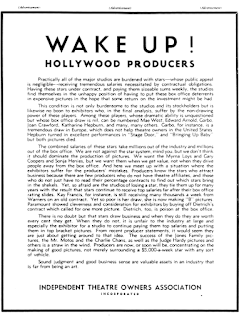
It did not originate in any article or research paper but comes from an ad in The Hollywood Reporter, in May 1938, and in it a lot of actors, some named and some unnamed, were referred to as poisonous. But for some reason, it is Hepburn who is now the one that is primarily singled out. It is not obvious why.

The ad was from the Independent Theatre Owners Association (ITOA further on) and their complaint was that the studios had lots of actors under expensive long-term contracts and therefore they had to let them star in film after film, even though the actors were "box office deterrents" and as a result, the cinemas were losing money. Beside Hepburn ("Hepburn turned in excellent performances in 'Stage Door,' and 'Bringing Up Baby' but both pictures died.") and Dietrich (she "too, is poison at the box office.") the ad also mentions Mae West, Edward Arnold, Greta Garbo, Joan Crawford, and Kay Francis. They also say, "We want the Myrna Loys and Gary Coopers and Sonja Henies, but we want them when we get value, not when they drive people away from the box office."


There is a lot of confusion here though. It is true what they say about Kay Francis, that she was doing B-movies at Warner Bros. and that she refused to give up her contract even though the studio wanted her to. This is not proof of her being unpopular but stems from other reasons, and it seems Warner treated her badly. It is not obvious she deserves to be included.

About Katharine Hepburn, the first thing to clear up is that it is not true that Stage Door (1937) died. It turned a profit for RKO. The situation for Bringing Up Baby (1938) is more mixed, it cost more to make than it took in, which was partly because of Howard Hawks's particular position as a freelance director. He had negotiated an unusually large fee for directing it and he, as he often did, went over schedule and over budget. (It cost almost twice as much to make as the previous year's screwball hit The Awful Truth (1937).) The film did well in some parts of the country, although it was unexpectedly a failure in New York, so these two films do not prove that Hepburn was repellent for audiences. Still, there were concerns about her career in 1938 since the last time she had acted in a film that did really well at the box office was in 1935: Alice Adams. In 1940 she was back at the top.

Two of the three most recent Hollywood films that Dietrich had made before the ad, Desire (1936) and Angel (1937), had both been successful, although Angel especially so in Europe. In 1937 she made Variety's top ten list of the most bankable stars. Hence calling her "box office poison" is wrong, and her next film, i.e. the next release after the ad had been published, was Destry Rides Again (1939) and it was one of the biggest hits of that year.

Greta Garbo's recent films had all been successful, but here the complaint in the ad was more relevant because her films made most of their money outside the US market, especially in Europe. Conquest (1937) was not profitable for MGM but that was not because people did not want to see it but because it was so expensive to make. But for the ad to question MGM's wisdom for having her on a contract is self-serving since MGM made a lot of money on her films, even if ITOA did not see much of it.

Mae West's films had not been doing poorly either, although her best years in films had been earlier in the decade and her latest film, Every Day’s a Holiday (1937) had been a disappointment. Her response to the ad was quoted in The Billboard in which she pointed out that she was doing excellent business on the theatre stage. She also said, "The only picture making real money was [Disney's animated] Snow White and that would have made twice as much money if they'd had me play Snow White."

Joan Crawford was making more films than any of the others, and the success rate of them varied a lot, but for example The Last of Mrs. Cheyney and Mannequin (both 1937) had done well. A columnist in The Hollywood Reporter asked how it was possible to refer to Crawford as box office poison when her last five films for MGM had all taken in over $990 000, domestically, each.

Edward Arnold is a different kind of actor than the others. He did at times play the lead, but often he was a supporting actor, and it is therefore tricker to evaluate to what extent his presence or absence in a film made much difference. The Toast of New York (1937) in which he played the lead had been a major flop. Even so, when The Hollywood Report in December of 1937 did a survey among exhibitors about the most attractive stars, Edward Arnold was among those that got votes although he did not make the top 12 list. The two films he made in 1938, The Crowd Roars and You Can't Take It With You, did good business and the latter was one of the biggest hits of that year.

It is unclear whether the ad is arguing that Myrna Loy, Gary Cooper, and Sonja Henie were also box office poison, or if they were the opposite, but either way their films, not least Cooper's, were doing very well and Test Pilot (1938), with Myrna Loy, was one of the biggest hits of the year of the ad.

In short, while IOTA might be correct in saying that some of the films in which these actors starred did not do good business in the particular cinemas run by IOTA, it is not accurate to say that these actors were keeping the audiences away overall, calling them "box office poison" is wrong, and suggesting that they should be relieved of their contracts is dumb business advice. The ad though is not really about that but part of a drive to get rid of the concept of block-booking, where the cinema owners could not just book the individual titles they wanted but had to take a slate of films from each studio in package deals, and since the studios did not necessarily care that different films played differently in different parts of the country, the cinema owners had reason to complain to them. But doing it by way of attacking their contracted actors was an unfair move.

Given all of this, and given that it is difficult to assess which the exact factors are that make a film a hit or a flop, or even to quantify what is a hit and what is a flop, it is worth asking how it came to be that critics, historians, and ordinary film enthusiasts, have all fallen for that ad, and still refer to it as some kind of authoritative source.

-----------------------------------------------

Sources:

Kinematograph Weekly, Nov 4, 1937

Picturegoer, March 16, 1940

The Billboard, May 14, 1938

The Hollywood Reporter, Nov 20, 1937

The Hollywood Reporter, May 3, 1938

The Hollywood Reporter, May 4, 1938

Variety, Dec 23, 1936

Variety, Feb 5, 1938

Variety, Jan 4, 1939

Kear, Lynn and John Rossman (2006) Kay Francis: A Passionate Life and Career

McCarthy, Todd (1997) Howard Hawks: The Grey Fox of Hollywood

Sedgwick, John, and Mike Pokorny (2010) "Hollywood's foreign earnings during the 1930s" in Transnational Cinemas vol. 1 #1.

Friday, 9 July 2021

1930 to 1945 by the numbers Part V (adaptations or original stories at the box office)

One of the more common complaints about contemporary Hollywood is that they have run out of ideas and are only recycling already well-known materials and doing remakes and adaptations. It is not only a common complaint now, but it has almost always been a common complaint. Some claim that this is what ruined Hollywood in the late 1970s, that pre-packaged films based on famous books/comics/shows took over what had once been a place of original ideas. But as I pointed out in one of my articles about "New Hollywood" it has always been the case that Hollywood bought the rights to whatever was big and successful and made a film adaptation of it. There is nothing wrong with that, and it is not something that is unique to Hollywood, or to mainstream films. Cinema as an art form is to a large extent built on adapting stories already told in some other art form, whether novels, plays, short stories, songs, poems, essays, or other films. Bergman, Fassbinder, Akerman, Kurosawa, Visconti, Zetterling, Hitchcock, Ford, Tarkovsky, Hawks, Troell, Denis, Truffaut; they have all made films based on other material instead of original stories. That is not particularly interesting. It is what they do with the material that matters. And so it is in Hollywood at the height of the studio era. Continuing my project of investigating the period 1930 to 1945 (read introduction here), I will now take a look at this topic. How many of the box office hits from those years were adaptations, and what were they adapted from, and how many were original stories?

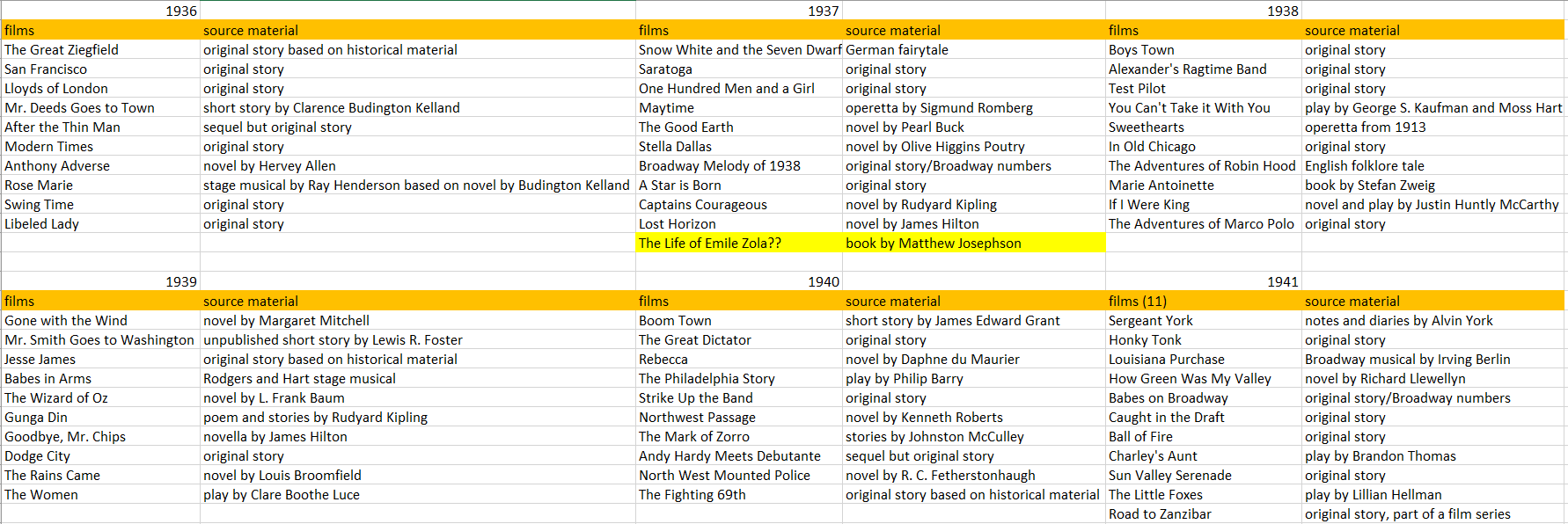
Here are the lists of all films, year for year, and what their source material was. (All the necessary caveats are presented here.) I make a distinction between novel and book, and use the latter when it is a work of non-fiction. The first list is 1930 to 1935, then 1936 to 1941, and then 1942 to 1945. Films marked with yellow are those I believe should be counted among the top ten box office hits of that year but I have not had it confirmed. The many films made in 1943 and 1944 explicitly to boost the morale of troops during World War 2 are difficult to classify.


Out of 166 films, 42% were original stories (70 films), making it the most common form. 50 were adaptations of books, 17 of plays, and 15 of short stories or novellas. The rest were based on other things, like radio shows or operettas. Most of those 17 adaptations of plays were made in the first half of the 1930s, after which they almost disappeared.

One thing to consider is that there is not much point in making distinctions between original stories and adaptations. The quality or originality of a given film is almost completely unrelated to that factor. It is not always easy to decide whether a film is an original story or not, as there are many layers and various factors involved. If a film is based on a novel but entirely rewritten so that all that remains are some characters and the setting, is it even relevant to call it an adaptation. What is an original story anyway? Above I have marked a film as an original story only if it has not got any specific source of any kind. But that does not mean that those stories are more original or that the others are less interesting or daring.

In an upcoming post I will compare the figures presented here with the Academy Award nominees for best film and see whether there are more, fewer, or the same amount of adaptations among them. 


------------------------------------------------------

Previous posts in the 1930-1945 project are:

https://fredrikonfilm.blogspot.com/2021/03/1930-to-1945-by-numbers-part-i.html

https://fredrikonfilm.blogspot.com/2021/04/1930-to-1945-by-numbers-part-ii.html

https://fredrikonfilm.blogspot.com/2021/04/1930-to-1945-by-numbers-part-iii-actors.html

https://fredrikonfilm.blogspot.com/2021/06/1930-to-1945-by-numbers-part-iv-oscar.html


Friday, 11 June 2021

1930 to 1945 by the numbers Part IV (Oscar nominees vs box office hits)

Previous articles within my 1930 to 1945 project were concerned with box office figures. Which films, studios, genres, directors, and actors were the most prominent ones at the box office. This article will look at the Academy Award nominees for best film for that time period, and compare it to the box office lists. What is the same and what is different? Is MGM as dominant there as it was at the box office?

Here are all the nominees for best film for each year. As you can see the number of films that were nominated varied a lot from year to year.

There are in total 142 films, and while there are overlaps with the most successful films, box office wise, there are also differences. Of those that made it onto the top ten lists for each year (see earlier post), 61 also got nominated for best film. Among the nominees are also several European films, four British and one French, and there are more production companies involved. MGM is the studio with the most nominations, but it does not dominate as much as at the box office.

For both the box office successes and best film nominees, the same three studios are in the top: MGM, Paramount, and Warner Bros, with MGM having the most films either way. Of the 142 films, 34 were made by MGM, which makes 24%. That is a lot but still considerably less than at the box office, where MGM dominated with 35%. Paramount also lost something, 11,3% among the nominees but 18% of the box office. They were overtaken by Warner Bros., which had 11% of the box office hits but 17,8% among the nominated films. Several small independent productions got nominated that were not among the box office hits, such as The Caddo Company (The Front Page 1931), Hal Roach Productions (Of Mice and Men 1939), Sol Lesser (Our Town 1940), and Argosy-Wanger (The Long Voyage Home 1940). A neglected part of the history of the studio era are definitely the independents, beyond David O. Selznick.

The European productions that got nominated for best picture were The Private Life of Henry VIII (1933), La grande illusion (1937), Pygmalion (1938), 49th Parallel (1941) and In Which We Serve (1942). The last two could be seen as contributions to the war effort (and 49th Parallel is set in Canada) but the first three are interesting, especially the inclusion of La grande illusion as the only non-English language film for the whole period. It shows in what immense esteem the film was held, and still is.

The kind of films that are nominated for best film are more or less the same as those that were the most profitable, but with some artistically more daring films nominated, and fewer melodramas, musicals, and rambunctious comedies. There are no European films among the box office hits, and none of Orson Welles's films either. The films by Chaplin were considerably more popular among the audiences than among the voters at the Academy.

That is one thing that signals a difference between box office hits and best film nominees, who directed the films that were nominated, compared to who directed box office hits.

These were the directors who did the most films among the box office hits:

Clarence Brown (mainly MGM), Frank Capra (Columbia), Mervyn LeRoy (WB and MGM), Michael Curtiz (WB), and Cecil B. DeMille (Paramount) had 5 films each. George Cukor (three studios) and Henry King (Fox and Twentieth Century-Fox) had 6 films each. Victor Fleming (Fox and MGM) had 7 films, and W.S. Van Dyke 8 films, all for MGM.

Among the nominees for best film, it is instead William Wyler who has directed the most films: seven. The following directed six each: John Ford, Mervyn LeRoy, Sam Wood, Frank Capra, and Michael Curtiz. George Cukor too, but one of them was co-directed with Ernst Lubitsch, One Hour with You (1932). The following had five films among the nominees: Henry King, Leo McCarey, and Lubitsch (including One Hour with You).

Only Capra, LeRoy, Curtiz, Cukor, and King are on both lists. Van Dyke, and especially DeMille, did a lot better with the audiences than with the members of the Academy. Here are all the best film nominees again, but with their directors instead of studio/producer:


You might want to compare it to the list of those who were nominated for best direction:

73 nominations, to 37 directors. Wyler, Capra, and Clarence Brown got five each. Ford and Curtiz got four each. Hitchcock, although he did not arrive until 1940, still managed three.

This research work continues, and in future posts I want to look at, for example, the extent to which the films at the box office, as well as among those nominated for best film, were based on previously published material, such as novels, short stories, or articles.


--------------------

The earlier articles in this series:

https://fredrikonfilm.blogspot.com/2021/03/1930-to-1945-by-numbers-part-i.html

https://fredrikonfilm.blogspot.com/2021/04/1930-to-1945-by-numbers-part-ii.html

https://fredrikonfilm.blogspot.com/2021/04/1930-to-1945-by-numbers-part-iii-actors.html