Showing posts with label Fritz Lang. Show all posts

Wednesday, 5 November 2014

Ministers of Fear - on Lang and Hobbes

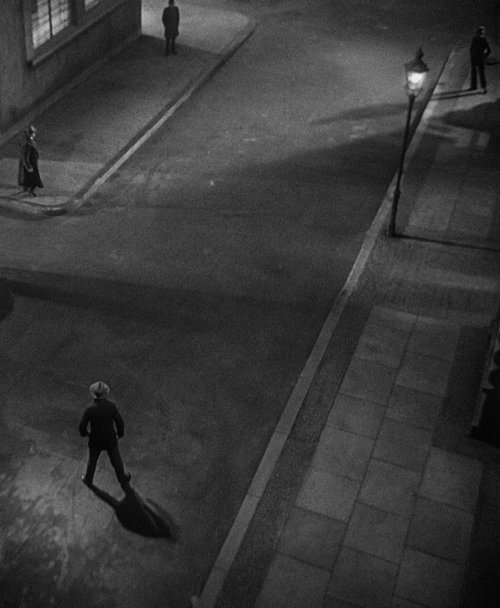
There are several filmmakers who have made conspiracy their particular niche, a kind of films I like to call "urban paranoia". Among the key directors are Alan J. Pakula and especially John Frankenheimer. But the most essential filmmaker here, and one of the definitive artists of the 20th century, is Fritz Lang. From the late 1910s until the early 1960s, in several countries and continents, he used his camera (with sharp, cool, clinical images) to tell us that the world was a crazy and scary place where we are all victims of the forces of evil. The threat can come from criminals, or the state, or the Nazis, or your friends and neighbours, but it does not really matter who they are; what matters is the existential fear. Thomas Hobbes had said in his book Leviathan from 1651 that we once lived in "worst of all, continuall feare, and danger of violent death; And the life of man, solitary, poore, nasty, brutish, and short.", and there is a feeling that Lang believed that this was still the case. Like Lang, Hobbes was no stranger to fear. He was born prematurely in 1588 because his mother got so scarred when she heard the Spanish Armada was gathering outside England's coast that she went into labour. "At that point my mother was filled with such fear that she bore twins, me and together with me fear." Hobbes later wrote in his autobiography.

The bleakness of Lang's vision is sometimes staggering, just look at the ending of Scarlet Street (1945), and repeatedly in his films the audience are being fooled and deceived. People we think are dead are really alive, people we think are alive are really dead, the person we thought was guilty turns out to be innocent and the innocent turns out to be guilty; frequently what we think we see happening is a lie, a fraud. Nobody can be trusted, least of all the filmmaker himself.


Occasionally people say that when Lang left Germany in the 1930s and went to the US he lost his touch, and the films faltered, but this is a peculiar view that is not at all backed up by the actual films. There are more things that unite than separate the German and the American Lang, just consider such films as Dr Mabuse Der Spieler (1922), M (1931), You Only Live Once (1937), The Big Heat (1953), Beyond a Reasonable Doubt (1956) and The Thousand Eyes of Dr Mabuse (1960). Regardless of what kind of films he made they are usually all as pessimistic.

The Big Heat

Although not his best film, Ministry of Fear (1944) has the best title and is perhaps the one where the rampant paranoia is given its most extraordinary expression. The first ten minutes or so in particular are like nothing else, almost incomprehensible, and sound and image are so controlled and so unsettling it is like a horror film by Samuel Beckett. It is set in England and based on Graham Greene's novel with the same title, a book Lang loved and really wanted to adapt. Unfortunately Lang and Seton I. Miller, who wrote the script and was also the producer, did not get along, and Lang hated the finished film. That is unfair, the only major weakness is the obvious fake last scene but that can easily be disregarded. Seton I. Miller should not be disregarded though, he was involved in writing many great films in the 1930s in particular and was once a writing partner of Howard Hawks. Ministry of Fear have not much in common with Hawks's films, but it is especially close to Lang's earlier Spies (1928).

Ministry of Fear is easy to find, and below is a fine celebration of it; a collection of scenes cut together without apparent coherence, which is exactly in keeping with the tone of the film itself. It is very good.


It should perhaps be mentioned that Lang's work was prefigured by serials such as those by Louis Feuillade, for example Les Vampires (1915) and Tih Minh (1918). It was a popular kind of film in early cinema, and Feuillade's work is almost as paranoid and haunted as Lang's films would be. But maybe paranoia is not the right word here. As Andrew Sarris wrote: "Lang might argue that in a century that has spawned Hitler and Hiroshima, no artist can be called paranoiac; he is being persecuted." or, as they say in Catch-22 (Mike Nichols 1970), "Just because you're paranoid doesn't mean they aren't after you."

Joe Wilson in Fury (1936) was not paranoid, and this is what the town did to him:


-------------------
There are visual links between Lang and Michael Curtiz, whom I wrote about last week. Seton I. Miller is also a link. The links between Lang and Alfred Hitchcock are more important, and plentiful. In the 1920s and early 1930s Hitchcock aspired to be like Lang, but then the roles were switched. Lang was envious of Hitchcock and wanted to be more like him, and made some films with that in mind. Together they mapped the 20th century from a Freudian angle, bringing forward its neuroses and fears. But whereas Hitchcock was more interested in guilt Lang was more interested in punishment.

This post is yet another of those challenges among Swedish-based bloggers to write something around a set theme, the theme this time was "conspiracies". Here are the other contributors.

In English: The Velvet Café

In Swedish: Rörliga bilder och tryckta ordJojjenito, Fiffis filmtajm, The Nerd Bird, Mackans film, Har du inte sett den (pod), Filmitch, Fripps filmrevyer, Flmr filmblogg, Absurd Cinema.
M

Friday, 25 April 2014

Robert Siodmak

When Robert Siodmak is discussed it is almost always said that he only made film noirs. For some this is a good thing, because they think he perfected that form and was its true master, and for others it is a sign of weakness, that he was not an artist but just a director with a lack of integrity and personal vision. This inability to look beyond noir when it comes to Siodmak does him a disservice however. For one thing he did not just make noirs so the whole argumentation is moot, and second, the two filmmakers closest to Siodmak, Fritz Lang and Alfred Hitchcock, are not referred to as only makers of noir even though their careers are rather similar to Siodmak's, and as varied. There is absolutely no reason why he should be treated differently from them.

He was born in Dresden, Germany, 1900, and made films there and then in France, like Pièges (1939), a thriller about a serial killer with Maurice Chevalier and Erich von Stroheim, before ending up in the US, having to escape the Nazis. He returned to Europe in the mid-1950s where he continued to make films until the late 1960s. (He said that he left Europe to escape the Nazis and the US to escape CinemaScope.) It is the string of films he made between 1944 and 1950, most of them at Universal Studios, that are considered his major achievement, and those are indeed fine films. Siodmak was a master of the unconscious, combining the everyday with surrealism and with his camera prowling around in long takes with great depth of field, looking for that unconscious, or becoming it even. The camera as id. It is typical for Siodmak that when he made Christmas Holiday (1944), a film with Gene Kelly, usually seen singing and dancing, Kelly's character turns out to be a murderer with mother issues. But although his films are filled with dread, always staring at the uncanny and with the ability to be really frightening, they are also full of dark comedy and a certain quirkiness that is reminiscent of Don Siegel. (Siegel was involved in the making of Siodmak's most famous film, The Killers (1946), inspired by Hemingway's short story, and would make his own version, equally good and even more quirky, in 1964. As it happens Andrei Tarkovsky has also made a version of it, in 1965.)

It is particularly appropriate to compare Siodmak with Fritz Lang, and to notice the differences. Lang's style is cleaner, clearer, more geometrical, whereas Siodmak's is more baroque. In Lang's films it is usually society as a whole that is the threat, with conspiracies and dark forces at work everywhere. With Siodmak the threat does not lie out there but within ourselves. We bring ourselves down, with our homicidal tendencies and our passions, as in the excellent The Killers and Criss Cross (1949).

The world is fractured and unstable. And look at that menacing cat. (From The Killers.)

Some other highlights among his 1940s films are The Suspect (1944), a drama set in England at the turn of the century where a nice old man murders his wife, and The Spiral Staircase (1945), a gothic horror film that also takes place at the turn of the century. (There is no point in calling either of them noir.) A good but lesser film is The Dark Mirror (1946), a psychological melodrama with the interesting twist that the unconscious has become embodied, as it is about twin sisters, one good and one evil, both played by Olivia de Havilland. The File on Thelma Jordon (1950) is uneven, but part of it is among Siodmak's best work, not least the opening sequence, and Barbara Stanwyck and Wendell Corey are great.

The Dark Mirror

I have seen very few of Siodmak's films before and after his time in Hollywood, they are not easy to come by, except People on Sunday (1930). It is a collaboration between him, Fred Zinnemann, Billy Wilder and Edgar G. Ulmer, and very good, a city symphony film and a documentary of how people in Berlin spend their weekends. But there is a lot more to discover. The bottom line though is that Siodmak was an artist with a very particular way of seeing the world, and he expressed that vision in a number of different films. 

Now, have a look at a sequence from Phantom Lady (1944), a quintessential Siodmak and one of his most bizarre. Maybe even his best.


and a still from the amazing stalking sequence