Showing posts with label society. Show all posts

Friday, 10 March 2017

Objectivity and elitism

Having written film criticism for some 20 years I can remember many conversations over the years with people about just that, film criticism. Often with guys persistently arguing that “the critics” are just elitist snobs who have no idea what real people like. Sometimes I try to counter these thoughts by using simple facts and statistics only to be met by angry outbursts about it being arrogant of me to use my knowledge against them. Sometimes they talk as if they believed that stopping a random person on the street and ask which film to watch is better than listen to a film critic.

I often think of these discussions because such views have, coming both from a right angle and a left angle, become fairly mainstream, and not just about film criticism. Such views are also common among Brexit and Trump supporters, and other similar people, parties and movements around Europe and the US. I felt then, as I feel now, that these unsettling positions and outbursts, the apparent belief that actually knowing something about whatever it is you speak is a flaw, proof of elitism and arrogance, come from a sense of low self-esteem and also, to some extent, from an awareness of them being wrong but rather than accepting that, lashing out at the person who they know is right. (What I am talking about is not differences of opinions but first the anti-fact attitude and then the habit of, instead of engaging in conversation or arguing for a position, just lash out and attack.)

To be called elitist these days does not take much effort. You only have to have an opinion which is either different from somebody else's, or to think for yourself and not accept whatever corporations proclaim. Even to assign value to things often infuriate people. Disliking The Avengers is considered elitist. If, for example, you complain about wrong aspect ratios on Netflix there will always be people who scream "Elitist!" even though it does not make any sense. If a big corporation is showing a film in such a way that part of the image is hidden, or the image is distorted, and you are elitist if you point this out, the only logical interpretation is that the people who scream elitist believe that the corporations are always right and we should unquestioningly accept whatever it is they provide, no matter in what way they provide it. It is in the same manner that Trump or Brexit supporters are saying that people should just shut up and accept whatever is happening. Aspect ratios are not as politically calamitous of course but everything that happens in a society, whether a local or global one, matters, and feed into everything else that happens. Screaming "elitist" is usually a sign of weakness, not awareness.

In the 1970s and 1980s academia was full of people who claimed that there was no such thing as knowledge or objective facts, and there are many who still claim to believe this. Such articles are still published, and such conference papers are presented. I have also met people under more informal circumstances making that same argument, that truth is a fantasy, or an elitist idea, and that all we have are subjective interpretations, even of such things as history. What is striking though is how rare it is for them to accept the consequences of their arguments, or to even actually be able to defend what they proclaim to believe. A Foucault-quoting scholar once tried to explain to me his position that there are no facts or truths by pointing to a candle and saying that if we were to describe it later we would not describe it the same way. I said that we would probably not but was it not an objective fact that there indeed was a candle on the table? And was not its molecular structure independent of our presence? He said that he had perhaps chosen a bad example. I did not point out that according to his line of thinking there could be no such thing as a bad example, as all arguments were supposedly equally valid. Instead I suggested he give another example. He took the American Civil War. Well, I said, was that not a conflict between one side led by Abraham Lincoln and another side led by Robert Lee.* He said that yes, this was true, and maybe this too was a bad example. Then he left. At least, unlike the Trump administration, he had some shame.

Henry Fonda in Young Mr. Lincoln (John Ford 1939)

Arguing that there are no facts or objective truths used to be a very fashionable thing among left-wing intellectuals, and now it has been appropriated by malignant right-wingers. But the problem with such positions was obvious long before Trump. It is also ideas like this that has turned schools in some places (not least in Sweden) into places were teachers are not supposed to teach but let the pupils teach themselves, and the important thing for a school is supposedly to make children creative and engage in critical thinking or some such. I have even heard people argue that teachers should not know more about the subject than the students because this would make them more equal. The ridiculous stupidity of such a position should be self-evident. What is even the purpose of teaching or schools if there is no actual teaching or transfer of knowledge? Behind this, again, lies the contempt for "elitism," against facts and figures, and instead an elevation of subjective feelings above all else. A student might take the lesson to heart and go looking for her own facts and by using her critical thinking decide that the Sandy Hook massacre was fake and 9/11 was an inside job, if it did indeed even happen. This is not how society prosper or move forward.

Those are extreme examples but another contemporary problem that is also about subjective feelings at the expense of facts and knowledge is the disappearance of nuance and complexity, in the public debate at large. If we keep to film, just look at the endless parade of think-pieces and hot takes in which a person has seen a film (or sometimes just the trailer) and then proclaim that there is only one way to understand that film, their way, and if that understanding is that this film is, say, terribly racist then anybody who disagrees is brandishing her privilege and is most likely racist too, or at least not woke enough. Many of these pieces are so bad that they become indistinguishable from parodies, for example since they are frequently so hyperbolic ("This is the most misogynistic film ever made!"), and so desperately lacking in historical context ("This is the first time ever that women have been allowed to be funny!").

The idea that such a complex object as a film or novel can only be understood or interpreted in one singular way, and anybody who sees it differently is a suspect character, is clearly wrong. Is the work racist, or is it about racist characters? Is it sincere or ironic? What was the context in which it was produced? Is it a well-meaning but perhaps failed work, or is it from beginning deliberately racist? These are some of the questions you need to wrestle with. Analysing films and books, art in general, is hard work unless you are arrogant. It takes time and knowledge to be attuned to all the nuances in a given work, and often you need to watch a film several times to understand it. But for many that is an elitist position; if a person feel something that is the end of it. Another reason has to do with economics; in this age of temp jobs and freelancing you might have to quickly write stupid columns or else you will starve. It is a Faustian bargain.

The position that there is only one correct interpretation is of course different from the "there is no truth, all is relative"-position. It is however related to Barthes's idea of the death of the author. According to him any meaning a text, such as a book, might have comes from the interpretation of the reader/viewer, and has nothing to do with any authorial intent, which does not exist. That too is a dubious position but the difference is that for Barthes any interpretation is potentially equally valid whereas the position in all of these pieces in assorted journals and websites is that there can be only one true interpretation. But there is no shortage of takes, or "correct" interpretations, however wildly inconsistent, as any given film is usually found to be problematic by someone. After all, Moonlight did not pass the Bechdel test.

The political climate in the world is increasingly fragile, and one might be forgiven for feeling that everything is getting worse by the hour. The constant updates, live feeds, the need to be first, to create new content, to keep one's brand sizzling, all conspire to make it very difficult for there to be a rational public conversation about anything. Instead we get pieces that proclaim that an Oscar win for the wrong film will be a disaster for us all. But fortunately that is not the whole picture. There are thoughtful, intelligent and knowledgeable people out there, participating in the discussion. There are still long-form essays, nuanced books and complex films. The problem is not that they are not there, the problem is that everybody seems to be so busy getting outraged that they do not have time to engage with these works, or to distinguish between what is important and what is not. Sometimes the proper, or even radical, thing to do is not to be outraged.

-------------------------------------

This piece is related to one I wrote two years ago. This one.

In a Twitter discussion I observed, but did not participate in, a film critic was accused of having said something racist. When the critic replied that he had never said that line he was accused of having said, the response was "Do not try to make this to be about facts."

2017-03-14
*To clarify, Lincoln and Lee were not equivalents. Lincoln was president, and Lee a commanding general. Lincoln's Southern equivalent was Jefferson Davis.

I also rewrote a few sentences in the second paragraph.

Wednesday, 5 November 2014

Ministers of Fear - on Lang and Hobbes

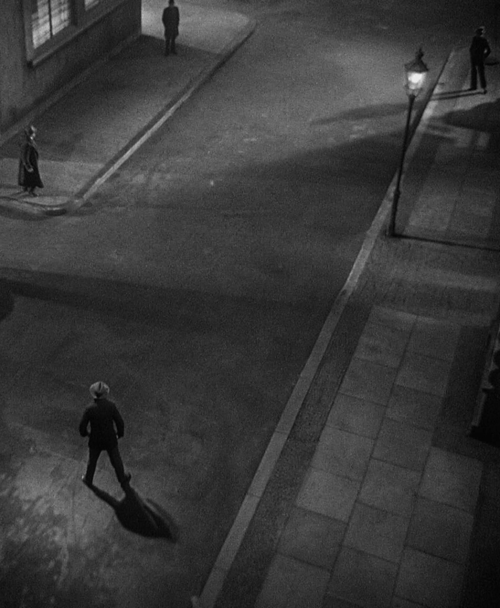
There are several filmmakers who have made conspiracy their particular niche, a kind of films I like to call "urban paranoia". Among the key directors are Alan J. Pakula and especially John Frankenheimer. But the most essential filmmaker here, and one of the definitive artists of the 20th century, is Fritz Lang. From the late 1910s until the early 1960s, in several countries and continents, he used his camera (with sharp, cool, clinical images) to tell us that the world was a crazy and scary place where we are all victims of the forces of evil. The threat can come from criminals, or the state, or the Nazis, or your friends and neighbours, but it does not really matter who they are; what matters is the existential fear. Thomas Hobbes had said in his book Leviathan from 1651 that we once lived in "worst of all, continuall feare, and danger of violent death; And the life of man, solitary, poore, nasty, brutish, and short.", and there is a feeling that Lang believed that this was still the case. Like Lang, Hobbes was no stranger to fear. He was born prematurely in 1588 because his mother got so scarred when she heard the Spanish Armada was gathering outside England's coast that she went into labour. "At that point my mother was filled with such fear that she bore twins, me and together with me fear." Hobbes later wrote in his autobiography.

The bleakness of Lang's vision is sometimes staggering, just look at the ending of Scarlet Street (1945), and repeatedly in his films the audience are being fooled and deceived. People we think are dead are really alive, people we think are alive are really dead, the person we thought was guilty turns out to be innocent and the innocent turns out to be guilty; frequently what we think we see happening is a lie, a fraud. Nobody can be trusted, least of all the filmmaker himself.


Occasionally people say that when Lang left Germany in the 1930s and went to the US he lost his touch, and the films faltered, but this is a peculiar view that is not at all backed up by the actual films. There are more things that unite than separate the German and the American Lang, just consider such films as Dr Mabuse Der Spieler (1922), M (1931), You Only Live Once (1937), The Big Heat (1953), Beyond a Reasonable Doubt (1956) and The Thousand Eyes of Dr Mabuse (1960). Regardless of what kind of films he made they are usually all as pessimistic.

The Big Heat

Although not his best film, Ministry of Fear (1944) has the best title and is perhaps the one where the rampant paranoia is given its most extraordinary expression. The first ten minutes or so in particular are like nothing else, almost incomprehensible, and sound and image are so controlled and so unsettling it is like a horror film by Samuel Beckett. It is set in England and based on Graham Greene's novel with the same title, a book Lang loved and really wanted to adapt. Unfortunately Lang and Seton I. Miller, who wrote the script and was also the producer, did not get along, and Lang hated the finished film. That is unfair, the only major weakness is the obvious fake last scene but that can easily be disregarded. Seton I. Miller should not be disregarded though, he was involved in writing many great films in the 1930s in particular and was once a writing partner of Howard Hawks. Ministry of Fear have not much in common with Hawks's films, but it is especially close to Lang's earlier Spies (1928).

Ministry of Fear is easy to find, and below is a fine celebration of it; a collection of scenes cut together without apparent coherence, which is exactly in keeping with the tone of the film itself. It is very good.


It should perhaps be mentioned that Lang's work was prefigured by serials such as those by Louis Feuillade, for example Les Vampires (1915) and Tih Minh (1918). It was a popular kind of film in early cinema, and Feuillade's work is almost as paranoid and haunted as Lang's films would be. But maybe paranoia is not the right word here. As Andrew Sarris wrote: "Lang might argue that in a century that has spawned Hitler and Hiroshima, no artist can be called paranoiac; he is being persecuted." or, as they say in Catch-22 (Mike Nichols 1970), "Just because you're paranoid doesn't mean they aren't after you."

Joe Wilson in Fury (1936) was not paranoid, and this is what the town did to him:


-------------------
There are visual links between Lang and Michael Curtiz, whom I wrote about last week. Seton I. Miller is also a link. The links between Lang and Alfred Hitchcock are more important, and plentiful. In the 1920s and early 1930s Hitchcock aspired to be like Lang, but then the roles were switched. Lang was envious of Hitchcock and wanted to be more like him, and made some films with that in mind. Together they mapped the 20th century from a Freudian angle, bringing forward its neuroses and fears. But whereas Hitchcock was more interested in guilt Lang was more interested in punishment.

This post is yet another of those challenges among Swedish-based bloggers to write something around a set theme, the theme this time was "conspiracies". Here are the other contributors.

In English: The Velvet Café

In Swedish: Rörliga bilder och tryckta ord, Jojjenito, Fiffis filmtajm, The Nerd Bird, Mackans film, Har du inte sett den (pod), Filmitch, Fripps filmrevyer, Flmr filmblogg, Absurd Cinema.

M

Friday, 10 October 2014

Waiting for Happiness (2002)

The coastal town of Nouadhibou in the North-west corner of Mauritania is a place where ships go to die, the sea outside it filled with old, abandoned ships. It is also a place to which Africans go as a last stop before trying to reach Europe. And it is where Waiting for Happiness (Abderrahmane Sissako 2002) is set, taking in the refugees, the ships and the locals. I first saw the film ten years ago and it has stayed with me. Now I have watched it again. For its type it is fairly conventional, a lingering narrative, more concerned with observing people than telling a story, little dialogue and plenty of shots with people sitting, or sometimes standing, in silence whilst looking pensive. In a way it is as clichéd as a Hollywood romcom but since clichés are a more or less unavoidable aspect of art, it would be unfair to demand something more. (I have written about clichés here before.)


The man in the shot above is Abdallah (he did not stay very long in that unfortunate room) and he is one of the main characters in the film, in passing on his way to Europe. He does not speak the local language, Hassaniya, so he speaks French, and the local girls make fun of him. His mother lives here though, so that is a reason for him being here. He befriends a little boy, Khatra, who is hanging out with an old man, helping him install light bulbs and electricity in the small houses in which the people live. They are moderately successful, which is also a source for comedy. The light bulb is a recurring motif, representing both life and death, and modernity and its problems.

There are a number of prostitutes around too, and a Chinese man who sings karaoke about being exiled. It is a motley crew, and they all have interesting stories to tell and to share. There is also an undercurrent of tragedy. If you are waiting for happiness, it means it is not with you now, and tales of broken promises, deaths and bodies washed ashore are plentiful. And always the lure of Europe is there, as a hope as well as something fearful, and always out of reach. Even if you happen to make it over there. But there is hope in the film, which, as is so often the case, comes through the children. They have not become cynical yet and they can carry on the culture and the traditions of a vanishing world.


This was Sissako's first full-length film, unless you count the one hour long Life on Earth (1998). His next film was Bamako (2006), which is also good, and more ambitious than Waiting for Happiness. After that it took some time before he was able (or willing) to do a new feature film but this year Timbuktu (2014) opened at Cannes, and hopefully I will be able to see it soon. It is about the Islamists' take-over of Northern Mali 20012-2013 and the subsequent horrors, which ended after France intervened at the request of the Malian government.

Sissako, who was born in Mauritania and now moves between France, Mali and Mauritania, is a fine filmmaker and it is a shame that he has made so few films. He wants to share his part of the world with the rest of it, the rest of us, and it is worthwhile to take the time to be a part of it.

Friday, 12 September 2014

J. Lee Thompson

This year is the centenary of the birth of John Lee Thompson, the British director who appeared in-between the golden years of British cinema in the 1940s and the kitchen sink movement in the 1960s. This means that he, like others such as Basil Dearden, has been somewhat neglected when British cinema is discussed. He peaked commercially in 1961 when he made The Guns of Navarone and after that he went to the US to make his most famous film, Cape Fear (1962). But his subsequent American career, despite the occasional film of interest such as the dark comedy What a Way to Go! (1964), is not when he was at his best. It was in the 1950s, home in Britain, that he thrived and his British films are as good, and often better, than the later, more famous films made by Karel Reisz, John Schlesinger, Lindsay Anderson and Tony Richardson in the 1960s.

There are three things that distinguish his work: the razor sharp images (he often worked with cinematographer Gilbert Taylor), the socially conscious themes, often involving a violent crime and its repercussions, and the acting. Yield to the Night (1956) is an unsettling drama about a woman, played by Diana Dors, who is sentenced to death. It was inspired by the case of Ruth Ellis, the last woman to be executed in Britain.


Woman in a Dressing Gown (1957) is about the implosion of a family and centred around the desperation of the mother and wife (played by Yvonne Mitchell) to keep both herself and her family together. 


An earlier film, The Yellow Balloon (1952), is about poor kids in the bombed-out parts of London. One I have not seen yet is another prison drama, The Weak and the Wicked (1954), also with Diana Dors.


The two films I like best are Ice Cold in Alex (1958) and Tiger Bay (1959). The first one is set in the Sahara desert and is about two British soldiers and two nurses trying to make it to Alexandria during World War 2. They pick up a South African solider on the way, who might be a German spy. It is an incredibly tense film and filled with astonishing images of the desert, both in the piercing sunlight and the cold darkness of the night. It is also one of those films where the pain and suffering is so palpable that watching it is an ordeal, where every drop of sweat or any broken ribs are as vivid as if they were your own. The main actors, John Mills, Sylvia Syms, Harry Andrews and Anthony Quayle, must have been exhausted after a day's shooting. The close-ups of their anguished faces and the stark compositions of cars, humans, mines, the sand and the sun are unforgettable.


Tiger Bay is set in Britain, and is about the unexpected bond between a Polish man, played by Horst Buchholz, and the little girl, played by Hayley Mills, he takes with him when he escapes from the police. The film cross-cuts between them and the police in pursuit and combines vivid characterisations with excellent cinematography. This time though it is not Gilbert Taylor but Eric Cross who is the cinematographer. It is possible that he got the job because he had previously shot the similar, and equally excellent, Hunted (Charles Crichton 1952). 


Although he also made a few comedies, Thompson was at his best when observing ordinary people, men as well as women, under extreme pressure and with a reluctance to judge their behaviour. He got great performances out of his actors and his visuals are almost always excellent, using depth and blocking to create tension while also capturing the beauty of the setting, regardless of where it is. It is a shame that he seemed to have lost his way after Cape Fear but he deserves retrospectives at any ambitious cinematheque. 

Irene Papas in the fine The Guns of Navarone

Friday, 29 August 2014

Die Hard (1988)

When I was a film student at Stockholm University back in the 1990s David Bordwell paid us a visit and he also gave some lectures. The one I attended was about Die Hard (John McTiernan 1988) and Three Colours: Blue (Krzysztof Kieslowski 1993), and Bordwell presented them as prime examples of a typical American film and a typical European film. I do not remember what he said but it was the first time I had heard anybody discuss a mainstream Hollywood film in a serious manner, analysing camera angles, editing, narrative, and pointing out that there is a lot of skill involved, as well as artistic decisions to be made, even in such a film. Sometimes you were led to believe (and some still seems to think so) that whereas European films are made by conscious people, American films more or less assemble themselves, without human agency. One way to appreciate the importance of the skills and ideas of the people involved is to compare films that are similar in style and genre, rather than comparing Die Hard with Blue you might compare it to the abysmal Money Train (Joseph Ruben 1995). But it is not important to compare Die Hard to anything in order to enjoy it, or to be dazzled by the skill with which it is made. It is a great film, which is perhaps why Bordwell chose it.

At the beginning of the film there is a shot from the arrivals hall at an airport (LAX I imagine), with the camera close to the floor and with the baggage carousel taking up most of the visual interest in the film. But in the far back is a staircase connecting the floor below with this floor, and suddenly John McClane, the hero played by Bruce Willis (his first appearance as an action hero rather than as a romantic comedian), appears there, not necessarily even noticeable if you watch the film on a small screen, although the screen is sharply divided into two parts, as you can see in the image below.


This is one of the best things about Die Hard, the fine, inventive and often quite beautiful cinematography (the DP was Jan de Bont). There is occasionally a Michael Mann-ish feel to it, but it is also a good example of McTiernan's interest in texture and reflections. (Among his films The Hunt for Red October (1990) and The Thomas Crown Affair (1999) are also great.) The spatial awareness in the film is another fine thing. McClane and the thieves/terrorists run around offices, staircases, ventilation shafts and so on, and a lot of care has been taken to make these spaces coherent and the layout comprehensible. If you pay attention there are a lot of signs and tell-tales to show the characters were they are and how and where people are in relation to each other. There is for example a little business with a photo collage of naked women that some workers has put up on a wall that is seen in several scenes, to help with the navigation and show that we have been here before, and the filmmakers probably did a calculated guess that the audience would primarily consist of young men and using photographs of naked women was something that they would notice and perhaps also remember where they were.

The script, which is both witty and clever, is also important, written by Jeb Stuart and Steven E. de Souza (based on a book by Roderick Thorp I have not read). It is not just the many one-liners but the way things are introduced, or delayed, or explained. Take McClane's bare feet. During the most part of the film he is without shoes or socks, the intention being that he shall come across as vulnerable and human. He bleeds a lot, and the bare feet are essential. But why would he run around with bare feet? Because he is afraid of flying. The first scene in the film, before the credits, sees him grabbing his chair as his plane is about to land. The man sitting next to him notice that he is afraid of flying and gives him the advice to put his feet on a soft carpet and "make a fist with your toes" when he is home. So when McClane has safely arrived at his destination, the skyscraper in which most of the film is set, he does just that. It makes him feel good, for a few seconds, and then the armed men strike and he has to run and hide, without the shoes.

In the film everybody takes it for granted that the bad guys are terrorists. But there is some confusion. "What kind of terrorists are you?" Mr. Takagi asks, accusingly, after they have taken charge of his building. "Who said we are terrorists?" answers their leader Hans Gruber. This is one of the things I like best about the script. These men are thieves masquerading as terrorists, and when people think they are terrorists they treat them with some level of respect. Then those who thought they were terrorists become disappointed when it turns out they do not have a noble goal, they just want to get rich. There is a funny scene in which Gruber demands the release of imprisoned members of Asian Dawn and his partner looks at him quizzically. "Asian Dawn?" he says. "I read an article about them in Time magazine." Gruber replies with a shrug. In today's climate it is unlikely that somebody who calls himself a terrorist would be regarded with an element of respect in a Hollywood film but here even a terrorist is seen as preferable to the money-obsessed men. This is a film about duplicity, fakery and greed, and there is a post-modern aspect to the film and these men; pretend-terrorists not bothered with ideals but only with money and a setting which is all glass and transparency yet hardly anything is what it seems to be, nothing refers to anything solid. The men are not terrorists, Ellis pretends to be McClane's friend yet is not, Holly pretends to be Ms. Gennero but is Mrs. McClane, the Japanese Mr. Takagi has lived in the US all his life. The only thing real is McClane's bleeding feet. (A difference from 1988 and today is that back then it was the rise of Japan that was on peoples' minds in the US, today it is the rise of China. Had Die Hard been made today it would perhaps have taken place in a building called Huang instead of Nakatomi.)

Having a vulnerable hero like McClane was in line with the times, coming as it did right after the first Lethal Weapon (Richard Donner 1987) with Mel Gibson and Danny Glover as troubled cops who also bleed and suffer, Gibson's in particular. That film and many others before it, including 48 Hrs. (Walter Hill 1982) but going back further than that, had at its centre a mismatched duo, often a white and a black man. This would not work in Die Hard with its premise about one lonely man, but in a nod to that tradition there is still a buddy element. Sergeant Al Powell as the (black) policeman who first arrives at the scene of the crime and then develops an emotional bond with McClane over the radio. Their scenes together are also very well-written, and surprisingly moving.


But the one thing in particular that makes Die Hard such a great film is Hans Gruber, played to perfection by Alan Rickman. He is a ruthless thief but also clever, funny, good-looking and able to show compassion; the filmmakers clearly likes him, as do many who have seen the film (there are plenty of celebrations online). He has several of the best lines. Part of the appeal is also that unlike most other characters in the film he is neither stupid nor a weasel. Compared to Holly's co-worker Ellis, Hans is not such a bad guy and the police, the FBI and the media are all portrayed in a very unflattering light. But all the same Hans too is a fraud and a killer, and in the end he must die. He might be, as he says, "an exceptional thief" but he is not better than the rest. He is not even a terrorist.

The reason why Hans and his men attack the Nakatomi building is that its vault contains stocks worth over 600 billion dollars. That is what he is after. The vault has seven different locks or security measures which they have to work their way through, one by one. In the end the doors finally open and Hans and two others watch in awe as the interior of the vault gradually appears before them, while the music playing is the last part of Beethoven's Ninth symphony, called An Die Freude. It is like a religious scene, of these men seeing the light. But it is only money and that scene might be the apotheosis of the entire film, and capturing the greed and emptiness of the 1980s. The whole film is a battle between a working-class guy and both the system (such as FBI) and high capitalism. Bordwell does not approve of talks about films capturing the Zeitgeist, but I would like to suggest that Die Hard is a strong contender for being such a film.

The opening of the vault.

--------------------------------------------
In Japan, Beethoven's Ninth is traditionally played at New Year celebrations but whether that influenced the filmmakers I do not know.

Wednesday, 15 January 2014

The Wolf of Wall Street

One of the joys of watching a film by Martin Scorsese is the confidence, even swagger, with which he tells his stories. There is an exuberance to the narratives that can be just as intoxicating as the drugs used by his characters. To some extent his power as a filmmaker is similar to the power Jordan Belfort, the main character in The Wolf of Wall Street, has when he is trying to sell things, anything, to a group of people. In that respect Scorsese might be the perfect director for this film. It might also be a reason why so many take issue with the film. had an excellent pace and rhythm with one of the best uses of voice-over/direct address in modern cinema, and several set pieces were fantastic, none more so than when Belfort and Donnie Azoff are experiencing the delayed effects of a powerful drug, severely inhibiting their control over their bodies and their ability to talk. There is a magic touch to the film, such as when a Ferrari suddenly changes colour whilst in motion. (Belfort is not necessarily a trustworthy narrator.) There was also a lot of good acting, especially Leonardo DiCaprio and Matthew McConaughey. (By the way, they released two trailers for the film: the first was excellent, the second much less so. What happened there? Why did they feel the need to make a new one?)

In some ways The Wolf of Wall Street, much like The Big Bang Theory, can be seen as Revenge of the Nerds writ large. The characters in WoWS, with the exception of Belfort, are not exactly the brightest kids in the room and they might very well have been picked last at gym sessions in school. But now it is payback time, and they aim to skin the fat cats and fuck as much, and as many, as humanly possible. They are not bankers, and they are not really on Wall Street either (that is just where Jordan Belfort works for a few days in the beginning). They are basically con men, so in a way the film is as related to The Sting (George Roy Hill 1973, which is a good film) as it is to Wall Street (Oliver Stone 1987, which is not). The victims at first are poorer middle class but that is presented as more of a moral problem, partly articulated by Belfort's then wife Teresa Petrillo. After that talk Belfort and his friends decide to go after those who are already rich and have lots of money to spend. Those who have criticised the film for not showing the victims of Belfort's frauds have to some extent showed themselves to be surprisingly concerned for the lives of the rich. Although, here the film is somewhat hazy because some of Stratton Oakmont's victims were not that rich.

The most persisted complaint against the film is that it is not critical, but glamourises these people and their behaviour. Yet the film opens with the people at Stratton Oakmont's office throwing a dwarf and then there is a freeze frame just as the head of the dwarf is about to hit the target. Is that not enough to make the point that this is a film about characters that are appalling in all ways? The film does not leave it at that though, there are several such scenes (a female employee's head is shaved in one scene, and she is clearly most uncomfortable with it) leading up to the end where there is a scene in which Belfort almost kills his daughter. Why would Scorsese have such scenes in the film if it was not to condemn these people and their behaviour? It seems to me to be clear that Scorsese wanted to show how it was possible for Belfort to get away with what he did; to show his shallow charm and persuasiveness while at the same time showing how he was a person who ruined everybody he came into contact with, including himself.

"Stratton Oakmont is America" Belfort says in one pep talk, and the film seems to be saying that yes, America is like Stratton Oakmont and that is a very bad thing. The film, much like Pain and Gain (Michael Bay 2013), is about the "American Dream" where the dream is presented as a shortcut to an abyss. But it is not just the stock brokers, the guys at Stratton Oakmont would not have succeed if ordinary people had not been so pathetically eager to beat the odds and get rich(er) fast. And it is not only an American thing of course, it is universal. In the last image of the film we see the awed faces of ordinary kiwis (the scene is set in Auckland, New Zealand) trying to learn from Belfort how to get rich quickly. We have met the enemy and he is us, as Pogo said.

----------------------------------------------
A number of other Swedish bloggers has also written about the film. Here are links. The first blog is in English, the others in Swedish: The Velvet Café, Fripps, Rörliga bilder och ord, Jojjenito, Fiffi, Har du inte sett den, Movies-Noir, Except Fear, Filmparadiset.

Wednesday, 13 March 2013

Wadjda

Saudi Arabia does not have any cinemas, and its first full length fiction film, Keif al Hal, was made as late as 2006. It was not shot in the Kingdom however, but in Dubai. The same year Shadow of Silence (Dhilal al sammt) was also made, and in 2007 came the horror film Al Qaryah Al Manseyyah. Wadjda, which premièred at the Venice Film Festival last year and has just began its world tour, is an even more remarkable milestone. Not only is it the first Saudi film which is made entirely on Saudi soil (in a suburb of Riyadh) but it is also written and directed by a woman, Haifaa al Mansour.

Wadjda is the name of the main character, a 10-year-old girl who goes to school, plays with the boy next door and dreams about a green bicycle. All of these things cause problems. She is not happy at the strict, conservative school, she upsets her mother by being home alone with the boy and everybody says that girls should not ride bicycles. The owner of the bicycle store and her friend are the only ones who are supportive. The film is also about her mother, whose husband is considering leaving her. After she gave birth to Wadjda she became infertile (or in some way reproductively challenged) so she cannot give birth to a son, which the husband wants.

Besides these major plot lines, the film shows in all sorts of ways, big and small, how the lives of women are restricted and controlled, and how they can neither move nor speak freely. Saudi Arabia is after all one of the most repressive countries in the world, for both men and women, with the women having a particularly hard time. A movement have just begun that is challenging the laws banning women from driving cars, and although Wadjda is too young to be wanting a car it is probable that she will be rebelling against that too, when she gets older.

Stylistically the film is rather mundane, low-key and natural. The acting feels somewhat restrained, inhibited. I do not know if this is because of difference in acting style or directorial intentions but the adults did not feel really at ease, with the exception of Reem Abdullah who plays the mother. Waad Mohammed, who plays Wadjda, and Abdullrahman Al Gohani who plays her friend Abdullah, are excellent, and really moving. Wadjda is an inspiring girl, very active and cunning  almost Machiavellian in the way she deals with people in order to get what she wants. She uses smiles, flattery, bribes and deception to get ahead, and with a lot of pluck, but usually without malice. She just is very good at playing people, and she needs these skills. She is also fortunate in having loving and well-off parents, even though the father is absent almost all the time. One of the ways in which Wadjda is trying to earn some money is by making and selling thread bracelets. In one scene she and her mother has gone to a posh mall. She walks up to a man selling such bracelets and wonders if he would sell hers. The man says that he gets his from China, that this is cheaper than if he were to get them locally made, a telling image of this brave new world.

Wadjda is al Mansour's first full length film, previously she has made a number of short films nad it is a co-production between the local company Rotana Studios (who also produced Keif Al Hal), German companies and money from Abu Dhabi. It was not easy to make the film for al Mansour, and being a woman she had to direct the scenes taking place outdoors from a car, and talking to the men in the team through a walkie-talkie. But it got made, and it is a beautiful film, sweet as well as angry.

Here is a clip:

Tuesday, 1 January 2013

Intruder in the Dust (1949)

In the end of Intruder in the Dust (1949) Lucas Beauchamp, an older black man arrested for a murder he did not commit, is asked by the white lawyer why he did not tell what had happened at the scene of the crime. "Would you have believed me?" Lucas asks, to which the lawyer has no reply. It is a remarkably powerful scene, for two special reasons. One is that the white lawyer has been set up as a hero in the film, the other is that Lucas says it with such a matter-of-fact tone of voice, albeit with a flash of anger. Everybody in the town had taken it for granted that Lucas was guilty, and since he is all too aware of the fact that this is the white man's world he refuses to play any games with them. He is a proud man, and he will not let go of his dignity and self-respect. This puts his behaviour at odds with what the white majority can accept, even those that would consider themselves progressive. In films about racism and injustices committed against African-Americans it is usually in the end white characters who are the heroes. But here Lucas Beauchamp is the hero, not for doing heroic acts but for not giving in or giving up, and he is not sentimentalised.

This is an angry and sad film, based on the novel by William Faulkner and shot in Faulkner's home town of Oxford, Mississippi. It was one of the last films made by Clarence Brown, being both its producer and director. Brown was an impressive filmmaker even though few of his films are remembered today. He was perhaps at his best in the 1920s but he is more famous for making films with Greta Garbo (he was her favourite), such as Anna Christie (1930) and Anna Karenina (1935). Other known films are National Velvet (1944), with Elizabeth Taylor on a horse, and the very sweet The Yearling (1946). Considering the kind of films he usually made Intruder in the Dust is something of a departure, but this was a film he wanted to make, and he struggled with MGM to be able to make it. He was from the south (although born in Massachusetts he lived in Tennessee from when he was 11) and he did have personal experiences of events such as those that take place in his film, as had Faulkner.

The adaptation was done by Ben Maddow, one of the more interesting scriptwriters of the 1940s and 50s. He had previously participated, together with Paul Strand and Leo Hurwitz, in the making of Native Land (1942), a film about attacks against workers and unions in America in the 1930s, with Paul Robeson as narrator. He also wrote scripts for two films by John Huston, The Asphalt Jungle (1950) and The Unforgiven (1960). In between he was blacklisted for his politics, eventually naming names in the HUAC hearings. During those years he wrote several scripts with Philip Yordan as his front, among them Men at War (1957), directed by Anthony Mann and one of the best war films ever made. Well, one of the best films ever made.

The style of the Intruder in the Dust is one of naturalism, in all aspects. It is shot on location, using deep focus and long takes, and there is no music. The use of natural sound is one of the strengths of the film, where every footstep, every breath, is emphasised, to add atmosphere and tension. Cinematographer Bruce Surtees' black and white cinematography is excellent, with the Southern milieu so evocatively captured you can almost feel the sweat and smell the stench. The combination of direction and cinematography is often magnificent. However, there are a few scenes where the dialogue is didactic, when the only purpose of the words seems to be to hit the audience over the head with the implications of what has taken place, as if we were not intelligent enough to understand what we were seeing. But there is also an irony here, in the occasional discrepancy between the words spoken by the white characters and what Lucas might have said had he been given the chance. Whether this was deliberate is not clear, and I leave that to the individual spectator to guess for themselves.

Lucas is played by Juano Hernandez, of Puerto Rican heritage (he grew up in Brazil). Before Intruder in the Dust he had done two films directed by Oscar Micheaux, Lying Lips (1939) and The Notorious Elinor Lee (1940). Then in 1950 he made three fine films, two by Michael Curtiz. He played the jazz musician Art Hazzard in Curtiz's Young Man With a Horn (1950) and in The Breaking Point, Curtiz's version of Hemingway's To Have and Have Not, he played Wesley Park, friend and partner of Harry Morgan. Finally he played Uncle Famous Prill, a man threatened by the Ku Klux Klan, in Jacques Tourneur's magnificent Stars in My Crown. Ten years later he played sergeant Skidmore in John Ford's Sergeant Rutledge (1960). There are several similarities between Intruder in the Dust and Sergeant Rutledge, where Woody Strode plays the title character as a sergeant in the 9th cavalry who is accused of rape and murder. He has the same pride and rigour as Lucas. A major difference between the two films is that Rutledge has lines such as "It was all right for Mr Lincoln to say we was free, but we're not. Not yet! Maybe someday!" and at another point he is saying that he is not a "swamp-running nigger", "I ain't that. I'm a man!" Lucas has no such lines, but he does not need them. Just by standing tall and looking the white man in the eye he says the same thing using only his gaze, body and posture.

To Kill a Mockingbird (1962) is another book turned into film that is similar to Intruder in the Dust. It too tells the story about a black man in the south being wrongfully accused of violent crimes. I leave the books out of the equation, but of the two films I prefer Intruder in the Dust. It is the braver and less comforting film, partly because it takes place in the present whereas To Kill a Mockingbird is set in the past. Intruder... also feels less conventional. In both films a simmering mob approaches the jail to kill the black prisoner. The jail is guarded by the white righteous lawyer in To Kill a Mockingbird. In the similar scene in Intruder in the Dust it is a frail old woman, knitting away, who face down the mob.

In "The Shadow and the Act" a great piece of film criticism from 1949, Ralph Ellison writes about blacks in Hollywood films and among the films he mentions Intruder in the Dust is the only one he cares much for. African-Americans have been abjectly treated by Hollywood for much of its history, much as in society at large, and that is primarily what Ellison's article is about. Even films that were well-meaning (i.e. attempts to criticise racism) are often so in a muddled, confused, cowardly and often patronising way. But not Intruder in the Dust. Ellison suggests that this is the only film that can be "shown in Harlem without arousing unintended laughter". That is reason enough to celebrate it, besides it being a very fine film aesthetically.

----------------------------------------
This post obviously ties in with the previous one, Film as a window to the past.
Ralph Ellison's essay can be found here.

Monday, 5 November 2012

Hill Street Blues

"When does it stop Francis?"
"I wish I knew that."

When I grew up my favourite television series was Hill Street Blues, about a police precinct in a non-specified town in the U.S. It was an MTM production which ran from 1981 to 1987 and I do not know what it was like in other countries but in Sweden it was a huge hit. The actors became rather famous, especially Michael Warren (I still remember how excited the media was when he visited Stockholm). Steven Bochco, who created it and wrote it together with Michael Kozoll, also became rather well-known, much like Michael Mann became known after Miami Vice. (Anthony Yerkovich, who was a major force behind Miami Vice, was also part of the creative team of Hill Street Blues for a few years, as was David Milch, now famous for Deadwood, among other series.)

As I have written before, Hill Street Blues was a key development in the history of television, and its impact of subsequent TV and cinema has been substantial. TV critics in general have remarkably short memories, but still occasionally Hill Street Blues is mentioned in passing. My own memory is rather long, but I decided to look at it today and see what I would think of it. It is hard to come by but I have been able to watch all of season 1 and a substantial part of season 2 (there are seven seasons), and it is just as good as I remembered it to be.

The Wire (2002-2008) is usually held up as being about as good as television gets, and there is no denying the power and quality of it. It is often said that it is like a snapshot of society, an anthropological study. This is exactly what Hill Street Blues feels like, and this is one of the things that make it so good, and so fascinating. It is as if the creators wanted to capture the conflicts in the underbelly of an unjust society, some kind of Marxist exposé of Reagan's America. It is not a pretty picture that is painted here, where the role of the police is not necessarily to combat crime but rather to control the lid on a pressure cooker, just making sure that too much steam is not let out at once. The police force is not pretty either, riddled with abuse, racism, sexism, corruption, alcoholism and violence. But it is not all bleak (it would not be as interesting if it was), there are also good men and women trying to do the best they can, even if it means negotiating a truce with a gang rather than locking them up for whatever crimes they have committed.

One remarkable thing about Hill Street Blues is that there are hardly any beginnings or endings. Things happen constantly, but nothing ever settles or comes to rest. Each episode is filled with a number of stories, some which lasts a whole season, some that lasts for a few minutes, but often they are somewhat opaque, and unpredictable. Things that seem unimportant suddenly escalate, things that were important suddenly fizzles out. A sequence might be funny but ends with an unexpected and tragic death, or a scene that begins dramatic ends with black humour. And you never know who might get shot. There is a real sense of urgency and desperation in the episodes, which is sometimes close to unbearable.

Hill Street Blues is filled with vignettes that can be quite powerful. In one episode a detective, Henry Goldblume (Joe Spano), helps a woman carrying her grocery shopping up a flight of stairs. When he is about to leave, she starts to cry. She is living alone with her mother (after the mother had a stroke), her husband left a year ago, and nobody has hold her since then. So she asks for a hug. Such moving snapshots of broken lives contribute to create a broad canvas of a whole society. The quote that opens this post (said after a pointless shooting) is also an illustration of the tone of the series. Sometimes despair is the only possible feeling.

The style of shooting is connected with the content. It has a rough edge, with jittery and "ugly" camera work, keeping close to the characters but constantly moving, as if trying to capture everything at once. It often misses the action though, as some things seem to happen just before the camera gets there. It has that quality which is often called "documentary", with people and things blocking the camera, dialogue hard to hear, and what we do hear is often just fractions of what is said, as people pass the camera. Sometimes the camera follows characters A and B, and then suddenly starts to follow character C and D instead. Important information is often mentioned in passing, and might not even be taken up by the spectator if she is not paying attention. It is a fair assumption to make that the makers have been influenced by Robert Altman and Sidney Lumet (Serpico (1973) and Dog Day Afternoon (1975) for example).

Race places an important part of the series, and is a constant source of tension, between white, blacks and Latinos in particular, but East Asians too. The police force itself also consists of a number of different ethnicities. However, it is partly here that the show shows its age, particularly the somewhat shrill acting among some of the Latino gang members.

As I said above, Hill Street Blues does not tell a conventional story and neither do the individual episodes stand on their own. There is hardly ever any kind of closure, and there is a constant sense of confusion and lack of payoff. Yet stories are told. One example in season 1 is the decline and fall of one of the plain clothes policemen, J.D. LaRue (played by Kiel Martin). In the beginning of the first episode he is confident, good-looking and something of a ladies' man. At the end of the season he has become a drunk who gets humiliated and thrown out of bars. This fall from grace is handled very subtle, so that there are small changes from one episode to another, until his unshaven face becomes so pronounced as to be unmissable. Just by watching one episode you will not get it, it comes from watching the whole season. No particular reason is given for his decline; it is a combination of bad habits and stress. Then in the last episode of season 1 he attends an AA meeting, sent there by captain Furillo (the police chief). 

That AA meeting is also an example of what is so good with Hill Street Blues. Because at that meeting is also Furillo. This is good because it is a complete surprise yet makes perfect sense. There has not been any mentioning of the fact that Furillo was a former alcoholic, but there has been scenes sprinkled through the season that now takes on a new meaning (such as a lunch when Furillo had orange juice instead of beer). These scenes though have probably been forgotten by those that saw it on TV, one episode each week. By watching a whole season over a weekend on DVD or online, all these hints, suggestions and connections will be remembered and they add to the impact of the series. It is important to pay attention to all that is going on since you do not know when something happens whether it will be come back in a later episode.

Speaking of Furillo, he is one of the best things about the series, and Daniel J. Travanti's performance. He is soft-spoken, like Lt. Castillo (Edward James Olmos) in Miami Vice, but fearless and filled with integrity. Whereas the rest of the police force is somewhat unruly and frequently do the wrong thing, or even illegal things, Furillo can be seen as the voice of reason and moderation. But the integrity can be a two-edged sword. He is the true hero of the series but his integrity sometimes works against his better interests, or even against the interests of the community. Sometimes he can come across as naive, yet he is also sometimes seen filled with rage (a rage he does his outmost to control). And, of course, he is a recovering alcoholic.

Furillo is not alone, he is having a relationship with a public defender, Joyce Davenport (played by Veronica Hamel) and due to a potential conflict of interests they keep their relationship a secret. But their relationship is a highlight of the series, because it feels real. It has the right combination of tenderness and resentfulness, since it is hard to have a relationship when you are always on call, and when you cannot show your affection in public. Some of the best writing and acting in Hill Street Blues is to be found in their intimate scenes together.

Davenport is a powerful and successful female character, but also is the only major character who is a female, although I think one of the female cops (played by Betty Thomas) develops into a major character as well, at least that seems to be happening in season 2. There is also to ex-wife of Furillo, Fay (played by Barbara Bosson) but she is more of a comic relief, at least in the beginning. Eventually she becomes more forceful.

So Hill Street Blues is a major series of considerable importance and need to be included when the history and development of TV is discussed. I hope all seasons will be released on DVD or online in pristine versions soon. As it is now, the title sequence, with Mike Post's great theme, is perhaps more known than what happens after. But the gloomy weather, the melancholic music and the decidedly unglamorous milieus is a great introduction to the world as it is presented in Hill Street Blues.