Showing posts with label Anthony Mann. Show all posts

Friday, 1 April 2022

John Sturges

As I have mentioned before, one of the first, or possibly the first, VHS tape I ever bought was Ice Station Zebra (1968), directed by John Sturges. I still have the tape, even though it has been at least 15 years since I had a VHS player. Sturges matters to me. While he was not as important as, for example, Alfred Hitchcock for my developing interest in films, he has always been a presence in a way no other filmmaker has been. I cannot explain this in any logical way, but I imagine it is related to the significant impact seeing some of his films had on me at a young, impressionable age. Besides Ice Station Zebra, there was also Kind Lady (1951), Jeopardy (1953), Gunfight at the O.K. Corral (1957), The Great Escape (1963), Hour of the Gun (1967), The Eagle Has Landed (1976). I watched them on TV whenever I had the chance, as I knew that if John Sturges were the director I would not be disappointed. Once I watched Joe Kidd (1972) with my grandmother, an unapologetic fan of Clint Eastwood, but she was sadly disappointed with that one.

The reason for why I am writing this now is that I have just read Dreams of Flight: The Great Escape In American Film and Culture, a new book by film scholar Dana Polan about the backstory, production, reception, and influence of The Great Escape, but it is also autobiographical; how Polan saw the film when he was a boy (at a drive-in), how it changed him, has followed him through his life, and how he felt compelled to write a book about it. Earlier this year I also read Sheila O'Malley's blog post, about Sturges, which also has that autobiographical aspect to it.

It is not just us. All through my childhood, my dad spoke about three films that had made an impact on him. The Ox-bow Incident (1943), The Magnificent Seven (1960), and The Man Who Shot Liberty Valance (1962). As you can see, they were all westerns and one of them was by Sturges, The Magnificent Seven. Even before I started to watch the films myself, I had already been introduced to one of them.

Alfonso Cuarón is another one for whom having watched a film by Sturges in their youth made a big impression. In his case it was Marooned (1969), which, not by chance, the characters in his autobiographical film Roma (2018) also go to the cinema to watch.

Paul Thomas Anderson has spoken of Sturges's Bad Day at Black Rock (1955), and the quality of Sturges's audio commentary to its Laserdisc release. What he said was "You can learn more from John Sturges’ audio track on the ‘Bad Day at Black Rock’ laserdisc than you can in 20 years of film school." (Confusingly there are several versions of this quote floating around on the internet, some inaccurate. What I just quoted is word for word what he said in an interview in the Los Angeles Times. You can listen to Sturges's commentary here.)

***

The earliest of Sturges's films that I have seen is from 1949, The Walking Hills, which is quite good. Next year's The Capture (1950) is very good. The People Against O'Hara (1951), with Spencer Tracy as a struggling attorney and John Alton as the cinematographer, is a fine drama. These were years in which Sturges could make 3 - 4 films a year, and several of the early films I have not seen, including interesting ones like Mystery Street (1950) and Right Cross (1950). But it seems his career settled on a more focused and deliberate trajectory in 1953, when he made the western Escape from Fort Bravo, with William Holden. Soon this became his defining kind of film, together with war movies, and I have seen almost every film he made after 1953. I would speculate that he was attracted to such films because they gave him plenty of opportunity to shoot widescreen films outdoors, and also to work with ensemble casts of men working together. He was also interested in history, not least American history. Some of the highlights are Bad Day at Black Rock, Backlash (1956), Gunfight at the O.K. Corral, The Law and Jake Wade (1958), The Magnificent Seven, The Great Escape, and Hour of the Gun. Another one I like a lot is A Girl Named Tamiko (1962), which is thematically unusual as it is a contemporary love story, focused on a man and a woman. (Gunfight at the O.K. Corral is also something of a love story, but between Wyatt Earp and Doc Holliday.)

***

There is not that much written about Sturges, but in the books and articles I have read it is often the case that the writer(s) discuss whether he can be considered an auteur or not, and there are often complaints about how Andrew Sarris was unfair to him. I find this tiresome. As I have written about earlier, I think we would be better off not using the term, or concept, of auteur as few seem to even know what it means. At least there is no consensus about what it means. (Which is true for many common terms used by film scholars and critics.) Sturges's films have a recognisable style across his oeuvre, and there are thematic consistencies as well as similarities regarding tone, style of acting, and pacing, and if you want to call him an auteur that is easy to justify. But what is gained by this? It has no bearing on the quality of the films. To get an example of this confusion, this is what Polan says in his book I mentioned above: "It is important, I think, not to turn Sturges into some sort of auteur imagined as working to express a deep metaphysics that somehow was engrained into these films made for the business of entertainment." (p. 79) No part of that sentence makes sense. Since Polan elsewhere in the books writes about the stylistic and thematic concepts he finds consistent throughout Sturges's body of work, his definition of what an auteur is must be different than how it is usually conceived. I do not know what he means by "a deep metaphysics" that is "engrained into" the films, or who has said that this is what it means to be an auteur. Or is Polan mocking people who make that argument? If so, who are these people he is mocking? And he seems to think that there is some contradiction between being an auteur and doing films "made for the business of entertainment." But if that is a contradiction, it is one that Polan himself has invented. Either way, arguing about whether Sturges is an auteur or not is pointless, since it has little to do with Sturges and primarily to do with what you mean with the word auteur, or what you think others mean by it.

The Law and Jake Wade

Joe Kidd

What is the style of Sturges? The images are clean, clear, spread out, uncluttered, spacious, whether indoors or outdoors. He is one of the great masters of the widescreen shot. Even in earlier films before the emergence of CinemaScope and other wide formats, such as The People Against O'Hara, he composed in width as well as depth; as if he spent those early years just waiting for a widescreen format to emerge. If I am not mistaken, all the films he made from 1953 have been in various widescreen formats, whether CinemaScope or Panavision or something else. His favoured way of filming has a stylised element to it, and it frequently involves a lack of people. The streets of his towns are usually empty, because that is how he wants his shots to be. When he made Bad Day at Black Rock, one demand he had was that he would not use any extras. The only people in the shots would be the characters who really had to be there. This makes the shots and street scenes unrealistic, but that is his way of filming, not just in Bad Day at Black Rock (below) but in general.

The streets are however crowded in The Hallelujah Trail (1965), but then that whole film is a crowded mess, a rare attempt by Sturges to be funny and boisterous. It is amiable but tiresome. But it is an exception. His characters otherwise seem to exist in isolation, and they are usually not just alone but lonely. This is a recurring thing in his films, loneliness. The most famous scenes from his films, such as Steve McQueen on a bike or in a cell (the cooler) in The Great Escape, are usually of people being alone and isolated. Consider a scene in the beginning of Sturges's penultimate film, McQ (1974). A cop in civilian clothes walks into a diner, uses the restroom to wash his hands, and then walks out to the counter and orders a glass of milk. He is the only customer in the place and the man who works there is primarily out of sight in the kitchen, so most of the sequence is just a lone man in a large diner having a glass of milk. It is true that several of his famous films are of a group of men working together, but they are still isolated, whether in jail, in space, or on a submarine, and their exchanges are rarely on a personal level. At the end of the film they will either have died alone or they will have split up. Companionship is not a lasting thing in Sturges's films. Has there ever been another American filmmaker for whom loneliness is such a central theme?

The outdoors are overwhelming too, and the characters, or some small town or hamlet in which they live, are dwarfed by mountains, trees, and the sky. Sturges likes to use a crane, and to move the camera both sideways and up and down, to make the shots fluid and to capture the vastness of nature. But action scenes, like fights or shootouts, are carefully choreographed and often done in a brief outburst, filmed with a fixed camera. He liked to prepare his shot in advance, doing diagrams and calculating angles. He had an engineer's interest in such things, and cutting was an important part of it too. (One person he worked most often with was the editor Ferris Webster, who cut some 15 of Sturges's films.) Hour of the Gun is his most extreme film in terms of style, so stylised that it reaches some kind of poetic abstraction, where everything not essential has been stripped away. The same is true for The Satan Bug (1965). I would say that these two films are his most abstract in style, but The Satan Bug is unfortunately not a good film, as the story is too ridiculous and incoherent. But through its spare, bare style, which includes the acting, it becomes a fascinating exercise just the same, more like a blueprint of a film than an actual film.

The world depicted in his films is a rough and hostile place, which Sturges's depicts without almost any traces of sentimentality. If you focus on what matters you might make it, and even if you do not make it, you might still have recovered your self-respect and die as a proud man, knowing you did the best you could. That is one reason some of his films are something of an emotional paradox, they are tragedies yet they can be simultaneously uplifting. But usually, they are more sad than uplifting. Some, like Last Train from Gun Hill (1959), end in darkness. Many of the films also end with the question "Was whatever was done worth all the pain it caused?" Sometimes a character explicitly asks it, sometimes it is unspoken, but the question is almost always there.

 
Hour of the Gun

One filmmaker I think would make for an interesting compare/contrast is Anthony Mann. They have for one thing a similar career trajectory: both started doing B-movies in the 1940s, then noirs with cinematographer John Alton, and then primarily making westerns and war films with bigger budgets and stars. They are downbeat, they do not do comedies or musicals, and rarely domestic films, and their westerns are psychological, focused on characters in turmoil or bent on revenge. There are also visual similarities, and they are excellent at staging fight sequences. But Mann is by far the greater director. There are more depth and complexities in his films, and in the performances he gets, and the visual style is more inventive and striking, especially when indoors. But I would have to spend more time with their films simultaneously to strengthen my argument. For now, I just add that two lesser-known westerns by Sturges, Backlash (written by Borden Chase who also worked with Mann on several occasions) and The Law and Jake Wade, are particularly close to Mann and they are among Sturges's best films. Yet they are not as good as Mann's best films. (Here is my earlier article about Mann.)

Speaking of compare and contrast, Sturges's By Love Possessed (1961), a for him uncharacteristic soap opera about love, family, and generational conflict, would make for an interesting triple feature with Henry King's This Earth is Mine (1959) and Douglas Sirk's Written on the Wind (1956). To add to the relevance of comparing them, they were all shot by Russell Metty. "I had no business making it." Sturges said.

***

In an early scene in The Magnificent Seven, Steve McQueen and Yul Brynner's characters Vin and Chris are talking. McQueen's Vin asks where Chris is heading. "I'm drifting south more or less." he says. "Where are you heading?" "Oh me, I'm just drifting." says Vin. That to me felt like a life-goal worth pursuing at the time, and when I went on my first trip around the world, in 2001, I had calling cards made out on which I had printed my name, email address, and as my profession "Drifter". Such is the influence of Sturges on me. Alas, the days of drifting around the world seem to be over. Maybe when I retire... Until then I at least have Sturges's films for strength and company, even if they rarely provide much comfort.
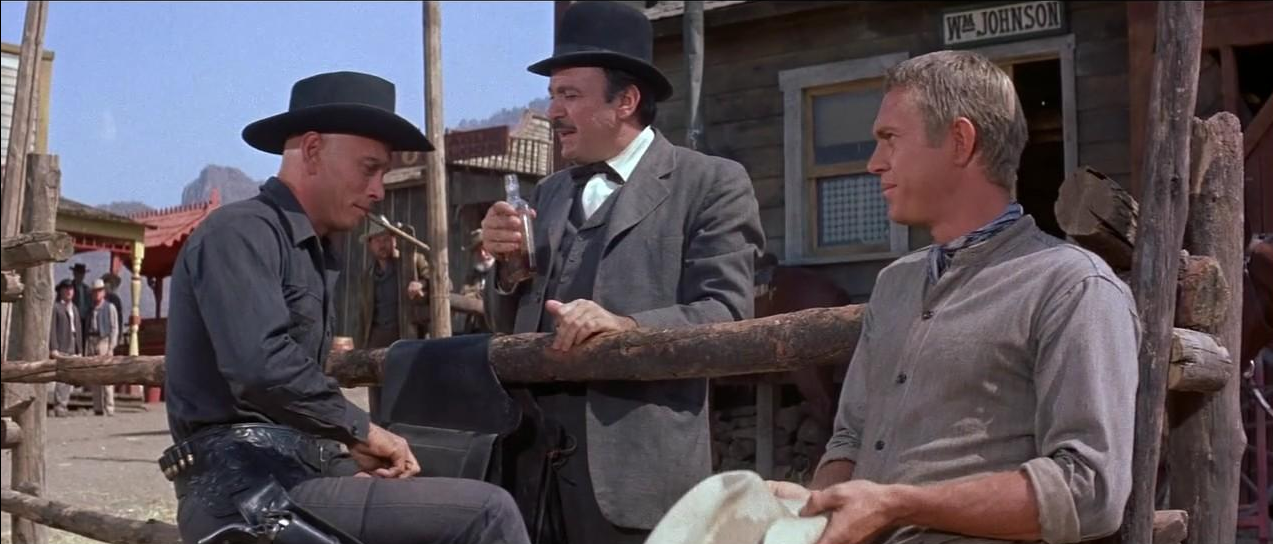
The Magnificent Seven
 

----------------------------------

Some selected readings:

Books:

Lovell, Glenn, Escape Artist - The Life and Films of John Sturges (2008)

Polan, Dana, Dreams of Flight: The Great Escape In American Film and Culture (2021)

Reframing Cult Westerns: From The Magnificent Seven to the Hateful Eight, editor Lee Broughton (2020)

Articles:

Bengtsson, Åke, "John Sturges" (1962) in Chaplin

O'Malley, Sheila, "'I think I'm a pretty good storyteller.' - John Sturges" (2020) in http://www.sheilaomalley.com/?p=164847

Me about Anthony Mann: https://fredrikonfilm.blogspot.com/2018/01/anthony-mann.html 

Friday, 12 June 2020

Film and philosophy

In Poetics, Aristotle says that "poetry is more philosophic, and more deserving of attention, than history" since it deals with more universal issues, and history "speaks of things which have happened, and the other of such as might have happened." Film can also do the work of poetry, or be like poetry, and film and philosophy can be fruitfully combined. This is what I want to discuss in this article, and as philosophy is something that interests me almost as much as film, and something I have studied almost as much too (I have a Master of Arts in History of Ideas), I aim to write more about it from now on. But first a brief background.

Film has been discussed in relation to philosophical issues for over 100 years. Sometimes by philosophers such as Henri Bergson and Martin Heidegger (however dismissively), but mainly by film theorists such as Hugo Münsterberg, Rudolf Arnheim and André Bazin, who took a philosophical approach to art. The American critic Dwight Macdonald complained in 1964 that film critics nowadays (i.e. in the 1960s) had to translate everything from "the language of art" to "the language of philosophy". I wonder what he would say today when "film philosophy" has become a fast-growing approach within film studies, whether it is to use films to illustrate philosophical issues or to make interpretations of films from a philosophical perspective. There are also those who claim that films in themselves are philosophical, not just because of the content of the film but due to it being a film; that films "philosophize" or "do philosophy." There are several anthologies on these issues, such as The Philosophy of Film: Introductory Texts and Readings (2005) or The Routledge Companion to Philosophy and Film (2009). There are journals like Film-Philosophy (published by Edinburgh University Press) and Film and Philosophy (published by the Society for the Philosophic Study of the Contemporary Visual Arts). A fairly recent edited collection I can recommend is Film as Philosophy (2017), edited by Bernd Herzogenrath. For anyone who wants an accessible introduction, Robert Sinnerbrink's New Philosophies of Film: Thinking Images (2011) is a good starting point.

Sinnerbrink wants New Philosophies of Film to be an introduction to the philosophical discussion of film and also an independent contribution to philosophical film criticism. The first part of the book is a background to philosophers' interest in film, the second part is an overview of the last decades' philosophical discussions of cinema, and the third part is Sinnerbrink's analysis of three films. The book's division into chapters and parts is a bit unclear, and overall the book should have received better editing. As an example, a chapter begins with the question "Can films philosophize?" The question is relevant and linked to Sinnerbrink's ambition, but it is found in the beginning of chapter seven, on page 141. It would have made more sense if it had been asked on page 1. The slight confusion, and the repetitions that also occur, may be because parts of the book have been published before, as individual articles in journals or anthologies. It is common that academics publish what seems to be a new book which, it turns out, is instead a collection of previously published material, and such books are especially in need of a skilful editor.

In the second part, Sinnerbrink describes which questions have been, and still are, the focus of the philosophical discussions. Questions such as whether film is art; whether film has unique properties, specific to itself; and about the relationship between film and spectators. As usual, he divides the philosophical traditions into two groups, or schools: the analytic-cognitive and the continental (or, as he also calls them, the "rationalist" versus the "romantic" school). The most prominent advocates of the "rationalist" school are Noël Carroll and David Bordwell, while Gilles Deleuze and Stanley Cavell are represented as members of the "romantic" school. The traditional division of analytical vs. continental philosophy is a simplification though, there are clear and important links between the two, and it is one of the book's strengths that Sinnerbrink does not want to put them against each other but tries to find the best from both schools, to find a synthesis.

In the third and final section, Sinnerbrink analyses three films from a philosophical perspective. What he is looking for is "the exploration of cinematic thinking by way of detailed film-philosophical criticism” (p. 139). The films he has chosen for this are INLAND EMPIRE (David Lynch, 2006), Antichrist (Lars von Trier, 2009) and The New World (Terrence Malick, 2005) because, he says, they are non-mainstream narrative; genre hybrids; and "display a 'resistance to theory'" (p. 135) and as such they are especially suitable for philosophical readings. I disagree.

Letter from an Unknown Woman

One of the biggest issues I have with film philosophy is that they too often focus on the obvious and ready-made, and it is often the same examples over and over again. Particularly popular are, for example, Rashomon (Akira Kurosawa 1950), The Seventh Seal (Ingmar Bergman 1957), The Matrix (the Wachowskis 1999), and Eternal Sunshine of the Spotless Mind (Michel Gondry 2004). But it is not particularly interesting to discuss The Matrix as being about the world as an illusion, since they hardly talk about anything else in it. It is more interesting to have a discussion about the world being based on illusions in relation to, say, The Shop Around the Corner (Ernst Lubitsch 1940), Laura (Otto Preminger 1944) or Letter from an Unknown Woman (Max Ophüls 1948). There are plenty of books and articles about Emmanuel Levinas's philosophy of ethics and its relationship to the films of the Dardenne brothers, but since the brothers themselves have mentioned Levinas in every other interview, that is not particularly interesting to discuss either. I have written about the ethics in the films of Henry Hathaway, and I mentioned Levinas at one point, because that is not obvious and therefore often interesting to explore.

Despite the fact that one of the inspirations for the current vogue of film and philosophy is Stanley Cavell, who wrote about the importance and joys of Hollywood cinema of the 1930s and 1940s, it is rare for such films to be under consideration today, and for many others as well. There are primarily three kinds of films that feature in film philosophy texts: high concept art cinema such as Michael Haneke, Apichatpong Weerasethakul, David Lynch and Terrence Malick; puzzle-films (or mind-game films); and a certain kind of science fiction, such as Stephen Mulhall's work on the Alien-series. While there is nothing wrong with such films, and I have written about some myself, it would be a richer and more interesting field of cinema studies if it was more widespread and broad-minded, because any kind of film is suitable for a philosophical enquiry, discussion, or analysis.

***

But what can be said about, as Sinnerbrink puts it, the marriage between film and philosophy? That films can be used to illustrate philosophical problems is obvious. Even a conventional action movie such as Executive Decision (Stuart Baird 1996) can address a concrete moral dilemma, in this case the question of whether it is right to sacrifice one or a few lives in order to save the lives of many more. (A thought experiment that is sometimes called the "trolley problem," first discussed, I think, by Philippa Foot.) Discussing film's "essence" on the basis of philosophical issues is also relatively unproblematic, as long as one is aware that it is just a discussion and that questions such as "is film an art form?" have no definitive answers. It is a matter of definitions, and therefore the discussion should be conducted at that level, about our definitions. If I claim that film is art, my opponent cannot say "You are wrong." (because on what ground?) but on the other hand, she can question my definitions and their consequences and use arguments in the style of "According to your own definition of what art is, it is not obvious that you should also classify film as art." Even when there are no definitive answers, one can still question whether the arguments are consistent and whether they are based on misconceptions or incorrect assumptions. Here is an example:

In the February 2020 issue of Film-Philosophy there is an article about boredom in cinema, how art films can be boring, and that this is a good thing because it makes it possible for “spectators to question what they see and hear, and more generally to problematise the relationship with audio-visual images” and ”it allows us to reflect on the ways we relate to and live in this extremely visible world” and "to question cinema and its images."

The problem I have with this is that boredom is not an objective property of a film, as colour or length is, but a subjective response from the spectator. L'Eclisse (Michelangelo Antonioni 1962) and Cries and Whispers (Ingmar Bergman 1972) were used as examples of "boring" art films, yet I have seen both many times and never found either to be boring in any meaningful sense of the word. When I watch them, I am focused on them and my mind does not wander, and neither do I start to question the ways of the world we live in. I would think that those who like L'Eclisse and Cries and Whispers would, on average, not find them boring, and hardly anyone would start "an interrogation of cinema, its images and our relationship with them" because of any longueurs in either film.

I have on the other hand been bored, experienced deep boredom, by the Avengers films. Given the premise of the article, it would therefore be better for me to watch them instead of L'Eclisse. Alas, the article does not give any reason to believe that Chiara Quaranta, who wrote it, would agree with this. I am aware of the fact that she speaks of three different kinds of boredom, borrowed from Heidegger, and that by being bored by the Avengers films I am supposedly experiencing boredom of the first kind (which is bad, because the filmmakers did not mean for us to be bored), whereas those who are bored by L'Eclisse experience boredom of the third kind (which is good, because the filmmakers meant for us to be bored), but really, what is that? In any case, I am more likely to reflect on the ways of the world when watching Avengers: Infinity War (Joe and Anthony Russo 2018) than when watching any film by Bergman, or even Jeanne Dielman (Chantal Akerman 1975); a film which keeps me in a constant state of immediate presence within the film, and not on any mind-wandering or "thinking about our modes of producing and consuming visual images." The argument of the article leads to some interesting questions though. If the alleged boredom of L'Eclisse is supposed to be a good thing, and I do not feel any boredom, has Antonioni then failed as a filmmaker by making his film insufficiently boring?

It is definitely relevant to talk about how different approaches to filmmaking and narration have different effects on spectators, but you cannot do so from the perspective of making one kind of imagined response a universal, true response, and then make ethical or practical assumptions from said response, because they will be misleading.

***

When it comes to the question of whether films can be philosophical in themselves, if film can "do philosophy" as some put it, it is complicated. Sinnerbrink claims that they can, as do others, but it is easy to get the impression that it is only for individual films. But if it is only for certain individual films, and then mainly based on their stories and dialogue, to what extent can you then say that film itself add something philosophical? It should not matter which movie you discuss. Furthermore, if the philosophical aspect of the film being discussed is something that was already present in the script, then it is not the film as moving images that is doing philosophy. If it is already there in the script, it is not medium specific, and no different from a book. It is almost always the content of the film that is being discussed, and not the style, but if you argue that film, by the very nature of it being a film, is doing philosophy, it must be in its style that the philosophy appears, not in the words that are written before filming began.

Melisa Sözen in Winter Sleep (Nuri Bilge Ceylan 2014)

Further, is the argument that anything, or at least any art form, has the potential to "do philosophy," so books or paintings or a symphony could also "do philosophy"? If so, then it is nothing special about films but just in the nature of art, or at least narrative art. But if not, what makes films special? Personally, I think it would be wiser to not pursue that chain of thought, except for specific examples that are focused on the style of a given film.

It also depends on how one defines philosophy, and what it means to be philosophical. If we say that you are philosophical if you discuss existential, moral and metaphysical issues in a coherent matter, then it is obvious that some directors make films that are consciously philosophical, such as Nuri Bilge Ceylan, Kelly Reichardt, Fred Zinnemann and Abbas Kiarostami, albeit mainly in terms of stories, actions and character development; the content of the films. But since the way the content is presented, the style of the films, is related to its content, it can be in the combination of the two that philosophy arises.

One can also think of other cases where the philosophical message is more subconscious and where perhaps it is precisely the film medium itself that provides the philosophising. An example is the films of Anthony Mann. His films are mainly discussed on the basis of their oedipal conflicts and their links to Greek dramas and myths. But if you just look at them, and Mann is one of the great visual filmmakers, then a specific message emerges (even with the sound muted). Mann's images are filled with sharp stones, high mountains, threatening clouds, sharp edges and shadowy interiors, of desolate cities and open spaces. These images, through Mann's collected works, together form a message that says that the world, perhaps even the universe, is threatening, but indifferent to us humans. That we are lonely and doomed in advance and that our mutual struggles fade before the real conflict, the conflict between man and the elements. The point here is that it does not matter if it is done consciously or unconsciously, it is the film images themselves that speak. It could be an example of how films "do philosophy" in the sense that a view of the world is formed outside of plot, dialogue or script.

Border Incident (Anthony Mann 1949)

----------------------------------

This post is a translated, updated, and rewritten version of an article by me published in 2013 in the Swedish philosophy journal Filosofisk tidskrift (in print only).

The quotes from Aristotle, Macdonald, and Quaranta are from:

Aristotle, Poetics, (unclear but around 335 B.C.) my quote is from chapter 9, and taken from https://www.bartleby.com/library/prose/336.html

Macdonald, Dwight, “8½: Fellini’s Obvious Masterpiece” (1964), republished in Awake in the Dark, ed. David Denby (1977)

Quaranta, Chiara, "A Cinema of Boredom: Heidegger, Cinematic Time and Spectatorship" (2020), in Film-Philosophy, February 2020

More on Anthony Mann can be found in my earlier article: https://fredrikonfilm.blogspot.com/2018/01/anthony-mann.html

Henry Hathaway and ethics is discussed in this article for example: https://fredrikonfilm.blogspot.com/2018/06/summing-up-hathaway.html

Friday, 23 March 2018

Border Incident (1949) and Anthony Mann links

Even by the usual violent standards of Anthony Mann, his 1949 drama Border Incident about the smuggling of Mexicans over the border to California is rather gruesome. It is also a film which impact has not diminished over the years as its very subject matter continues to rouse emotions and hatred.


Border Incident was one of four films Mann made with writer John C. Higgins and cinematographer John Alton (Mann also worked with Higgins without Alton, and with Alton without Higgins). The earlier ones were produced by Eagle-Lion but this time the big, and glamorous, MGM bought both the script and Mann from Eagle-Lion. But it is not a film of luxury but one that stays close to the dirt, capturing the texture of barbed wire and the barren soil, and it is shot on locations on both sides of the border. It begins like a documentary, with a voice-over describing the area's irrigation system, the landscape and the agriculture economy, and how the farms in California depend on Mexican day wagers, or braceros. (In 1942 the United States and Mexico signed the Mexican Farm Labor Agreement which organised and legalised this system, partly because of a lack of domestic manpower after World War 2 broke out. The agreement lasted in various forms until 1964.) But while some come legally, other are smuggled across the border and it is this the film is focused on. The film emphasises that this is based on true stories, case-files from the Department of Justice, and that it is important that the people are told about this. (The trailer for the film calls it "The angry truth!")

The main character is Pablo Rodriguez, a Mexican policeman played by Ricardo Montalbán, who pretends to be a bracero in order to be smuggled across and this way expose one of these networks. Sig Ruman plays the German headman of the smugglers on the Mexican side and Howard Da Silva plays Owen Parkson, the boss for the whole outfit, with Charles McGraw playing his enforcer. They are all excellent in their parts but Da Silva is the one that stands out. He radiates understated menace.


There are a few scenes showing discussions between Mexican and US officials that come across as stiff and speechifying, advocating the importance for cooperation and friendship between the two "great republics", and however important the message might be these scenes almost seem to belong to another film. But the rest of the film is masterful, especially the cinematography, the silences and the constant tension. The framing and compositions are all quintessentially Mann, and the lighting quintessentially Alton. There is probably not a single shot in Border Incident that could not be taken out and exhibited at MoMA or Tate Modern. There is a shot in the beginning of lines of Mexican men with their faces pressed against barbed wire that has such force and desperation it becomes unforgettable. There are also many small scenes that deepens the characters, whether through acts of friendship or acts of violence. And the tension comes from the fact that life has so little value and death comes to almost all characters sooner or later. In one scene, on a truck filled with Mexicans being taken over the border, an old man dies, struggling for breath, and is quickly thrown on the ground and left behind. This is no country for either young or old.

Today, even though more people are moving from the United States to Mexico than the other way around, poor workers are still try to get across. The stories told in Border Incident are not just a thing of the past.


***

In an earlier post I said that Mann should be regarded as one of the best filmmakers of all time, in the same league as Ford, Hitchcock, Hawks, Renoir, Kurosawa, Bergman and so on. Unfortunately Mann is not as well-known and well-researched as most of his peers but there has been some good writing about him. There are two important books, one by Jeanine Basinger called Anthony Mann, published in a "new and expanded edition" in 2007, and one by Max Alvarez called The Crime Films of Anthony Mann, published in 2013. In Horizons West (2nd edition 2007), Jim Kitses has a good chapter on Mann. For articles and essays here are some links and quotes:

Robin Wood wrote an article in CineAction #46, 1998, primarily about Man of the West (1958), but if you cannot get hold of a copy there is another piece primarily about The Furies (1950) here at Mubi.
Mann’s westerns, on the other hand, show little interest in history or in mythology; they are grounded in a fallen world of existential struggle in which the villains often become the heroes’ dark shadows. Typically, when he shoots down his enemy, the Mann hero experiences not triumph but exhaustion, almost prostration, as if he had forfeited a part of himself, his manhood.
Imogen Sara Smith wrote about Man of the West as a guest-writer at Shadowlands.
In The Furies (1950) and The Man from Laramie (1955), the Lear figures are cattle barons who have usurped huge territories over which their children fight for control. In Man of the West the decaying monument is instead the leader of a gang of bandits. While the plot elements of Mann’s last western owe less to Lear than those of the two earlier films, Man of the West captures best the overwhelming flavor of waste and ruin, of senseless destruction (Kurosawa rightly titled his Lear film Ran, “chaos”), and of irrevocable loss that suffuse the play.
Nick Pinkerton wrote about Mann's career for The Village Voice in 2010, to be found here.
Breaking down a flanking maneuver during the West‘s climactic ghost-town gunfight, Mann delineates space clearly through camera placement and cutting, an art as common today as fine lacemaking. In a Mann film, you understand who’s shooting, from where, the bullet’s path, where the ricochet goes—and the results. A new widower’s cry lingers after this gunfight—a reckoning moment like the quick-cut of the body dropping at the end of Winchester ’73, as the movie’s fever breaks. Even the “justified” violence of his ostensible heroes is a queasy triumph. His protagonists, he said, ended up not “exalted,” but “exhausted.”
In print only there is Paul Willemen's article "Anthony Mann: Looking at the Male" in Framework #14, 1980. It has also been re-published in The Western Reader (1998), which also has a fine interview with Mann. And finally, Jacques Rancière's essay "Some Things to Do: The Poetics of Anthony Mann" which is to be found in the collection Film Fables, published in English in 2006. He will get the final word: 
Before being a moralist or a craftsman, Mann is an artist, that is, he is first and foremost what Proust understood by an artist: a polite man who doesn't leave price tags on the gifts he gives.

Friday, 26 January 2018

Anthony Mann

There is a fight scene in a saloon in Devil's Doorway (Anthony Mann 1950) between a Shoshone Indian and a white racist. The staging of the fight, the camera work (the images are brutal and uncomfortable yet there is also a peculiar beauty in the composition of each shot, a beauty that only enhances the power of the scene) and the choreography, together with the force of the punches and the righteousness of the Shoshone man's fight (he is not just fighting for himself but for all other Native Americans), makes it one of the best fight scenes in cinema history. The fist fight between Link and Coaley in Man of the West (Anthony Mann 1958) is another contender. It is slightly different in that it is more about humiliating the other, than standing up for a historic injustice, but the power and force of it is on the same uncomfortable level. This is the essence of Anthony Mann, these complicatedly staged and emotionally electric fight scenes between men in a state of frenzy. They reach some primordial level, and are expressions of each combatants true being, as well as Mann's. These are fights as existentialist statements.

Mann's films are not just about these fights but the fights are what the rest revolves around because such is the world as Mann sees it. A cruel, pitiless place where you fight or you die, or more often you fight, you win and then you die anyway. Man is hostile to man, and neither family nor nature will protect you. Rather the opposite. It might sound like his films are unbearably bleak and to some extent they are, but not altogether. There is also love, laughter, companionship and community, but it is always a struggle to get that, or to keep it, and you will often lose it. And it does not matter whether a film is set in ancient Rome, Texas in the late 19th century or New York in the late 1940s. We humans are the same, always, and there is no place and no time to hide. Mann also drew from old sources when making his films, such as the Bible, Shakespeare and Greek tragedy, emphasising the timelessness of human violence and suffering. But there is hope, and redemption is possible.

This world of Anthony Mann is depicted in images shot and designed with remarkable intelligence, coherence, symbolism and, again, beauty. Not the beauty of a John Ford or a Terrence Malick, well, sometimes such as in Winchester '73 (1950), but the beauty that comes from a perfect composition. A composition with a balance that brings everything together and where the theme of the film can be expressed in a single image. Through framing and blocking he often manages to make the images feel claustrophobic (sometimes becoming like pressure cookers), even if it is outdoors in the wilderness. That is one stylistic consistency through his career. Another recurrent trait of Mann is to have something threatening appearing in the lower corners of the frame, either suddenly rising in a shot, or being there from the beginning, right after a cut. It can be the face of a person, but more often it is an object, like a knife or a gun. But it is not always a threat, sometimes it is there the victim is placed.

A typical Mann composition, this from The Tall Target (1951).

Another, this from Winchester '73.

Early films such as The Great Flamarion (1945), Railroaded (1947) and in particular T-Men (1947) have great moments and incredible shots but Mann's first unequivocally great work is Raw Deal (1948), an astonishing film of genuine anguish. A raw deal is also pretty much what all Mann's characters have been given, sometimes just by having been born, or, to sound Heideggerian, thrown into this world. After Raw Deal Mann would make films for another 20 years and now, when evaluating his oeuvre as a whole, it is appropriate to say that he is one of the very best American filmmakers. He should be mentioned alongside Hawks, Ford, Welles and Hitchcock, and also alongside Fritz Lang, Kurosawa, Bergman and Visconti. Up there is where he belongs. The ghost town sequence in Man of the West is in itself enough to put him in the pantheon.


***

Mann reached his peak with Men in War (1957). It is based on a book called Day Without End (aka Combat) and written by Van Van Praag, a soldier and platoon leader. The film script, with the setting changed from the Second World War to the Korean War, was written by Philip Yordan, although his name is possibly a front for Ben Maddow. It tells of one day in 1950 with a handful of soldiers drifting through enemy territory towards a hill. They are tired, afraid and confused but push forward while getting killed off, one after another. It is a tense, minimalist and almost abstract film, brilliant and disturbing.


The cinematography in Men in War is a peculiar blend of lyricism and harshness (Ernest Haller was the DoP) and everything has almost the same colour, there is very little contrast. Calling it a black and white film almost seems wrong, it is just different shades of grey. One effect this has is that the actors and the environment are sometimes hard to tell apart, they all blend into each other, making the characters one with nature. While the camera sometimes moves back and gives a bigger picture it mostly stays on the ground, tracking back and forth among the men. (To quote Manny Farber from his essay "Underground Films": "the terrain is special in that it is used, kicked, grappled, worried, sweated up, burrowed into, stomped on.") Then there is the music by Elmer Bernstein, which is spare and distinct. Sometimes a bit eerie, sometimes more lyrical, and never a traditional war movie score but more experimental. Sometimes only a single note will be heard, sometimes a longer sequence. Music and images are in complete sync.

All of these stylistic elements work together to enhance the point of the story, which is that war is brutish and nasty, but not short, and that in order to win you need to be ruthless and inhuman. When this realisation hits the platoon leader, Lieutenant Benson (played by Robert Ryan), he says through gritted teeth: "If fighting like this is what is needed to win this war then I'm not sure I want to win." It is also about how war becomes like a decease, contaminating everything. It does have a certain nihilistic quality, perhaps best expressed by Benson: "Battalion doesn't exist. regiment doesn't exist. Command HQ doesn't exist. The USA doesn't exist. We're the only ones left to fight this war."


***

So Men in War is the best. But there are so many other films, ranging from good to exceptional, that I have not even mentioned yet. Side Street (1950) and The Naked Spur (1953). The Man from Laramie (1955) and The Tin Star (1957). God's Little Acre (1958) and El Cid (1961). The Last Frontier (1955) and The Fall of the Roman Empire (1964). The companion pieces Bend of the River aka Where the River Bends (1952) and The Far Country (1954), both scripted by Borden Chase. Then there is Border Incident (1949) which is so special it deserves its own post. Reign of Terror aka The Black Book (1949) has its weaknesses but is such a visual marvel that it defies belief. That is also true for He Walked by Night (1948). Those are three of his six films made with cinematographer John Alton, one of three well-known collaborations Mann had, the other two being of course those with James Stewart (eight films) and Philip Yordan (seven films, perhaps). Writer John C. Higgins (five films) and cinematographer William H. Daniels (five films, including the uncommonly beautiful Winchester '73) should also be mentioned.

There is much that has not been discussed here (such as politics and race) but the bottom line is that there is real pain in Mann's films, and there is real beauty. That is the source of their power.

The Fall of the Roman Empire


--------------------------------
For those who want to read more there is Jeanine Basinger's book Anthony Mann. The second and expanded edition from 2007 is the one I recommend.

An associate of Mann was Irving Lerner, so you might also want to read my earlier post about him.

Philip Yordan wrote for Lerner as well as for Mann, so perhaps you would be interested in Nick Pinkerton's article about Yordan.

Friday, 7 July 2017

Irving Lerner

In 1943 Irving Lerner directed two short documentaries, both pretty good: Swedes in America (aka Ingrid Bergman Answers) and The Autobiography of a "Jeep". At the time he was working for OWI, the United States Office for War Information and this should not come as a surprise because during his career Lerner did so many different things in movies that it beggars belief. He made anthropological films for Columbia University. He was unofficial editor on Spartacus (Anthony Mann/Stanley Kubrick 1960) and he was assistant to Mann on two other films, Men at War (1957) and God's Little Acre (1958). He acted in a few films and he worked in different capacities with such famous documentary filmmakers as Willard Van Dyke and Robert Flaherty, sometimes as co-director. The last film on which Lerner worked was Scorsese's New York, New York (1977), as an editor. He died during the making of the film and Scorsese dedicated it to him. Lerner was also a man of strong left-wing beliefs and in 1944 he was even accused of spying for the Soviet Union. (His point man was Arthur Adams who, despite the name, was a Russian agent working in the US. Adams was actually born in Sweden, in the town of Eskilstuna, to a Swedish father and a Russian mother.)

Lerner himself

From 1948 to 1952 Lerner had been a teaching film at the University of Southern California, and then he apparently felt the time was right the start making his own feature-length films. He directed at least seven fiction films and some also list him as uncredited director on A Town Called Bastard (aka A Town Called Hell 1971), for which only Robert Parrish received credit, but I do not know what the deal is what that. I have seen only three of them, Murder by Contract (1958), City of Fear (1959) and Cry of Battle (1963), but I have read enough about the other four, Man Crazy (1953), Edge of Fury (1958, co-directed with Robert Gurney Jr.), Studs Lonigan (1960) and The Royal Hunt of the Sun (1969), to be interested in them too. His first feature, Man Crazy, was written and produced by Philip Yordan, as was Studs Lonigan and The Royal Hunt of the Sun. Yordan was also the credited writer on both Men at War and God's Little Acre, although on the first of them he was just the front for the blacklisted Ben Maddow. Maddow also was an uncredited writer on Murder by Contract. So there was a fairly tight little group. Lerner was also a close friend of Fritz Lang, to the extent that Lerner's wife allegedly wondered exactly how close they were.

Murder by Contract

But it would not matter that Lerner is an interesting person if the films were bad, but they are not. At least not those I have seen. The most famous (comparatively speaking) is Murder by Contract, a low-budget film shot during one week and starring Vince Edwards. He plays Claude, who, unsatisfied with his regular job and impatient to fulfil his dream of buying his own house in Ohio, decides to become a hired killer. As he sees it, it is just another job, a business like any other. It is a quite remarkable film (Scorsese was of course a huge fan) and it is easy to imagine Godard watching it repeatedly. It is very tense and hardboiled, filled with eccentric details, unusual editing, handheld camera work and suggestive pans. The characters are also colourful, not just Claude but also the other people he meets. Especially the two men who are his guides when he comes to Los Angeles to do a job. (He is not particularly eager to get going. First, he wants to see the sights, gaze at the Pacific Ocean and go swimming.) In one scene Claude walks around in a gun store and is amazed by it all. What is it with all these guns? And he wonders (self-servingly) why it is that if you kill one man you are a murderer but if you drop bombs on cities, killing thousands of people, you are a hero. The film is also interesting for Claude's weird relationship to women, and it is what is to become his undoing. Murder by Contract is on the one hand pretty typical for its kind but it manages to put so much interesting stuff into its 75 minutes and is shot, by Lucien Ballard, in such an inspiring style that it is close to irresistible. The unusual score by Perry Botkin is another strength.


City of Fear is also a low-budget film shot in a week, it also stars Vince Edwards and is again shot by Lucien Ballard. The excellent jazz score is by Jerry Goldsmith. But despite all this the film is less special and more conventional than Murder by Contract. This time Edwards plays an escaped convict who has by mistake brought with him a metal canister with Cobalt-60, a highly toxic radioactive substance. (He thinks it is heroin in the canister, which he is unable to open.) The police are desperately trying to find him before he opens the canister and inadvertently contaminates the city, while he is getting sicker and sicker by being so close to the canister all day. He is coughing, sweating, gets covered in rashes and starts to bleed through his nose. It is a good thriller, playing on the fear of nuclear power and radiation, yet more ordinary and less visually imaginative than Murder by Contract.

City of Fear

Best of the three I have seen though is Cry of Battle (aka To Be a Man). It is very different from the other two as it was shot in the Philippines and set during the second world war, and it has three big stars, Van Heflin, James MacArthur and Rita Moreno. The rest of the cast consists of Philippine actors, some of them famous locally. The cinematographer is also from the Philippines, Felipe Sacdalan (read a profile here). It tells a rather unusual story, and deals with male chauvinism and racism. The main character is David, a young American, played by MacArthur, whose father owns a plantation and who has lived a sheltered life. But when the Japanese attack the Philippines all of his old life is gone at the blink of an eye. The film begins in 1941, right after the Japanese assault, when David is attacked with some marauding soldiers. He is rescued by a Philippine resistance fighter (played by Leopoldo Salcedo) and is brought to a hut where he stays for a time with an old man and a young woman (played by Marilou Muñoz). They do not speak English, only Tagalog, so David has to learn it in order to communicate with them. But then another American appears, Joe, played by Heflin, and again David's sheltered life is shattered. Joe is deeply unpleasant, he hates the Philippine people and treat women with contempt and sexual aggression. After Joe rapes the young woman they both have to flee, and eventually get caught up in the resistance against the Japanese. But the real conflict is between Joe and David, the ugly American versus to naive and, if you will, quiet American. (The script was based on a book by Benjamin Appel and written by the former blacklisted Bernard Gordon.)

There are several startling scenes in the film, despite many lyrical passages and moments of beauty. One of the resistance fighters that they met is a woman, Sisa, played by Rita Moreno. (Moreno was from Puerto Rico, but in the film she plays a Filipina.) David falls in love with her but Joe, obviously, treats her like a sex object, and she is accustomed to have to play along with the men to stay alive. In one scene a jealous David screams "You're a whore!" to her. She is silent for a moment and then she strikes back. He knows nothing about the world, and what it takes to survives, she points out. He is just ignorant about the evils she has to face. And what is he, Sisa asks. Considering how he survives, is he not a whore himself, if she is one? He does not know how to respond to that, unable to handle her justified combination of weariness and anger.

I will not give away the ending, but that too is pretty powerful. Cry of Battle, with its strange lyrical visual style, harsh subject matter and interesting politics, can stand alone but it is also an interesting companion piece to John Ford's They Were Expendable (1945), which is also set in and around the Philippines. But in Ford's film the focus is only on the American soldiers, not on the people who actually live there. Ford's film is artistically superior but Cry of Battle is rather special too.

------------------------
My earlier piece on They Were Expendable is here.

Lerner's close personal friend Lang also made a film about the war in the Philippines, with the clunky title American Guerrilla in the Philippines (1950). I will have to write about it too, one day. Especially since it was made for 20th Century Fox.

Here is a film Lerner made with Joseph Strick in 1948, a nine minutes long film called Muscle Beach. I do not know how to define it.

City of Fear

Friday, 7 March 2014

Thinking about directors

Four years ago I wrote a blog post called On Authorship - or Auteurship but I was never completely satisfied with it, and as my thoughts on the subject has evolved since then I have now written a new piece, which incorporates parts of the old piece. It is primarily aimed at students:

When the first films were made at the end of the 19th-, beginning of the 20th century it was no secret who made them. The brothers Lumière for example, or Georges Méliès. As cinema evolved and developed the director became more and more important and by the 1910s some directors were global phenomenon such as D.W. Griffith, Thomas Ince, Fred Niblo, Cecil B. DeMille and Victor Sjöström, and it has been like that ever since. In the 1920s Ernst Lubitsch had become such a superstar that he was invited to the White House and had songs written about him. He was celebrated and influential in the US, Europe and East Asia. This background is important for this discussion since it shows that the history of directors and the history of cinema run parallel with each other. It is not an accident that the director has almost always been singled out as the most important person on the set. But they of course do not work in isolation.

The idea of the director as auteur, as the creative force behind the film, has often been criticised, even ridiculed. Pauline Kael was one who was skeptical. In the 1970s and 1980s it was customary to dismiss the director, any author, for ideological reasons. Some well-known examples of such views are Roland Barthes, Michel Foucault and Stephen Heath. But these efforts were never all that satisfying or successful. Films are made by living, breathing individuals with ideas, beliefs and dreams and although these individuals work with restrictions (financial, cultural, political, personal) they still impact the films that they make, and the books that they write. No film is completely unique, but no film is completely like another film either, and the differences matter. Any work of art, such as a film, is the result of the combining forces of an artist's personal agency and the context in which the artist works, just as Foucault's writings are the combination of his own beliefs and the context in which he was working. He is firmly embedded in a French post-war academic culture. So looking at the auteur/artist/author must not mean neglecting context or social circumstances; in good auteur criticism/scholarship discussing the relationship between the author and her context is key. But since one person's engagement with her surroundings and context is different from that of another person, the art works will be different too. Anthony Mann's films are easily distinguished from Budd Boetticher's, just as Picasso is different from Braque. A work of art is an expression of the particular artist's engagement with the particular context in which she finds herself, and that is true for painters, writers and directors alike, if they have that interest. Emphasising the author can also be a progressive, political act. Bringing forward women filmmakers and filmmakers from minorities and non-Western regions is an important part of auteur studies.

The extraordinary ending of Ride Lonesome (Boetticher 1959)

Some think that "auteur" is synonymous with "a good director", with particularly talented directors and "art cinema", but that is not satisfactory. It is the consistencies of the director's body of work, not the quality of it, that matters here. Auteurism is not about giving medals and awards, it is empiric work. Being called an auteur is sometimes seen as a badge of honour, a club for the elite, but that is not a good way of going about it. The way that deep focus has been seen as the exclusive style of certain filmmakers (Jean Renoir, Orson Welles and William Wyler) rather than accurately seen as a common tool used by many filmmakers, good or bad, all throughout film history, is a good example of how ideas of auteurs as exceptional can lead to wrong and ahistorical assumptions. (See my earlier post on deep focus.)

Another assumption is that there is an "auteur theory". There is not, and never has been. Even Andrew Sarris, who did unfortunately use that phrase, said almost simultaneously that it was not a theory. “[u]ltimately the auteur theory is not so much a theory as an attitude.” he wrote in The American Cinema: Directors and Directions (1968). It should preferably be regarded as an approach, one among many, of looking at films where a given film is discussed in the context of the film's director's other films. What are Hou Hsiao-hsien's trademarks, how does he view the world, and how has his style and his themes evolved through his career? How does Three Times (2005) compare to Café Lumière (2003) and Millennium Mambo (2001), and are they different from A City of Sadness (1989), and if different, how? These are questions that auteurism are concerned with, and they are the same questions that critics and scholars asked themselves in the 1920s and 1930s and 1940s as well, about Fritz Lang or John Ford and many others. And before there was cinema, these questions were asked about writers and painters. For some it may seem uninteresting or unnecessary, but that does not make it wrong or romantic. Barthes himself wrote loving tributes to several auteurs, not least Michelangelo Antonioni.

 Café Lumière (Hou Hsiao-hsien 2003)

One of the most persistent arguments against auteurs is that cinema is a collaborative art form. Although that is true it is not the final word, a case-by-case approach is needed here. There are editors and cinematographers and composers and actors who are very important and can have a profound influence on a film, but they all do just their part. The directors are (in most cases) the only ones involved in the whole process and the director is also usually the one to whom the others answer. They usually write the scripts and if they have not written the original script they almost always rewrite it, officially or unofficially. The director is also the only one who is concerned with both the look and the sound of the film, with camera angles, editing, decor, colour, effects and so on. And, of course, the only one who directs the actors. There are exceptions. Some producers, such as David O. Selznick, have been intimately involved with all aspects of many of the films they have been producing, and some writers, like Carl Mayer in Weimar Germany, take on responsibilities that are usually the director's. Some films can have two or more auteurs of distinction. For example The Social Network (2010) has two, director David Fincher and writer Aaron Sorkin, and it does not feel like they are really compatible. Midnight (1939) should be approached both as an important part of Billy Wilder's oeuvre (he wrote it together with Charles Brackett) and of Mitchell Leisen's oeuvre, who directed it. Another point worth making is that whether a director has a contract with a studio or not does not matter within auteur studies. Ingmar Bergman (who worked for SF most of his life) is not less of an auteur than somebody using their own digital camera and their own money. Making very personal films, like Bergman or John Ford or Andrei Tarkovsky, is more a question of integrity, ambition and judgement than whether you have a contract or not. Even in pre-1960s Hollywood many filmmakers had contracts that gave them comprehensive creative control, none more so than Lubitsch when he came to Hollywood in the early 1920s. (It is often said that Orson Welles was given unprecedented creative control when he made Citizen Kane (1941) but that is not the case. Creative control yes, but not in a unique way.) Ultimately, arguments against auteurs are best answered by pointing at the films. If there are strong links between the films of a particular filmmaker, and if those films are different from those by other filmmakers, then that is what matters.

Directors are often called auteurs as if the words were synonymous, but they are not. All directors are not auteurs, whether someone is is revealed through studying the films. But most well-known filmmakers, regardless if they are contemporary or from earlier days, are auteurs after all, be they from Iran, Brazil or working in Hollywood. Yet just calling somebody an auteur is not enough, further elaborations are needed. There are different kinds of auteurs. For example, one approach I have been developing is to distinguish between external and internal auteurs. An external auteur is somebody who just makes the films, with thematic and stylistic consistencies, but without having any personal presence in them. An internal auteur is somebody who not only makes the films but appears in them as well, and/or makes explicit autobiographical films, in short somebody whose personal presence is experienced directly. Charlie Chaplin, Hasse Ekman, Chantal Akerman, Ingmar Bergman, Clint Eastwood, Rainer Werner Fassbinder, Alfred Hitchcock, Francois Truffaut are some obvious examples.

Hasse Ekman in The Banquet (1948), which he also wrote, directed and co-produced.

Howard Hawks might also be considered an internal auteur, and in many ways an excellent example of the whole concept of auteurs. In all his films certain recurring characters, scenes, lines of dialogue, stylistic ideas, ethical discussion, ideas about life and love and gender, are to be found (and his voice). They are easy to recognise. He also was a freelancer, and often his own producer. But just because Hawks is an auteur does not mean that he alone has contributed to his films. There were indisputable contributions from writers such as Leigh Brackett, Jules Furthman, Ben Hecht, William Faulkner and Ernest Hemingway; cinematographers like Joseph Walker and Russell Harlan; actors like Walter Brennan, Lauren Bacall, Cary Grant, John Wayne, among others, and his wife (for a few years) Nancy Keith, aka "Slim". But the strongest input, and the special particularity that separates a film by Hawks from all other films made, comes from Hawks himself. Not least since he frequently got the inspiration for the films from his personal experiences and his life. Any film by Hawks is to some extent about him, he is embodied in them.

Auteur studies is empirical work and it requires a lot of effort to figure out who is responsible for what in a given film. Only after seeing most, if not all, of a director's films is it possible to tell whether he or she was an auteur, and in addition seeing films made by other contemporary directors, and other films written by the writers this director worked with, and other films shot by the cinematographers this director worked with, and so on and so forth. There are also useful questions to help in the research, such as:

How does the director use music?
Are there particular recurring characters?
Are there visual motifs that figure throughout the director's oeuvre?
Does the director have a special view of space, or use space in a specific way?
Can any specific views on questions about death and love be found?
Are there certain words or expressions that return in different films?
If a director is working for a particular studio (like Paramount or UFA or Toho or SF), how does the style of his films compare to the films of that studio in general.

The films in themselves are not enough either but interviews, biographies, on-set reporting and history overviews are also essential tools for getting to the bottom of the issue. But most important is still looking at the films.

Chocolat (Claire Denis 1988)

But it is not only hard work. Watching the films of a particular director, seeing how his or her films belong to each other, how they seem to be engaged in conversations with each other, to notice how Hawks's Only Angels Have Wings (Hawks 1939) is intimately connected to his Hatari! (1962), how Nicole Holofcener's Lovely & Amazing (2001) and Enough Said (2013) are dealing with similar people with similar problems yet with different emphasises and solutions, is, ultimately, the joy of auteurism, besides its scholarly usefulness.

---------------------------------------------------
A related posts about cinematographers.

2014-03-12. I always forget to include references. Here are some articles/essays:
Pauline Kael: Circles and Squares
Roland Barthes: The Death of the Author
Roland Barthes: Cher Antonioni
Michel Foucault: What is an Author?
As a bonus, a contemporary, nuanced text by James Naremore: Authorship,, Auteurism, and Cultural Politics.

Friday, 31 January 2014

Sturges vs. Sturges

When people talk about a filmmaker called Sturges it can automatically be assumed that they refer to Preston Sturges. Conventional wisdom has it that Preston Sturges is the important one and John Sturges is "the other Sturges". However, I think the differences between the Sturges' are interesting and is about something essential in cinema, and what we value in the art form. What is valued in Preston Sturges is dialogue, humour, satire, characters and plotting, more of literary qualities. His films are extraordinarily quotable, his characters are rich and vivid, down to the smallest part (a thesis could be written about his bartenders), he tells ingenious, convoluted stories, and his satire can be both brave and dark. Nobody is safe from his sharp tongue and raised eyebrow and for at least eight years, from The Great McGinty (1940) to Unfaithfully Yours (1948), he was a one-man show in Hollywood, a writer-director-producer who made films that were very much his films.


But he has not made a film that is better than John Sturges's best films; Bad Day at Black Rock (1955, image above), a tense drama attacking racism and the treatment of Japanese Americans, and Hour of the Gun (1967, image below), a bitter and wise film with extraordinary music by Jerry Goldsmith. John Sturges had a strong visual sense and when he had the right script and a good cast he could do great things. His compositions are often striking, many of his films have shots and images that are far beyond anything found in Preston's films, and few have such a firm command of the widescreen image. There is real beauty in the geometrical precision with which he can stage and frame a shot. In addition, the ensemble acting in many of his films is remarkable, how the group becomes one. There is also, often, a peculiar mood to the films; as I have said earlier he is good at being uplifting and downbeat at the same time. Besides the two high points already mentioned other fine films of his are The Capture (1950, an independent production from his early, pre-widescreen, days), Backlash (1956), Gunfight at the O.K. Corral (1957), The Magnificent Seven (1960) and The Great Escape (1963).


So neither of the Sturges' is ideal, but both have great strengths; for one it is the written word, for the other the visuals. There is room for both.

-----------------------------------------
Preston Sturges is not really like anybody else, but it is tempting to put John Sturges together with Richard Fleischer (whom I wrote about four years ago here). A topic for another day. Andrew Sarris put both in the "Strained Seriousness" category but they are more than that.

Backlash, with its story (by Borden Chase) of a man hunting the man he believes is responsible for the death of his father, only to find out in the end that it is the other way around, that his father is a killer, is very good but it makes you wonder what Anthony Mann might have done with it. Mann is a much greater artist than any of those mentioned in this post.

Sunday, 4 September 2011

Screenplays and screenwriters

I've written short stories, poems, a theatre play and I've been working on film scripts, not least together with Lisa James Larsson, so I know that scripts are important and meaningful. But I'm still sceptical about the primacy often given to the script. It is sometimes said, not least by writers, that it is impossible to make a good film without a good script, but I'd like to challenge that. For one thing how do you compare, say, the script and the casting? The quality of the acting has nothing to do with the script and theatre actors have been known to move the audience to tears just by reading from the phone book. (For what it is worth I have publicly read bus timetables as poetry.)

A more interesting question though is what constitutes a good script. Is it enough that it has a witty dialogue or does it have to have rich and complex characters and a multi-layered story to be considered a good script? And what is the script? On many films some of the great scenes, and great lines of dialogue, were improvised on the set. Should that be retroactively considered part of the script?

But even if we could agree upon a definition of a good script, are they still essential to make a good film? To take a specific example we can look at Hitchcock's version of The 39 Steps (1935). The script by Charles Bennett, which is based on the novel by John Buchan (from which it is rather different), can easily be regarded as nothing more than sketches of various set-pieces and there's not much plausibility, nuance or complexity. But I think it is a great film, and so do a lot of other people, as it is sometimes voted as among the best British films ever made. To me it is a great film because it is amusing and inventive and much of this comes from the actors, the editing and the visual style. How much of that is in the script? 

A modern example could be The Tree of Life (2011). It has admittedly confused and bored many, and they may find that what the film lacks is a good script. But those that do like it, perhaps even think it is great, isn't that primarily for the way Malick visually expresses ideas, age-old ideas, more than the actual words and the story (which would be the script)? I don't know.

This is not meant to belittle the work of the writers, it is merely to point out that a film is different from the script, and it is not possible to single out one thing as being generally the most important part. To quote Nicholas Ray: "But it was never all in the script. If it were, why make the movie?". Sometimes it is the script that is most important, sometimes it is not. And it should also be said that many great scripts have been damaged or destroyed by bad direction and/or bad acting. I think that Mike Leigh and Sam Mendes are two directors who almost always manhandles their scripts, even though in Leigh's case he writes the scripts as well. The King's Speech (2010) is another example when I feel inappropriate direction (by Tom Hooper) diminishes a script (by David Seidler), as I explained here. 

With those words as an introduction, I'd like to add a translated, and slightly amended, version of a blog post I wrote a few years ago in Swedish about scriptwriters (the Swedish original is here http://film-forum.blogspot.com/2005/07/manus-och-manusfrfattare.html):

Sometimes you hear disgruntled scriptwriters, and critics, blame French film critics in the 1950s for starting the trend of claiming the director as a film's true creator, leading to a disrespectful approach to writers and to directors getting uppity. But blaming the French for this is not really fair. To take one example: when Billy Wilder came to the US in the 1930s he quickly established himself as a sought-after scriptwriter, working  with Charles Brackett, but he became frustrated by how the directors changed and, to his eyes, made his script worse. He was perhaps particularly upset with Mitchell Leisen. So Wilder began directing his own scripts, to get more control over the process. (It could be argued though that his greatest strengths are as writer rather than director.)

Film is a collective artform, that is inevitable. But the director has, pretty much since the beginning of cinema, been given the most elevated position, by ad men and critics alike. Usually out of convenience, or because you are of the opinion that the director really is the true auteur of the film. But it is not only convenient but often also proper to highlight the director. Obviously so if the director is also the scriptwriter and/or the producer, as the above mentioned Wilder, alone or with Charles Brackett or I.A.L. Diamond. But sometimes a film can have five, six screenwriters while hardly ever has it got more than one director. Sergio Leone's films for example usually have a staggering number of screenwriters but that doesn't make them any less Leone's films, perhaps the opposite.

When I wrote about Ernest Lehman [I'll perhaps published a translated version of that article soon] I said that North by Northwest (1959) feels very Hitchcock-esque, you might even say that it is a copy of The 39 Steps, just 30 minutes longer without anything new added. Before he wrote it, and during the writing process, Lehman watched most of Hitchcock's best films to be able to capture the right Hitchcock mood, and before Lehman wrote it Hitchcock gave him specific ideas of what he wanted, such as the sequence with the crop dusting plane. As Dan Auiler put it once: "It is Hitchcock's sequence - but it is his sequence as realized by Lehman and Huebner [the storyboard illustrator]."

But having said all that, when talking about films it is only proper to consider the scriptwriters, if for no other reason than respect. When people criticise Hollywood they usual say that directors are being controlled and hampered and that the producers and studios call all the shots, but that has always been ahistorical, and the reality was always more nuanced and complex. Andrew Sarris for one has argued that it was actually the writers that suffered the most in the studio system, not the directors. Thelma and Louise (1991) is directed by Ridley Scott, but it is Callie Khouri's script, and she work long and hard on it, not only when writing but during the shooting of the film as well. It is therefore most unfair that Scott got all the praise and glory, whereas Khouri was forgotten almost instantly. That might partly be because of gender discrimination, Scott being a man and Khouri a woman, but even male scriptwriters are diminished or forgotten. Bend of the River (1952) is a typical Anthony Mann film, and Red River (1948) a typical Howard Hawks, and the respective filmmaker's themes and styles are easy to see, and keeps the film apart. But they have the same writer, Borden Chase, and the two films share many things such as structure, character development and even lines of dialogue. Some of Mann's other films were written by Philip Yordan and it is therefore worthwhile to compare those to Bend of the River and also to other films Yordan has written but that have not been directed by Mann, for a deeper understanding of the complex authorial situation, without there being any need to question those films as being the very essence of Mann's art. Or take Hideo Oguni and Shinobu Hashimoto, how important were they for the films of Akira Kurosawa? Or Kogo Noda's scripts for Yasujiro Ozu's films?

A more modern example is the writing team of Lowell Ganz and Babaloo Mandel. They've been writing together since the 1970s, and have both a theme and a style, without getting much attention. The feel of the films, and the quality of them, changes depending upon who directed them, but you can still feel the Ganz/Mandel touch. Some good examples are Splash (1984), Parenthood (1989) and Multiplicity (1996) and a few others.

Some screenwriters become famous. Garson Kanin in the 1950s for example and Charlie Kaufman is a modern example, as is Aaron Sorkin. But more of them deserve a place in the sun. (A quick test, Theodore Dreiser wrote the novel A Place in the Sun (1951) is based on, a film George Stevens directed, but who wrote the script?)

-------------------------------------------
Mitchell Leisen directed three scripts from the writing team Billy Wilder/Charles Brackett: Midnight (1939), Arise My Love (1940) and Hold Back the Dawn (1941). They're great, as are many others of Mitchell's films, written by less known writers.

Babaloo is surely the coolest name in show business. Unfortunately not his birth name but a name borrowed from Philip Roth's novel Portnoy's Complaint. Incidentally, the only film Ernest Lehman directed, in 1972, was based on that novel.