Showing posts with label adaptations. Show all posts

Friday, 9 July 2021

1930 to 1945 by the numbers Part V (adaptations or original stories at the box office)

One of the more common complaints about contemporary Hollywood is that they have run out of ideas and are only recycling already well-known materials and doing remakes and adaptations. It is not only a common complaint now, but it has almost always been a common complaint. Some claim that this is what ruined Hollywood in the late 1970s, that pre-packaged films based on famous books/comics/shows took over what had once been a place of original ideas. But as I pointed out in one of my articles about "New Hollywood" it has always been the case that Hollywood bought the rights to whatever was big and successful and made a film adaptation of it. There is nothing wrong with that, and it is not something that is unique to Hollywood, or to mainstream films. Cinema as an art form is to a large extent built on adapting stories already told in some other art form, whether novels, plays, short stories, songs, poems, essays, or other films. Bergman, Fassbinder, Akerman, Kurosawa, Visconti, Zetterling, Hitchcock, Ford, Tarkovsky, Hawks, Troell, Denis, Truffaut; they have all made films based on other material instead of original stories. That is not particularly interesting. It is what they do with the material that matters. And so it is in Hollywood at the height of the studio era. Continuing my project of investigating the period 1930 to 1945 (read introduction here), I will now take a look at this topic. How many of the box office hits from those years were adaptations, and what were they adapted from, and how many were original stories?

Here are the lists of all films, year for year, and what their source material was. (All the necessary caveats are presented here.) I make a distinction between novel and book, and use the latter when it is a work of non-fiction. The first list is 1930 to 1935, then 1936 to 1941, and then 1942 to 1945. Films marked with yellow are those I believe should be counted among the top ten box office hits of that year but I have not had it confirmed. The many films made in 1943 and 1944 explicitly to boost the morale of troops during World War 2 are difficult to classify.

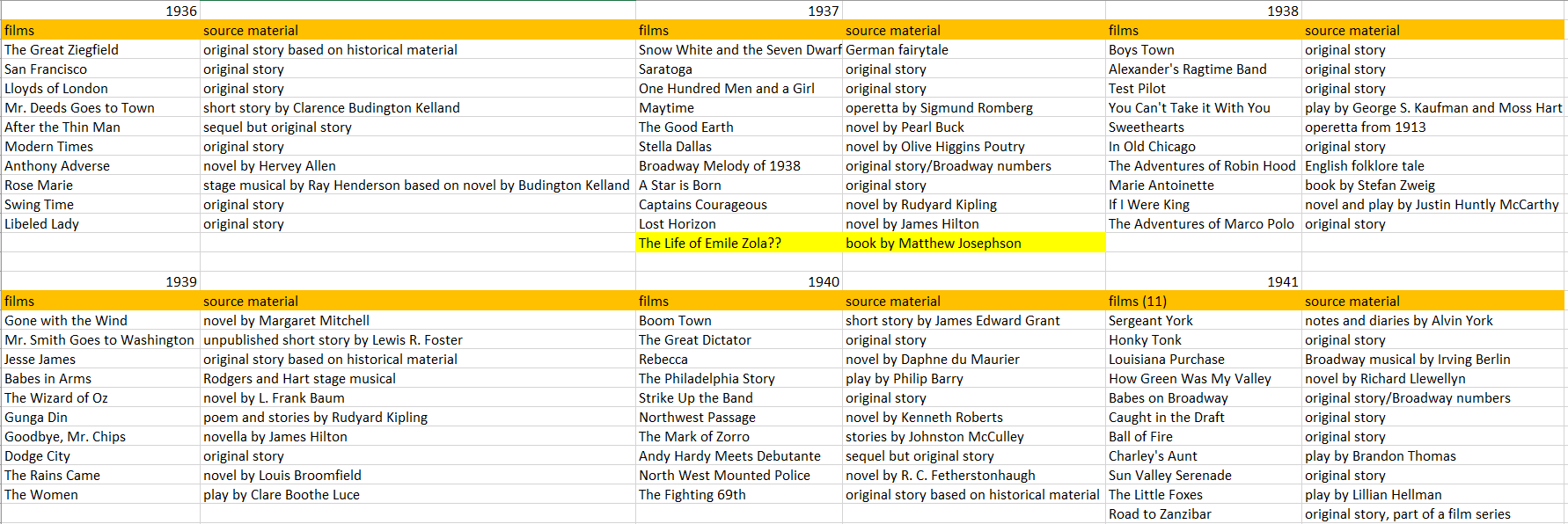

Out of 166 films, 42% were original stories (70 films), making it the most common form. 50 were adaptations of books, 17 of plays, and 15 of short stories or novellas. The rest were based on other things, like radio shows or operettas. Most of those 17 adaptations of plays were made in the first half of the 1930s, after which they almost disappeared.

One thing to consider is that there is not much point in making distinctions between original stories and adaptations. The quality or originality of a given film is almost completely unrelated to that factor. It is not always easy to decide whether a film is an original story or not, as there are many layers and various factors involved. If a film is based on a novel but entirely rewritten so that all that remains are some characters and the setting, is it even relevant to call it an adaptation. What is an original story anyway? Above I have marked a film as an original story only if it has not got any specific source of any kind. But that does not mean that those stories are more original or that the others are less interesting or daring.

In an upcoming post I will compare the figures presented here with the Academy Award nominees for best film and see whether there are more, fewer, or the same amount of adaptations among them. 


------------------------------------------------------

Previous posts in the 1930-1945 project are:

https://fredrikonfilm.blogspot.com/2021/03/1930-to-1945-by-numbers-part-i.html

https://fredrikonfilm.blogspot.com/2021/04/1930-to-1945-by-numbers-part-ii.html

https://fredrikonfilm.blogspot.com/2021/04/1930-to-1945-by-numbers-part-iii-actors.html

https://fredrikonfilm.blogspot.com/2021/06/1930-to-1945-by-numbers-part-iv-oscar.html


Friday, 10 April 2015

A Time to Love and a Time to Die

In the beginning of A Time to Love and a Time to Die (Douglas Sirk 1958) there is a scene where a group of German soldiers at the eastern front see a frozen hand in the snow-covered ground. It is not just the hand, it is clearly attached to a body hidden in the snow. So they dig it out and it turns out it is a comrade of theirs, who had been missing for some time. As the body is removed from its ice package it starts to melt, including the frozen eyeballs, making it look like the dead man is crying.


It is an opening which is both shocking and poetic, and sets the tone of the film very well. A film which is ambitious and unsettling, working on several layers. It is partly a love story, between a young German soldier and a girl he meets when he is on leave for three weeks; it is partly a film about Germany, about a once cultured and civilised country now consumed by death, corruption and despair, where fear and madness has taken hold of the German soul, and how it is perhaps necessary for Germany to be destroyed in order for it to come back to life. But it is also a film by a man, Douglas Sirk, who was German but left it in 1937 with his Jewish wife. Behind stayed his former wife who had become a Nazi and their son who was a soldier in the war and died at the Russian front. So he went back to Germany 14 years after the war to make a film about it, about Germany, and about the son that he had lost (twice, considering the son stayed when Sirk left in 1937.)

It is based on a novel by Erich Maria Remarque called Zeit zu leben und Zeit zu sterben which means A Time to Live and a Time to Die. When the book was translated into English the title got the word Love instead of Live, and became more poetic for it. Remarque also plays a part in the film, as a professor hiding from the Gestapo. It is one of several adaptations of his writing, earlier successful efforts include All Quiet on the Western Front (Lewis Milestone 1930) and Three Comrades (Frank Borzage 1938), but they are not like this film.

At one point a woman is summoned to Gestapo headquarters and as she is not home her husband goes instead. When he gets there he is given a small wooden box and a document to sign. He looks at it with confused eyes and asks "What is this?" The Gestapo clerk says, emotionless, "That is a receipt for the ashes of your wife's father." This is the first they have heard about him for a very long time but for the Gestapo it is just an annoying routine, paper work that must be dealt with. They killed him, now the remains must be handled according to the manual, the signatures collected, the papers rubber stamped and properly filed.

In another scene the young soldier on leave meets an old school-friend by chance, a man who is now an important member of the Nazi party. ("Imagine that. Me, the milkman's son.") He invites the soldier to his home, and asks if he wants to take a bath. The soldier says yes, and after he has taken of his clothes and sat down in the bathtub the other man joins him. Not in the water but he sits on the side of the tub, and they drink wine together, whilst the Party man talks flippantly about concentrations camps. Later there is a party scene in the same house, filled with drunkenness, seductions and self-loathing, close to surreal, that Luchino Visconti might have approved of. An uncomfortable message is that there is no escaping the guilt for what has happened, is happening. "We're only following orders." is not a valid excuse. The only one free of guilt is a Jew hiding in the ruins.


The scene above is set in a museum, destroyed by bombs, in which the young lovers have taken shelter, a poignant symbol of what has been lost, the art and history of Germany a victim, but still there under the wreckage to be brought back for a new generation. As it happened I read W.G. Sebald's novel Austerlitz (one of the greatest of books) shortly after I had re-watched A Time to Love and a Time to Die and it struck me that the two work well together, as stories about the trauma in the heart of Europe in the middle of the twentieth century.

There are other unforgettable images all through the film, such as a black horse-driven hearse abandoned on a street during a bombing raid, or a rocking horse on fire outside a home, or children's drawings on a wall of bombs falling. As always with Sirk every scene, every shot, every image is a symbol of something larger. By the river in the town a tree is in blossom, although it is too early in the year, not warm enough. But a bomb has started a fire and the heat from the fire, while damaging half of the tree, has made the other half blossom. Life and death, beauty and ugliness, in the same tree, side by side. It is there too in Lilo Pulver's wonderful performance of Elisabeth, the young girl, combining pride, fear and an urge for happiness, always under a deep cloud of sadness. The young soldier, played by John Gavin, is more consumed by doubt and guilt. But the sadness covers him too.

The two young lovers do not have much time, he will soon go back to the Russian front and death is inevitable. So they must date, fall in love, sleep together and get married in just a few days. There is no time for anything but honesty and openness. At the same time they are worried about their families; whether they are alive and, if they are alive, where they are. This is not really a time for love, but love we must because why else go on living?


---------------------
Between 1955 and 1959, Sirk made All That Heaven Allows (1955), There's Always Tomorrow (1956), Written on the Wind (1956), The Tarnished Angels (1957), A Time to Love and a Time to Die and Imitation of Life (1959), a streak of extraordinary films. He had made fine films before, such as Lured (1947), Has Anybody Seen My Gal (1952) and All I Desire (1953), but it was in those final years he was at his best. Most of them were shot by cinematographer Russell Metty, produced by Ross Hunter (two by Alfred Zugsmith), and with music by Frank Skinner. However, on A Time to Love and a Time to Die, the only member of Sirk's regular crew who participated was Metty. Miklós Rozsa wrote the music and Robert Arthur was producer.

Sirk made two other films between 1955 and 1959, Interlude (1957) and Battle Hymn (1957), but those I have not seen, and they seem to be regarded as minor work, by critics and by Sirk. I will eventually find out for myself.

Friday, 5 December 2014

Bright Star (2009)

Exquisite is the word that best describes Bright Star (Jane Campion 2009), and that encompasses all aspects of the film. The dialogue, the music, the movements, the butterflies, the flowers, the cat, the tea, and above all the clothes that Fanny Brawne makes, and is so proud of.


She is the central character in the film, a strong-willed young woman who lives with her mother and her younger sister and brother. They are close to the poets John Keats and Charles Armitage Brown, who live and work together. Fanny Brawne and Keats are rather alike, passionate and headstrong, and they are also deeply in love, although nobody else approve of this, for different reasons. Financial reasons for some (Keats is poor, and has few prospects of becoming less so), whereas Charles Brown seems to be jealous of the love affair, as well as thinking it interferes with their writing.


But Bright Star is not a film of conflict, it is rather a film of beauty; delicate and sensuous. Although it too is sensuous, it is far from the blood, mud and sex found in Campion's The Piano (1993), not to mentioned In the Cut (2003). But the same fascination with the texture of fabrics and things, of close-ups of hair, needlework, cloth, body parts, is there, as it always is in Campion's films, and people looking at each other through fingers or curtains or something else which is not exactly seen (as it is so close to the camera) but rather just felt, as a thin veil between the person (or us) watching and whoever is being watched. And it also seems to be a conscious effort to visualise the poetry of Keats.


Campion had earlier made an adaptation of Henry James's novel The Portrait of a Lady (the film came out 1996) and although Bright Star is based on a true story, and the characters in it real, it sometimes feels like an adaptation of Jane Austen, because of its tone, setting and cast of characters. Fanny Brawne could easily be an Austen heroine. She is tempered and proud, and as she is also witty she uses her wit to hurt others. She knows what she wants and aims to get it. Although had this actually been a story by Austen it would probably have ended with her and Charles Brown getting married.

Instead it ends in tragedy, as John Keats died as a young man and Fanny Brawne desperately calls out to her mother for help, being unable to breathe when she is told about his death in Rome. It is a powerful scene and Abbie Cornish, who plays Fanny, is very good, there and elsewhere. She and the film are equally exquisite.

------------------------------
Another good film with Abbie Cornish is Somersault (Cate Shortland 2004). Trailer here.

Friday, 5 September 2014

The Grapes of Wrath (1940)

John Ford is one of those filmmakers that I write about repeatedly, since I consider him to be one of the great artists of the 20th century. There are many aspects that make up his artistry, such as his themes and his conception of time, his work with the actors, his creation of distinctly Fordian characters. But it is perhaps above all else the poetic images, with many typical compositions recurring all the way through his career. Some of his films must be regarded as the most beautiful, visually, that has ever been made. The Grapes of Wrath (1940) is one of them. It is not Ford's best but it is still very impressive, and quite wonderful. Here are some stills:


In his correspondence with Lindsay Anderson for Anderson's book About John Ford, the scriptwriter for The Grapes of Wrath, Nunnally Johnson, boldly claimed that whatever quality is to be found in Ford's films came from the scripts Johnson had written, and the films Ford had made with other writers were just bad. As claims go it is depressingly weak. These images alone contradict Johnson because the images are Ford's, not Johnson's (nor John Steinbeck's). The cinematographer on the film was Gregg Toland, famous for his work with William Wyler and especially with Orson Welles on Citizen Kane (1941), but there is nothing in either Wyler's or Welles's films that are like the images to be found in the films of Ford for the obvious reason that their films were not directed by Ford. Of course, Toland was important for the look of the film, and producer Darryl F. Zanuck took a great, and close, interest in the production (Ford was more independent on other films), but the look and feel of the film is still Ford's. "Let's take a chance and do something different." he said to Toland when they were preparing it, and he later added "It worked out all right."

Tuesday, 6 August 2013

The film as a thing in itself

I am frequently asked "What kinds of films do you like?" and my response is always the same. All kinds, as long as they are good. This often leads to protests from those who ask this question and an effort to disprove me, by way of mentioning different kinds of films that they think I could not possibly like. (Some have suggested spaghetti westerns, others Bollywood musicals, others action blockbusters.) But that is a game they cannot win because what I say is not just a line, it happens to be true. It also means something more important, and that is that I see every film as a unique entity or, as Kant might have said, a thing in itself. It appears that this is surprisingly rare.

There are many ways in which films are not judged on their own merits but in comparison with something else. One obvious example is adaptations. As I have written before, I have a problem with the way films that are adapted from other art forms are discussed and appreciated, as when the quality of a film based on a book is measured on how faithful the film is to its source. I have a problem with this because it says nothing about the film in itself; it only says something about the film's relationship with something else (such as a book). When I see a film based on a book, even if it is a book I love, I do not care about that book, I only care about the film. Its fidelity to its source is immaterial.

When you ask a person what they thought about a horror film they have just seen they might say "I didn't like it, it wasn't scary enough." But by this they do not mean that they only like films that are really scary, what they mean is that since this was supposed to be a horror film it was bad because it was not scary enough. To me that is going about it the wrong way. You might be disappointed because the film was not as scary as you thought it to be but that does not make it a bad film. If the film had great acting, great cinematography, a good story, fantastic music and so on, that should be enough. Whether it was scary enough is something else because it is not based on the actual film but the film's relationship to other films, and that is unfair. If you had approached it as "a film" instead of "a horror film" you might have really liked it.

In her review of Pacific Rim (2013) Deborah Ross wrote that "Pacific Rim is a giant monsters v. giant robots film and although written and directed by Guillermo del Toro, who made Pan’s Labyrinth, which was sublime, it’s still just a giant monsters v. giant robots film, and now we have dealt with that". But there is no such thing as "just a giant monsters v. giant robots film". How were the visuals? How was the acting? Did the film stay true to its own inner logic? What did the film's politics look like? Any film can be discussed, analysed and appreciated, and they should be, especially by critics and reviewers. A related situation is when somebody says "It was good for being a horror film." (You can exchange horror film with Western, comedy, musical or, well, any kind of film.) What does that mean? Was it a bad film, because horror films are always bad, even though this one was better than the rest of them? Or was it actually a really good film? But if it was good, then why not just say that, instead of adding a caveat? And compared to which horror films? Was it good on the level of Psycho (1960), Peeping Tom (1960) or Alien (1979)? Any genre has a wide spectrum of films, from the really bad to the really good.

So all films should be discussed, analysed and treated with respect, but preferably on their own terms and not in relation to something else. You can of course compare a film to others like it, or how it relates to other films by the same filmmaker or with the same actor or from the same country, but these comparisons should not be used as a way of passing judgement; but rather as a way of comparing. This is not to say that all films are good, it is just to say that any film has the potential to be good, regardless of style, genre, place of origin or source material, and the chances of you appreciating it increase if you regard it as a unique work, instead of comparing it to some matrix. That, as Kant might have said, should be a categorical imperative.

Monday, 20 May 2013

The Great Gatsby (2013)

Whenever a well-known book becomes a film the world is suddenly filled with experts on the source, and more often then not they do not know what they are talking about. I sometimes feel that filmmakers show more fidelity to the novels than critics who complain about alleged detours and changes. The same is true for The Great Gatsby. A personal favourite is an article in which the writer complained that they had changed the ending since Gatsby does not kill himself. [Spoiler alert, he does not kill himself in the book either, at least not in the versions I have read.] Yet whether any changes have been made is more or less immaterial, unless you do a compare and contrast study, specifically looking for the things that have been removed and added. The only thing that matters when evaluating the quality of the film is whether it is any good on its own, not how closely it follows the original work, a topic I have elaborated on earlier here.

To focus on the film, I liked it a lot. This was primarily because of Leo DiCaprio and Carey Mulligan. The film has mainly be described as an extravagant party zone but I was pleasantly surprised by how sweet it often was, and it was when these two, Jay Gatsby and Daisy Buchanan, were together. They have an awkward date, drinking tea in a sea of flowers, and afterwards Gatsby take her on a tour of his majestic house. This was probably the highlight of the film, where the visual flourishes of Baz Luhrmann was held in check. Here the night really was tender. But it was not just that sequence, from start to finish I thought DiCaprio was excellent and convincing. It has been a long time since I saw an actor carry a film to such a degree as DiCaprio does here. It was a shame that Tobey Maguire, as Nick, was not his equal, but rather made the screen unbalanced when they had scenes together. With Mulligan the balance was just right. The other actors, although good, did not make much of an impression because the film, more than the book, was all about these three characters, Gatsby, Daisy and Nick.

The first 20 minutes or so of the film were rather annoying, because they were so forced and frenetic, with people screaming rather than speaking. Then things settled down, including the characters, and it was easier to enjoy the film. There was just one thing that got in the way. Nick's voice-over, which nearly ruined several scenes because it was so superfluous. It explained the scene for us, what we were seeing, and it was always unnecessary, not to say insulting. Apparently Luhrmann have very little regard for the emotional intelligence of the audience. But it was not so bad that I was not able to enjoy the film, all the way to the beautiful last scene.

..............................
This post is my contribution to a number of blog posts about The Great Gatsby from Swedish bloggers. Here are links to the others. The first one is in English, the others are in Swedish:

http://thevelvetcafe.wordpress.com/2013/05/22/gatsby/
http://bilderord.wordpress.com/2013/05/22/the-great-gatsby-2013/
http://jojjenito.wordpress.com/2013/05/22/the-great-gatsby/
http://fripp21.blogspot.se/2013/05/the-great-gatsby-2013.html
http://www.fiffisfilmtajm.se/den-store-gatsby/
http://www.harduintesettden.se/2013/05/the-great-gatsby/

Tuesday, 1 January 2013

Intruder in the Dust (1949)

In the end of Intruder in the Dust (1949) Lucas Beauchamp, an older black man arrested for a murder he did not commit, is asked by the white lawyer why he did not tell what had happened at the scene of the crime. "Would you have believed me?" Lucas asks, to which the lawyer has no reply. It is a remarkably powerful scene, for two special reasons. One is that the white lawyer has been set up as a hero in the film, the other is that Lucas says it with such a matter-of-fact tone of voice, albeit with a flash of anger. Everybody in the town had taken it for granted that Lucas was guilty, and since he is all too aware of the fact that this is the white man's world he refuses to play any games with them. He is a proud man, and he will not let go of his dignity and self-respect. This puts his behaviour at odds with what the white majority can accept, even those that would consider themselves progressive. In films about racism and injustices committed against African-Americans it is usually in the end white characters who are the heroes. But here Lucas Beauchamp is the hero, not for doing heroic acts but for not giving in or giving up, and he is not sentimentalised.

This is an angry and sad film, based on the novel by William Faulkner and shot in Faulkner's home town of Oxford, Mississippi. It was one of the last films made by Clarence Brown, being both its producer and director. Brown was an impressive filmmaker even though few of his films are remembered today. He was perhaps at his best in the 1920s but he is more famous for making films with Greta Garbo (he was her favourite), such as Anna Christie (1930) and Anna Karenina (1935). Other known films are National Velvet (1944), with Elizabeth Taylor on a horse, and the very sweet The Yearling (1946). Considering the kind of films he usually made Intruder in the Dust is something of a departure, but this was a film he wanted to make, and he struggled with MGM to be able to make it. He was from the south (although born in Massachusetts he lived in Tennessee from when he was 11) and he did have personal experiences of events such as those that take place in his film, as had Faulkner.

The adaptation was done by Ben Maddow, one of the more interesting scriptwriters of the 1940s and 50s. He had previously participated, together with Paul Strand and Leo Hurwitz, in the making of Native Land (1942), a film about attacks against workers and unions in America in the 1930s, with Paul Robeson as narrator. He also wrote scripts for two films by John Huston, The Asphalt Jungle (1950) and The Unforgiven (1960). In between he was blacklisted for his politics, eventually naming names in the HUAC hearings. During those years he wrote several scripts with Philip Yordan as his front, among them Men at War (1957), directed by Anthony Mann and one of the best war films ever made. Well, one of the best films ever made.

The style of the Intruder in the Dust is one of naturalism, in all aspects. It is shot on location, using deep focus and long takes, and there is no music. The use of natural sound is one of the strengths of the film, where every footstep, every breath, is emphasised, to add atmosphere and tension. Cinematographer Bruce Surtees' black and white cinematography is excellent, with the Southern milieu so evocatively captured you can almost feel the sweat and smell the stench. The combination of direction and cinematography is often magnificent. However, there are a few scenes where the dialogue is didactic, when the only purpose of the words seems to be to hit the audience over the head with the implications of what has taken place, as if we were not intelligent enough to understand what we were seeing. But there is also an irony here, in the occasional discrepancy between the words spoken by the white characters and what Lucas might have said had he been given the chance. Whether this was deliberate is not clear, and I leave that to the individual spectator to guess for themselves.

Lucas is played by Juano Hernandez, of Puerto Rican heritage (he grew up in Brazil). Before Intruder in the Dust he had done two films directed by Oscar Micheaux, Lying Lips (1939) and The Notorious Elinor Lee (1940). Then in 1950 he made three fine films, two by Michael Curtiz. He played the jazz musician Art Hazzard in Curtiz's Young Man With a Horn (1950) and in The Breaking Point, Curtiz's version of Hemingway's To Have and Have Not, he played Wesley Park, friend and partner of Harry Morgan. Finally he played Uncle Famous Prill, a man threatened by the Ku Klux Klan, in Jacques Tourneur's magnificent Stars in My Crown. Ten years later he played sergeant Skidmore in John Ford's Sergeant Rutledge (1960). There are several similarities between Intruder in the Dust and Sergeant Rutledge, where Woody Strode plays the title character as a sergeant in the 9th cavalry who is accused of rape and murder. He has the same pride and rigour as Lucas. A major difference between the two films is that Rutledge has lines such as "It was all right for Mr Lincoln to say we was free, but we're not. Not yet! Maybe someday!" and at another point he is saying that he is not a "swamp-running nigger", "I ain't that. I'm a man!" Lucas has no such lines, but he does not need them. Just by standing tall and looking the white man in the eye he says the same thing using only his gaze, body and posture.

To Kill a Mockingbird (1962) is another book turned into film that is similar to Intruder in the Dust. It too tells the story about a black man in the south being wrongfully accused of violent crimes. I leave the books out of the equation, but of the two films I prefer Intruder in the Dust. It is the braver and less comforting film, partly because it takes place in the present whereas To Kill a Mockingbird is set in the past. Intruder... also feels less conventional. In both films a simmering mob approaches the jail to kill the black prisoner. The jail is guarded by the white righteous lawyer in To Kill a Mockingbird. In the similar scene in Intruder in the Dust it is a frail old woman, knitting away, who face down the mob.

In "The Shadow and the Act" a great piece of film criticism from 1949, Ralph Ellison writes about blacks in Hollywood films and among the films he mentions Intruder in the Dust is the only one he cares much for. African-Americans have been abjectly treated by Hollywood for much of its history, much as in society at large, and that is primarily what Ellison's article is about. Even films that were well-meaning (i.e. attempts to criticise racism) are often so in a muddled, confused, cowardly and often patronising way. But not Intruder in the Dust. Ellison suggests that this is the only film that can be "shown in Harlem without arousing unintended laughter". That is reason enough to celebrate it, besides it being a very fine film aesthetically.

----------------------------------------
This post obviously ties in with the previous one, Film as a window to the past.
Ralph Ellison's essay can be found here.

Thursday, 25 October 2012

Anthony Asquith

A critic once called Anthony Asquith the most underrated British filmmaker of all time (although considering how underrated British cinema in general is many filmmakers can plausibly claim that dubious honour). The one thing that Asquith's name brings to mind is of course theatre adaptations, from Oscar Wilde to Samuel Beckett, and in particularly plays by Terrence Rattigan and George Bernard Shaw. He did three adaptations on Shaw's plays, with the version of Pygmalion from 1938 the most famous. But it was with Rattigan he worked most closely. Together they made 10 films, and they are among Asquith's best, especially The Browning Version (1951) with its heartbreaking performance by Michael Redgrave. However, there is a lot more to Asquith than adaptations. When I began looking at his films one thing I felt was that they had a musical sensibility, that music was important to them, and it did not come as a surprise when I later read that he was passionate about music, and apparently had an encyclopedic knowledge about composers. He also played the piano and would perhaps have become a musician if a teacher had not told him he lacked the necessary skills to become great. So instead he discovered the cinema. He has said that during his time in Oxford, as a student, he went to the movies constantly, learning the technique and trying to come up with his own ways of telling stories. He also went to Hollywood to closely study how the likes of Charlie Chaplin and Ernst Lubitsch worked (there is a similarity there between him and Hasse Ekman).

Asquith's career had its ups and downs. He began in the late 1920s very successfully with four silent films, including Underground (1928) and the expressionistic A Cottage at Dartmoor (1929), Then in the 1930s he was less successful, although some of the films are of interest, with Pygmalion being both a great success and a great film. This is a multi-authored film, with Asquith, Shaw, Leslie Howard and David Lean, who was editor, and others all contributing with their own ideas and talents to the finished film. This too is a remarkably expressionistic film, in editing, framing and lighting, and what is so impressive, besides Wendy Hiller’s performance, is that it does not fall apart but actually holds itself together as a sustained piece of bravura filmmaking. It is a testament to Asquith’s skills and boldness, as well as his patience and kindness,  that it all comes together in the end. A film made during the war, Cottage to Let (1941 aka Bombsight Stolen), is also something of a marvel. It is a film that is part comedy, part thriller, part romance, and yet it too works surprisingly well, including John Mills performance as a Nazi agent posing as a RAF pilot. It also has rather stylish visuals. This film, and others, shows Asquith’s love for the medium and his eagerness to try out new things, visually as well as narratively. However, for the next phase of his career, he changed style. Now his films becomes more restrained, even austere, and this phase holds most of his great films. One brilliant example is The Way to the Stars, (1945), one of the films he made with Rattigan. It is exquisitely shot, framed and edited, and tells the story of the life and frequent deaths of pilots, British and American, on an airbase somewhere in England. It is told in flashbacks, beginning with tracking shots across the now empty airfield, where only the ghosts and the memories of the pilots and the crew remains. Other films to mention from this phase are The Winslow Boy (1948), The Browning Version and Carrington V.C. (1954). Then in the late 1950s Asquith somewhat changed track again and the films become more glossy and “international”, where before they had been distinctly English, both in themes and in setting.

It is tempting to see Asquith as a British equivalent of George Cukor. Although Cukor shows more coherence, not least in terms of style, and is the better director, there are strong similarities. The focus on acting and adaptations is the most obvious link. But like Cukor Asquith, at least from the 1940s and onwards, does not try to “open up” the adaptations but instead use the source material as a strength, and with exquisite sensitivity in his handling of the movement of the actors and the camera on the set, or the lack of movement when called for, make the films cinematic without being flamboyant. (Our notions of what is cinematic and what is not are often still rather crude.) Take a film like The Importance of Being Earnest (1954). It begins with an audience settling down at a theatre to watch a stage performance of the very play the film is based on. Here Asquith has foregrounded the film's theatre roots, and the film is done as if it takes place on a stage. At the end it returns to the theatre in the beginning, with the curtain coming down. By deliberately staying so close to the theatre the film makes for an interesting case-study when discussing stage adaptations and notions of what and what is not cinematic. The use of editing and close-ups are techniques that the theatre has not got. Something else that differs between cinema and theatre is the use of framing. It is not that the theatre does not use framing devices, but the cinema can use framing in different ways, and this is something the skillful director can work wonders with, and in so doing distinguishing the filmed version of a play from a stage version of the same play. The Browning Version is an example of how a director’s precision in framing can add layers of meaning to the words and the performance, and make a film cinematic without having to include opaque camera movements or outdoor scenery.

Among the noticeable things in Asquith’s films are the uses of mirrors. Asquith puts them in his images to add frames to the larger frame, to give a sense of larger world, or for startling effects, visual or psychological. The ending of Cottage to Let even takes place in a hall of mirrors. The films are also full of wit and irony, which sometimes has a slight subversive effect. The effective and morale-boosting film We Dive at Dawn (1943), about the crew on the submarine Sea Tiger, has several hilarious scenes, but the most surprising thing is the last line of dialogue. Some officers are watching the submarine come and go in the bay, and an admiral says “It's like I'm running a bloody bus service.” This kind of wit effectively counterpoints the often heavy subjects Asquith deals with.

His passion for innovation, of taking every film as an opportunity to try out new ideas and approaches also means that they are almost all of them interesting in some ways. This is very much the case with The Woman in Question (1950 aka Five Angels on Murder). It is on the one hand a not very exciting detective story about the search for the murder of a woman called Astra, played by Jean Kent. But the way it is told is remarkable. The detective, played by Jon Linnane, interviews several people about the woman and what happened the night she was murdered. Each flashback is narrated by the witness that is being interviewed, and they all have a completely different take on Astra, and what kind of woman she was, and why she was killed. What she says, how she says it, what she wears, and how she behaves in the various flashbacks are all different and when the film is over we will have to guess ourselves which of the many versions of Astra’s personality was the closest to the truth. It is the same idea as Akira Kurosawa would explore later in Rashomon (1951), letting an event being told from each interested party’s own subjective view.

There is a lot more to discover about Asquith himself too, and his films. This has only been an introduction. He is ripe for retrospectives and critical discussions of his career. Suffice to say for now that he was much loved by his cast and crew, and that he left a body of work which is emotionally rich and filled with both great acting and creative boldness.
---------------------
2013-07-11 I've changed two words that were incorrect. I'd also like to add that it is interesting to look at Asquith's films (at least some of them, such as The Browning Version) from a queer perspective. 

Friday, 28 October 2011

Tintin

The early Tintin albums were inspired by silent cinema, and they in turn inspired cinema. But all of Hergé's 23 proper Tintin albums, are should they be called graphic novels?, are very cinematic yet there have been few film versions. I myself have seen only one, the non-animated Tintin and the Blue Oranges (Tintin et les oranges bleues 1964), which is not based on any of the albums. I have also seen a TV-version, which was actually pretty good.

But I have never felt the need for any film adaptations. For me the albums have been enough, and I have been a Tintin fan since I was a young boy. I have read them in Swedish, English and French, and I even have an album in Japanese at home. I know them all very well, and I adore them. Especially the style, Hergé's ligne claire, which has become a very influential and easily recognisable style. Another thing about them is how they grew over time, developed in many different ways. Hergé changed when the world changed, both the global world and his own personal world, and the albums changed with him. First they were imaginative but rather crude, and in the case of Tintin in the Congo (Tintin au Congo 1931, re-edited colour version 1946) embarrassingly racist. Then came the middle period of such work as the anti-fascist King Ottokar's Sceptre (Le Sceptre d'Ottokar 1938, re-edited colour version 1947) and then the late masterpieces with the emotionally complex and beautifully illustrated Tintin in Tibet (Tintin au Tibet 1960) as the high point. That album, I think, is one of the greatest drawn art work of the 20th century. Other highlights are Blue Lotus (Le Lotus bleu 1936, re-edited colour version 1946), the album with which Hergé stopped being "just" a cartoonist and became an artist and storyteller, and the double feature The Seven Crystal Balls (Les 7 boules de cristal 1948) and Prisoners of the Sun (Le Temple du soleil 1949).
Now Steven Spielberg's film The Adventures of Tintin is here, and I saw it yesterday. Spielberg has been a fan of Tintin for several decades and got the rights from Hergé's, or to use his proper name Georges Remi's, wife in 1983, after Remi had died. Remi liked Spielberg's films and was happy for him to have the rights. But it has taken a long time before anything came of it.

I liked the film. For one thing it looks great, it is witty and it got a very strong drive. But somehow what is good about the film is also a problem. Spielberg has such a strong personality as a filmmaker, his style is easily recognisable and forceful and it all but negates Hergé's presence. What I mean is that although based on two albums there is very little left of the feel, texture and style of Tintin, whereas almost every shot clearly signals Spielberg's presence. It is not so much an adaptation as an appropriation. These means that there is a strong sense of wonder, and dazzling displays of visual imaginations, Spielberg at the top of his game. But there is also a certain breathlessness to the film, which I feel is a bit inappropriate. Hergé's albums are not breathless, they are more measured. Also, I did not like John Williams music, and there was too much of it at that. One thing that has got lost altogether is the subconscious level. Hergé filled his albums with hallucinations, dreams and nightmares, elements which he sometimes took from his own dark secrets. But the film is all surface.

They have taken the album The Secret of the Unicorn (Le Secret de la Licorne 1943) and blended it with The Crab With the Golden Claws (Le Crabe aux pinces d'or 1941, 1943). They are not related, but since they have taken so very little from The Crab..., I suppose they just wanted that album's first meeting of Tintin and Haddock . But when I saw the film and the traitorous first mate Allan appeared I thought, almost angrily, "Hey, he's not supposed to be in this adventure!" Then I realised what they had done and calmed down. It also says something about the quality of the film that I immediately recognised Allan, even though I was not expecting him to be there.

Of the new things that has been added to the film (but which are not in any album) a car chase, involving a hawk, a tank and a collapsing damn, was particularly breathtaking, even though they took place in a stereotypical fantasy of a Middle East kingdom. But the best part of the film was the opening, after the title sequence. It takes place on a square where there is a market, and a man is drawing a picture of somebody else. But we do not see the faces of either man. When the faces are revealed we see that it is Georges Remi drawing Tintin. I thought it was a nice gesture.

So there it is. A meeting between two of the most successful makers of popular art in the 20th century, Hergé and Spielberg (and Peter Jackson on the side), has resulted in a film which is both a dazzling piece of film, and a disappointment. It actually ties in well with what I wrote not long ago about adaptations. It is also fun to consider which other filmmaker's would have been suitable. A version of The Castafiore Emerald (Les Bijoux de la Castafiore 1963) by Ernst Lubitsch or perhaps even by Eric Rohmer would have been something. A Michael Mann version of The Calculus Affair (L'Affaire Tournesol 1956) would be interesting as well. But the beauty of the albums is still unsurpassed.

--------------------------------------------

There is a very good documentary about Tintin and Hergé called Tintin et Moi (Anders Ostergaard, 2003). Not sure of its availability but look for it, it is worth the effort.

Friday, 23 September 2011

Books, films and adaptations

I think that despite a century of practice we still get confused with discussing books and films, and comparing them, and in this post I've pointed out of some of that confusion.

The first question might be what an adaptation is. You could perhaps say that all films are adaptations of the scripts they are based on, but let's for now concern ourselves only with films that are adaptations of books or other self-sufficient written sources (like comics, short stories and plays). One thing to remark upon is that adaptations are almost always only discussed as such when it is adaptations of either classic masterpieces, primarily novels of the 19th century, be it Jane Austen or Leo Tolstoy, or modern bestsellers. When did you last read an analysis of Rear Window (1954) as an adaptation of Cornell Woolrich's It Had to be Murder or Rashomon (1950) discussed as an adaptation of two stories by Ryunosuke Akutagawa?

Another thing is that when discussing a film that is an adaptation you need to differentiate between the film in itself and the film as an adaptation. It might be a great film but a bad adaptation, in the sense that perhaps most of the book has been removed and the sentiments and/or morals have been altered. Or it might be a good, faithful adaptation but a terrible film, because the acting is all wrong, the direction hysteric and the cinematography unintentionally ugly. Since the film is the film, and not the book, it seems to me that it is the quality of the film, not the quality of the adaptation, that should matter, unless for scholarly purposes.

How faithful an adaptation should be is an open question, it all depends. Being too faithful might ruin the film, even though it might work for a TV-series where there is more time available. It is a common mistake among filmmakers that they try to get as much from the novel as possible into the film. Maybe it would help if we stopped using the word "adaptation" and instead used the word "interpretation".

Even though adaptations are so very common, and popular, one of the oldest comments in film criticism, scholarly and popular, is "the book was better", sometimes generalised into "the book is always better than the film". Even more generalised is the argument "books are better than films". Two common reasons given for this is that a) books allow more freedom for the reader to interpret and/or imagine what is happening on the pages than a film does and b) books have more depth and complexity. To me these arguments are often flawed.  Films can be as complex and deep as books, although what constitutes complexity and depth are debatable points and in any event neither complexity nor depth are essential for great art works. Obviously it is one thing to like a particular book better than the film made from it, there is nothing strange or flawed about that, but to take it further than that I think is unsatisfactory.

The argument that the book is always better than the film is flawed partly because it only takes into consideration adaptations of great books. But hundreds and hundreds of films are based on bad books, which do not stop those films from being good. And why could not a terrible book be transformed into a great film? Because the art form is by necessity deformed in same way?

Another flaw in the argument is that it compares two things that are not necessarily comparable. Apocalypse Now (1979) is based on Heart of Darkness, written by Joseph Conrad, but which one is best, the book or the film? Yes, you could on an individual level prefer one over the other, but that is not enough to make it into some general principle. Besides, it is two different art forms and should be judged on different grounds. This is why it is a mistake to say that books are better than films. It is a bit like saying that apples are better than oranges. Why? Because you think so? That is not a valid point. How do you compare a long take in deep focus in the film with the description on the page in the book? How is one better than the other? Is Shakespeare's King Lear automatically better than Kurosawa's version of it, Ran (1985)?

When you see a film it is true that you often see everything (but not always, violence might sometimes be suggested or hidden, as are often monsters in horror films) whereas in a book you must make the images yourself. But on the other hand in a book the only thing you get is exactly what the writer has put there. There is nothing else. When you watch a film there are always a lot of things which are just there, even if nobody put them there especially for you. A street scene in a film will be filled with people, buildings, the clouds on the sky, birds flying and so on, and you can choose to look at that instead of the main characters arguing in the centre of the image. When you read the book you do not have the luxury to choose which words to read, you must read them all. Well, you could of course choose to ignore some pages, or the whole second half of the book if you find it boring, but that is not the same. I am not saying one is better than the other; my point is only that you do not necessarily have more freedom when reading a book than when watching a film.

Maybe the bottom line is that we should not forget that they are two different art forms which cannot easily be compared. And that, here and everywhere, we should not use our own personal preferences as if they were general truths about art.

-------------------------------------------------------------------------
I was partly inspired for this post by my friend Paisley Livingston's recent research on the subject of adaptations. See an example here: http://www.ingentaconnect.com/content/berghahn/proj/2010/00000004/00000002/art00007