
As I have mentioned before, one of the first, or possibly the first, VHS tape I ever bought was Ice Station Zebra (1968), directed by John Sturges. I still have the tape, even though it has been at least 15 years since I had a VHS player. Sturges matters to me. While he was not as important as, for example, Alfred Hitchcock for my developing interest in films, he has always been a presence in a way no other filmmaker has been. I cannot explain this in any logical way, but I imagine it is related to the significant impact seeing some of his films had on me at a young, impressionable age. Besides Ice Station Zebra, there was also Kind Lady (1951), Jeopardy (1953), Gunfight at the O.K. Corral (1957), The Great Escape (1963), Hour of the Gun (1967), The Eagle Has Landed (1976). I watched them on TV whenever I had the chance, as I knew that if John Sturges were the director I would not be disappointed. Once I watched Joe Kidd (1972) with my grandmother, an unapologetic fan of Clint Eastwood, but she was sadly disappointed with that one.

The reason for why I am writing this now is that I have just read Dreams of Flight: The Great Escape In American Film and Culture, a new book by film scholar Dana Polan about the backstory, production, reception, and influence of The Great Escape, but it is also autobiographical; how Polan saw the film when he was a boy (at a drive-in), how it changed him, has followed him through his life, and how he felt compelled to write a book about it. Earlier this year I also read Sheila O'Malley's blog post, about Sturges, which also has that autobiographical aspect to it.
It is not just us. All through my childhood, my dad spoke about three films that had made an impact on him. The Ox-bow Incident (1943), The Magnificent Seven (1960), and The Man Who Shot Liberty Valance (1962). As you can see, they were all westerns and one of them was by Sturges, The Magnificent Seven. Even before I started to watch the films myself, I had already been introduced to one of them.
Alfonso Cuarón is another one for whom having watched a film by Sturges in their youth made a big impression. In his case it was Marooned (1969), which, not by chance, the characters in his autobiographical film Roma (2018) also go to the cinema to watch.
Paul Thomas Anderson has spoken of Sturges's Bad Day at Black Rock (1955), and the quality of Sturges's audio commentary to its Laserdisc release. What he said was "You can learn more from John Sturges’ audio track on the ‘Bad Day at
Black Rock’ laserdisc than you can in 20 years of film school." (Confusingly there are several versions of this quote floating around on the internet, some inaccurate. What I just quoted is word for word what he said in an interview in the Los Angeles Times. You can listen to Sturges's commentary here.)
***
The earliest of Sturges's films that I have seen is from 1949, The Walking Hills, which is quite good. Next year's The Capture (1950) is very good. The People Against O'Hara (1951), with Spencer Tracy as a struggling attorney and John Alton as the cinematographer, is a fine drama. These were years in which Sturges could make 3 - 4 films a year, and several of the early films I have not seen, including interesting ones like Mystery Street (1950) and Right Cross (1950). But it seems his career settled on a more focused and deliberate trajectory in 1953, when he made the western Escape from Fort Bravo, with William Holden. Soon this became his defining kind of film, together with war movies, and I have seen almost every film he made after 1953. I would speculate that he was attracted to such films because they gave him plenty of opportunity to shoot widescreen films outdoors, and also to work with ensemble casts of men working together. He was also interested in history, not least American history. Some of the highlights are Bad Day at Black Rock, Backlash (1956), Gunfight at the O.K. Corral, The Law and Jake Wade (1958), The Magnificent Seven, The Great Escape, and Hour of the Gun. Another one I like a lot is A Girl Named Tamiko (1962), which is thematically unusual as it is a contemporary love story, focused on a man and a woman. (Gunfight at the O.K. Corral is also something of a love story, but between Wyatt Earp and Doc Holliday.)
***
There is not that much written about Sturges, but in the books and articles I have read it is often the case that the writer(s) discuss whether he can be considered an auteur or not, and there are often complaints about how Andrew Sarris was unfair to him. I find this tiresome. As I have written about earlier, I think we would be better off not using the term, or concept, of auteur as few seem to even know what it means. At least there is no consensus about what it means. (Which is true for many common terms used by film scholars and critics.) Sturges's films have a recognisable style across his oeuvre, and there are thematic consistencies as well as similarities regarding tone, style of acting, and pacing, and if you want to call him an auteur that is easy to justify. But what is gained by this? It has no bearing on the quality of the films. To get an example of this confusion, this is what Polan says in his book I mentioned above: "It is important, I think, not to turn Sturges into some sort of auteur
imagined as working to express a deep metaphysics that somehow was
engrained into these films made for the business of entertainment." (p.
79) No part of that sentence makes sense. Since Polan elsewhere in the books writes about the stylistic and thematic concepts he finds consistent throughout Sturges's body of work, his definition of what an auteur is must be different than how it is usually conceived. I do not know what he means by "a deep metaphysics" that is "engrained into" the films, or who has said that this is what it means to be an auteur. Or is Polan mocking people who make that argument? If so, who are these people he is mocking? And he seems to think that there is some contradiction between being an auteur and doing films "made for the business of entertainment." But if that is a contradiction, it is one that Polan himself has invented. Either way, arguing about whether Sturges is an auteur or not is pointless, since it has little to do with Sturges and primarily to do with what you mean with the word auteur, or what you think others mean by it.


What is the style of Sturges? The images are clean, clear, spread out, uncluttered, spacious, whether indoors or outdoors. He is one of the great masters of the widescreen shot. Even in earlier films before the emergence of CinemaScope and other wide formats, such as The People Against O'Hara, he composed in width as well as depth; as if he spent those early years just waiting for a widescreen format to emerge. If I am not mistaken, all the films he made from 1953 have been in various widescreen formats, whether CinemaScope or Panavision or something else. His favoured way of filming has a stylised element to it, and it frequently involves a lack of people. The streets of his towns are usually empty, because that is how he wants his shots to be. When he made Bad Day at Black Rock, one demand he had was that he would not use any extras. The only people in the shots would be the characters who really had to be there. This makes the shots and street scenes unrealistic, but that is his way of filming, not just in Bad Day at Black Rock (below) but in general.

The streets are however crowded in The Hallelujah Trail (1965), but then that whole film is a crowded mess, a rare attempt by Sturges to be funny and boisterous. It is amiable but tiresome. But it is an exception. His characters otherwise seem to exist in isolation, and they are usually not just alone but lonely. This is a recurring thing in his films, loneliness. The most famous scenes from his films, such as Steve McQueen on a bike or in a cell (the cooler) in The Great Escape, are usually of people being alone and isolated. Consider a scene in the beginning of Sturges's penultimate film, McQ (1974). A cop in civilian clothes walks into a diner, uses the restroom to wash his hands, and then walks out to the counter and orders a glass of milk. He is the only customer in the place and the man who works there is primarily out of sight in the kitchen, so most of the sequence is just a lone man in a large diner having a glass of milk. It is true that several of his famous films are of a group of men working together, but they are still isolated, whether in jail, in space, or on a submarine, and their exchanges are rarely on a personal level. At the end of the film they will either have died alone or they will have split up. Companionship is not a lasting thing in Sturges's films. Has there ever been another American filmmaker for whom loneliness is such a central theme?
The outdoors are overwhelming too, and the characters, or some small town or hamlet in which they live, are dwarfed by mountains, trees, and the sky. Sturges likes to use a crane, and to move the camera both sideways and up and down, to make the shots fluid and to capture the vastness of nature. But action scenes, like fights or shootouts, are carefully choreographed and often done in a brief outburst, filmed with a fixed camera. He liked to prepare his shot in advance, doing diagrams and calculating angles. He had an engineer's interest in such things, and cutting was an important part of it too. (One person he worked most often with was the editor Ferris Webster, who cut some 15 of Sturges's films.) Hour of the Gun is his most extreme film in terms of style, so stylised that it reaches some kind of poetic abstraction, where everything not essential has been stripped away. The same is true for The Satan Bug (1965). I would say that these two films are his most abstract in style, but The Satan Bug is unfortunately not a good film, as the story is too ridiculous and incoherent. But through its spare, bare style, which includes the acting, it becomes a fascinating exercise just the same, more like a blueprint of a film than an actual film.
The world depicted in his films is a rough and hostile place, which Sturges's depicts without almost any traces of sentimentality. If you focus on what matters you might make it, and even if you do not
make it, you might still have recovered your self-respect and die as a
proud man, knowing you did the best you could. That is one reason some of his films are something of an emotional paradox, they are tragedies yet they can be simultaneously uplifting. But usually, they are more sad than uplifting. Some, like Last Train from Gun Hill (1959), end in darkness. Many of the films also end with the question "Was whatever was done worth all the pain it caused?" Sometimes a character explicitly asks it, sometimes it is unspoken, but the question is almost always there.

One filmmaker I think would make for an interesting compare/contrast is Anthony Mann. They have for one thing a similar career trajectory: both started doing B-movies in the 1940s, then noirs with cinematographer John Alton, and then primarily making westerns and war films with bigger budgets and stars. They are downbeat, they do not do comedies or musicals, and rarely domestic films, and their westerns are psychological, focused on characters in turmoil or bent on revenge. There are also visual similarities, and they are excellent at staging fight sequences. But Mann is by far the greater director. There are more depth and complexities in his films, and in the performances he gets, and the visual style is more inventive and striking, especially when indoors. But I would have to spend more time with their films simultaneously to strengthen my argument. For now, I just add that two lesser-known westerns by Sturges, Backlash (written by Borden Chase who also worked with Mann on several occasions) and The Law and Jake Wade, are particularly close to Mann and they are among Sturges's best films. Yet they are not as good as Mann's best films. (Here is my earlier article about Mann.)
Speaking of compare and contrast, Sturges's By Love Possessed (1961), a for him uncharacteristic soap opera about love, family, and generational conflict, would make for an interesting triple feature with Henry King's This Earth is Mine (1959) and Douglas Sirk's Written on the Wind (1956). To add to the relevance of comparing them, they were all shot by Russell Metty. "I had no business making it." Sturges said.
***
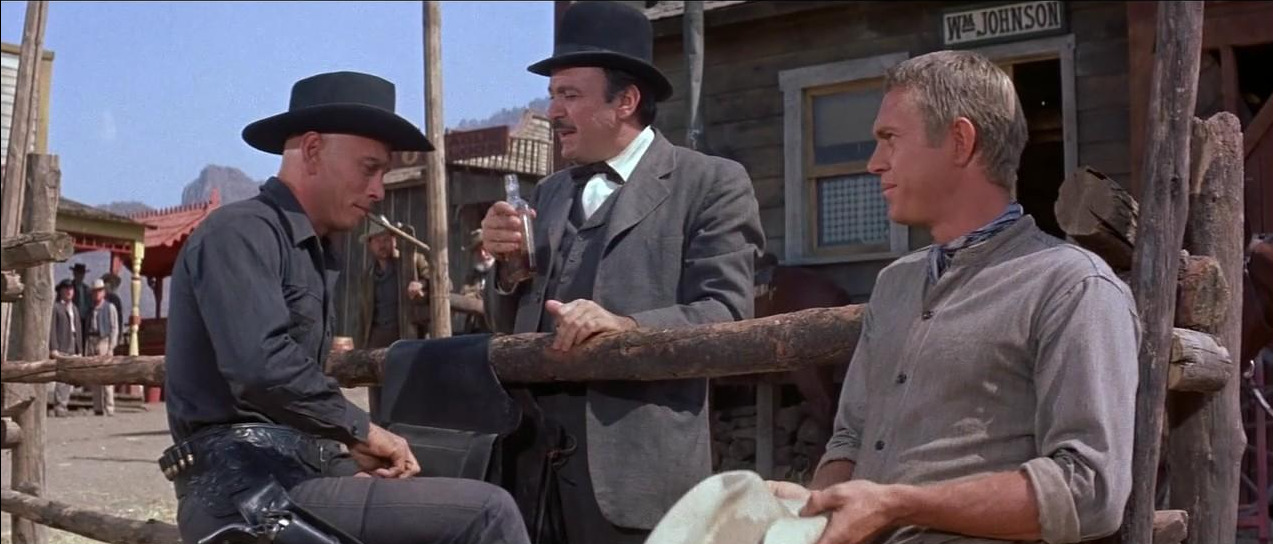
In an early scene in The Magnificent Seven, Steve McQueen and Yul
Brynner's characters Vin and Chris are talking. McQueen's Vin asks where Chris
is heading. "I'm drifting south more or less." he says. "Where are you heading?"
"Oh me, I'm just drifting." says Vin. That to me felt like a life-goal
worth pursuing at the time, and when I went on my first trip around the world, in 2001, I had
calling cards made out on which I had printed my name, email
address, and as my profession "Drifter". Such is the influence of Sturges on me. Alas, the days of drifting around the
world seem to be over. Maybe when I retire... Until then I at least have Sturges's films for strength and company, even if they rarely provide much comfort.
----------------------------------
Some selected readings:
Books:
Lovell, Glenn, Escape Artist - The Life and Films of John Sturges (2008)
Polan, Dana, Dreams of Flight: The Great Escape In American Film and Culture (2021)
Reframing Cult Westerns: From The Magnificent Seven to the Hateful Eight, editor Lee Broughton (2020)
Articles:
Bengtsson, Åke, "John Sturges" (1962) in Chaplin
O'Malley, Sheila, "'I think I'm a pretty good storyteller.' - John Sturges" (2020) in http://www.sheilaomalley.com/?p=164847
Me about Anthony Mann: https://fredrikonfilm.blogspot.com/2018/01/anthony-mann.html


