Showing posts with label film historic myths. Show all posts

Friday, 4 February 2022

The actors who were called box office poison

Whenever the career of Katharine Hepburn is discussed, it is mentioned that she once upon a time was considered "box office poison" and that The Philadelphia Story (1940) rescued her career, or put it back on track. Sometimes when Marlene Dietrich is discussed, the "box office poison" label is also brought out. What is rarer is for some specification of who called them that, and if the claim was even true. As part of my "box office figures of 1930-1945" project from the spring of 2021 I wanted to look into that, and although that project has been cancelled due to the unreliability of older box office figures, I still want to discuss that "box office poison" in some depth.

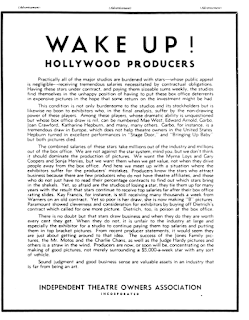
It did not originate in any article or research paper but comes from an ad in The Hollywood Reporter, in May 1938, and in it a lot of actors, some named and some unnamed, were referred to as poisonous. But for some reason, it is Hepburn who is now the one that is primarily singled out. It is not obvious why.

The ad was from the Independent Theatre Owners Association (ITOA further on) and their complaint was that the studios had lots of actors under expensive long-term contracts and therefore they had to let them star in film after film, even though the actors were "box office deterrents" and as a result, the cinemas were losing money. Beside Hepburn ("Hepburn turned in excellent performances in 'Stage Door,' and 'Bringing Up Baby' but both pictures died.") and Dietrich (she "too, is poison at the box office.") the ad also mentions Mae West, Edward Arnold, Greta Garbo, Joan Crawford, and Kay Francis. They also say, "We want the Myrna Loys and Gary Coopers and Sonja Henies, but we want them when we get value, not when they drive people away from the box office."


There is a lot of confusion here though. It is true what they say about Kay Francis, that she was doing B-movies at Warner Bros. and that she refused to give up her contract even though the studio wanted her to. This is not proof of her being unpopular but stems from other reasons, and it seems Warner treated her badly. It is not obvious she deserves to be included.

About Katharine Hepburn, the first thing to clear up is that it is not true that Stage Door (1937) died. It turned a profit for RKO. The situation for Bringing Up Baby (1938) is more mixed, it cost more to make than it took in, which was partly because of Howard Hawks's particular position as a freelance director. He had negotiated an unusually large fee for directing it and he, as he often did, went over schedule and over budget. (It cost almost twice as much to make as the previous year's screwball hit The Awful Truth (1937).) The film did well in some parts of the country, although it was unexpectedly a failure in New York, so these two films do not prove that Hepburn was repellent for audiences. Still, there were concerns about her career in 1938 since the last time she had acted in a film that did really well at the box office was in 1935: Alice Adams. In 1940 she was back at the top.

Two of the three most recent Hollywood films that Dietrich had made before the ad, Desire (1936) and Angel (1937), had both been successful, although Angel especially so in Europe. In 1937 she made Variety's top ten list of the most bankable stars. Hence calling her "box office poison" is wrong, and her next film, i.e. the next release after the ad had been published, was Destry Rides Again (1939) and it was one of the biggest hits of that year.

Greta Garbo's recent films had all been successful, but here the complaint in the ad was more relevant because her films made most of their money outside the US market, especially in Europe. Conquest (1937) was not profitable for MGM but that was not because people did not want to see it but because it was so expensive to make. But for the ad to question MGM's wisdom for having her on a contract is self-serving since MGM made a lot of money on her films, even if ITOA did not see much of it.

Mae West's films had not been doing poorly either, although her best years in films had been earlier in the decade and her latest film, Every Day’s a Holiday (1937) had been a disappointment. Her response to the ad was quoted in The Billboard in which she pointed out that she was doing excellent business on the theatre stage. She also said, "The only picture making real money was [Disney's animated] Snow White and that would have made twice as much money if they'd had me play Snow White."

Joan Crawford was making more films than any of the others, and the success rate of them varied a lot, but for example The Last of Mrs. Cheyney and Mannequin (both 1937) had done well. A columnist in The Hollywood Reporter asked how it was possible to refer to Crawford as box office poison when her last five films for MGM had all taken in over $990 000, domestically, each.

Edward Arnold is a different kind of actor than the others. He did at times play the lead, but often he was a supporting actor, and it is therefore tricker to evaluate to what extent his presence or absence in a film made much difference. The Toast of New York (1937) in which he played the lead had been a major flop. Even so, when The Hollywood Report in December of 1937 did a survey among exhibitors about the most attractive stars, Edward Arnold was among those that got votes although he did not make the top 12 list. The two films he made in 1938, The Crowd Roars and You Can't Take It With You, did good business and the latter was one of the biggest hits of that year.

It is unclear whether the ad is arguing that Myrna Loy, Gary Cooper, and Sonja Henie were also box office poison, or if they were the opposite, but either way their films, not least Cooper's, were doing very well and Test Pilot (1938), with Myrna Loy, was one of the biggest hits of the year of the ad.

In short, while IOTA might be correct in saying that some of the films in which these actors starred did not do good business in the particular cinemas run by IOTA, it is not accurate to say that these actors were keeping the audiences away overall, calling them "box office poison" is wrong, and suggesting that they should be relieved of their contracts is dumb business advice. The ad though is not really about that but part of a drive to get rid of the concept of block-booking, where the cinema owners could not just book the individual titles they wanted but had to take a slate of films from each studio in package deals, and since the studios did not necessarily care that different films played differently in different parts of the country, the cinema owners had reason to complain to them. But doing it by way of attacking their contracted actors was an unfair move.

Given all of this, and given that it is difficult to assess which the exact factors are that make a film a hit or a flop, or even to quantify what is a hit and what is a flop, it is worth asking how it came to be that critics, historians, and ordinary film enthusiasts, have all fallen for that ad, and still refer to it as some kind of authoritative source.

-----------------------------------------------

Sources:

Kinematograph Weekly, Nov 4, 1937

Picturegoer, March 16, 1940

The Billboard, May 14, 1938

The Hollywood Reporter, Nov 20, 1937

The Hollywood Reporter, May 3, 1938

The Hollywood Reporter, May 4, 1938

Variety, Dec 23, 1936

Variety, Feb 5, 1938

Variety, Jan 4, 1939

Kear, Lynn and John Rossman (2006) Kay Francis: A Passionate Life and Career

McCarthy, Todd (1997) Howard Hawks: The Grey Fox of Hollywood

Sedgwick, John, and Mike Pokorny (2010) "Hollywood's foreign earnings during the 1930s" in Transnational Cinemas vol. 1 #1.

Friday, 28 May 2021

Conventional wisdom part II

Writing about problems and errors concerning conventional wisdoms about film history, as I did last week, is difficult because people often misunderstand, or dismiss as irrelevant, what I say. Three common responses are: a) But you always need to simplify when talking about something as large as film history; b) It is understandable that people make factual errors and this is not a big deal; c) There are more than one way of interpreting film history and what is to say yours is the only correct one.

While I did not intend to write more about this, I have received some variations of all three responses since my previous post, and some clarifications were requested, so I am doing this brief postscript.

Let me make an analogy with the history of World War 2. If somebody wrote an article or book about the history and origins of that war, which argued that "World War 2 began in 1942 when Germany invaded Belgium with two cavalry divisions." people would not defend it by saying that it was a necessary simplification, or that it was a factual error that could happen to anyone, or that it is just another way of interpreting the war. They would say "This is wrong, and it must be withdrawn or corrected." If the writer proceeded to analyse the origins of the war based on that faulty premise, the analysis would not be taken seriously.

The things I complain about, when I write about conventional wisdoms, are of similar kind but within film history. It is not interpretations or factual mistakes but basic misunderstandings or unawareness of what was happening, and when, and how. You can write a book or article, or give a conference paper or a lecture, in which you say the equivalent things about film history as the war example above, and hardly anyone would notice (because they would think it was correct), and even fewer would care. This is peculiar in itself, but when the basic premises of your arguments are wrong it matters even more because if the premise is wrong, and not because you get a few dates mixed up, your argument or analysis will at best be questionable and at worst useless.

Here is an example, recently re-stated in the New York Times: "'Bonnie and Clyde' could be made in Hollywood in the '60s not only because of the influence of the French New Wave but because of the lapsing of a rule that had banned movies from showing a gun firing and the bullet hitting its target in the same shot."

If you think that Hollywood films never had scenes showing a gun firing and the bullet hitting its target in the same shot before Bonnie and Clyde you are wrong, and your discussion about why Bonnie and Clyde was made when it was made will not result in a good answer because of this faulty premise. There are hundreds, maybe thousands, of films from the decades preceding the 1960s in which such scenes take place; in westerns, war films, thrillers, science fiction, melodramas, and such. Some of these scenes are even famous. I do not know where the mistaken belief about this ban comes from, but it was not invented by the Times, it has been brought up in many places. In one of my first blog posts, in September 2009, I complained about a documentary I had recently seen about Sergio Leone in which it was claimed that Leone was the first to break with this alleged rule. He was not, not even if there had been such a rule.

Wilson shoots Torrey in Shane (George Stevens 1953)

In the previous article I said I do not know why the conventional wisdom is often confused and/or wrong. But one reason is that the situation in academia and within publishing, as well as for newspapers and journals, is such that there is little time, few incentives, little editorial oversight or fact-checking, to make sure that what is published is accurate and relevant. Scholars are under immense pressure to publish all the time if they want to be able to advance in their careers, or even to keep their current positions, and do not have the luxury to spend enough time on it, or be picky about which publications they publish with. That the research should preferably be trendy, or "timely," is another factor. Meanwhile, many writers for newspapers and journals are poorly paid, and also under immense pressure to publish all the time, quality be damned. No single person is to be blamed for this; it is a structural problem.

However, as this is true for most, or all, disciplines, not just for films, it does not explain all of the problems. I have sat through enough lectures and conference presentations to know that it is not just in publishing that film scholars often seem to be unaware of the extent to which the conventional wisdoms they repeat or rely on are wrong, on the level of "World War 2 began in 1942 when Germany invaded Belgium with two cavalry divisions." This too is not necessarily the fault of any individual, but a systemic issue: the field of cinema studies can perhaps be described as historically underdeveloped. I struggled with this early on when doing research myself, constantly realising that things were different from what I had been told, and different from how almost any given textbook on film history tells it.

***

Conventional wisdoms that are incorrect are everywhere, so they are naturally widespread within film criticism and cinema studies as well. Conventional wisdom about airborne diseases led to a lot of mistakes and delays for many months (and still do today) concerning the best ways of dealing with, and protecting people from, Covid-19. That was a conventional wisdom that led to people dying. (Read more here and here.) That is not something we have to worry about within film history, and maybe that is why the conventional wisdoms in this field are frequently so wrong. It is not considered important enough, and maybe it is not.

***

A recent, expensive, series for Swedish public television (UR to be precise) about the history of film contained hardly a single correct depiction or description of its subject. It was almost surreal, but that is how things are. And as I wrote in my previous post, I will just have to accept that and move on. And focus on those critics and scholars who are aware of the flaws of the conventional wisdoms, the people who do not accept those stories but push against them.

--------------------------------------

Link to the previous article about conventional wisdom. 

Links to some earlier articles where I discuss aspects of film history and conventional wisdoms:

Using Max Weber to understand film history

About the French New Wave

About neorealism

About deep focus cinematography

About "New Hollywood"

About directors and auteurs

Friday, 21 May 2021

Conventional wisdom

In the previous article (only last week) I said I was considering doing a series of articles about research, and best practices for it. Over the weekend that followed, three things happened:

- I got a comment from Corey Creekmur saying that my article was both interesting and important, but that I should keep in mind that it was not until fairly recently that it became easy to do deep research, as films were not available to watch to the extent that they are now.

- I read two new articles about film, in Swedish newspapers, whose ideas of the history of the areas the articles' focused on were both expected and completely wrong.

- I got an email from a friend wondering why I was continually writing about, and complaining about, these things. "Just do the work the way it should be done and let conventional wisdom take care of itself. It always has and it always will."

To the first point; Corey is right but, as I said in my article, the researcher needs to adjust their arguments so they do not go further than what the research tells them. When you have less access to the necessary films this should be reflected in the scope and reach of the arguments you try to make. If you do not have access to the necessary films, you should not argue as if you had. Another problem is that contemporary research, and books/articles, often rely on older articles and books, despite them not being fit for purpose. Corey also said that it is worse when researchers and writers today do not do the required research, even though they can. I agree with this too.

But one reason why proper research is often (I am tempted to say usually) not being done is that most people, whether scholars or critics or journalists, seem to be knowledgeable enough of the conventional wisdom, and do not see any need to do the required research, because they believe they know what is needed (as in the two articles I referred to above). But that conventional wisdom about film history, whichever aspect of it that it concerns, is almost always wrong. I do not know why that is, but it is a fact. Whether we are talking about technical developments, studio systems, genre developments, audience reactions, box office numbers, New Waves, golden ages, censorship rules, neorealism, directors' reputations, or any other thing you could think of, it seems as if at some point it was collectively decided that "Now we know enough." and what was considered the conventional wisdom at that point remains uncontested, regardless of how ahistorical and misleading it might be. Whatever you think you know about a period, genre, movement, convention, or country, assume that it is wrong unless you have watched a lot of relevant films and done proper research yourself. There are those who are doing, or have done, the kind of research that is needed to break with the conventional wisdom, and published on it, but that has not helped much in terms of general awareness.

In film studies, and film criticism, there has over time been an increased emphasis on women and on ethnic and sexual minorities, but while this is right and important, it is not the same as questioning that conventional wisdom. It is more frequently a case of taking the conventional wisdom for granted and adding to it, or criticising the conventional wisdom as if it was the truth of how things were.

Which leads us to my friend's comment. He too is right. Since this is the situation, I will have to accept this and move on. Not least because my writing might become intolerable if I turn into a writer's version of another Fredrik (or Frederick), Max von Sydow's character in Hannah and Her Sisters (1986), railing against the world. (“If Jesus came back and saw what was being done in his name, he'd never stop throwing up.”)

I might still do book criticism on the blog as this remains relevant, as long as the book in question is something widely known and used. That is another difficulty, to know to what extent something that bugs you is even known to other people. It can sometimes feel like "everybody" is talking about something, but that is hardly ever true. More often than not it is probably just a handful of people online, and it will all be forgotten the next day, even if it was a four-page spread in a leading newspaper. It is best to let such things slide. But a new book by, say, David Bordwell is a different matter. If I am going to engage in discussions and criticism of someone else's work, it should be with somebody like that (not that I often have reason to complain about Bordwell) and not some hack. To criticise some unknown person's recently published PhD thesis, regardless of how bad it is, is not worth the effort, and might even be cruel.

[A postscript is now available here: https://fredrikonfilm.blogspot.com/2021/05/conventional-wisdom-part-ii.html]

-------------------------------------

I use "conventional wisdom" in the way J.K. Galbraith defined it: "Because familiarity is such an important test of acceptability, the acceptable ideas have great stability. They are highly predictable. It will be convenient to have a name for the ideas which are esteemed at any time for their acceptability, and it should be a term that emphasizes this predictability. I shall refer to these ideas henceforth as the conventional wisdom." (From The Affluent Society (1958).)

If you wish I had provided specific examples of common mistakes/misunderstandings, I choose not to because there are too many. But I have written repeatedly about it on the blog before, and examples are easy to find here. Such as my recent posts about "New Hollywood".


Friday, 26 February 2021

New Hollywood and the box office Part II

The previous post, where I wrote about "New Hollywood" and some conventional wisdoms surrounding it, has generated an unusually large number of comments and agreements/disagreements, and misunderstandings. It seems appropriate to follow it up with another piece with clarifications and elaborations, and a couple of responses to some of the comments I have received. For that reason, this post is one week earlier than usual, and will primarily be of interest to those who have read the first article. [Part III is also available now here.]

The first thing I want to clarify, as some have misunderstood this, is that I am not suggesting that the critics/scholars I am talking about are saying that audiences wanted one thing when in reality they wanted another thing. My point is that there were large audiences for different kinds of films, including expensive musicals, as well as cheaper "counter-cultural" films (whatever a "counter-cultural" film is), but too much of the critical and scholarly writings about it have been focusing on the latter films, and arguing that it was primarily this that audiences wanted, all evidence the contrary. Neither am I claiming that nobody has questioned that conventional wisdom before, because some scholars have, such as Steve Neale. But Neale and a few others have unfortunately not had as big an impact on the conversation around "New Hollywood" as for example Biskind's Easy Riders, Raging Bulls and other books and articles with a similar story to tell. Biskind’s unearned reputation shows itself in how often he is generously quoted in even some of the better books on the subject.

One reaction I have had is "I did not know this!" and another has been "Well, does not everybody know this by now?" and while the first response negates the second response, it is worth pointing out that one of the challenges with writing about such a topic is to figure out how widespread the tendency that you describe is. I think it is fair to say that what I have described is the most prevalent view among scholars, critics, students, and among film enthusiasts in general. Only the few who have explicitly researched the films and era of New Hollywood with a critical eye take a different view, and even among them some inaccurate claims, such as about the release of Jaws and about the history of blockbusters, usually remain unchallenged. There is also, persistently, a confusion as to whether "New Hollywood" refers to a period in time, and if so, which time, or to a group of films. If it is a group of films that share certain characteristics, then it cannot be boxed in by arbitrary years but must always be true for films with these characteristics, regardless of when the films were made. It is the same problem that we have with film noir. If film noir refers to a certain kind of film with certain characteristics, you cannot say that the first one appeared in 1941 and the last in 1958 (as is often claimed) because films with such characteristics have been made before and after those arbitrary years, unless it was technologically impossible to do so, and it was not.

***

Something I did not mention in the previous post was that despite the undeniable successes of The Graduate (1967) and Easy Rider (1969), it did not follow that such films replaced the roadshow musicals, despite what many scholars and critics seem to be saying. There were films, made on the back of Easy Rider and The Graduate, that were aimed for an audience who supposedly wanted edgy, counter-culture stuff about the young ones, people such as themselves, but they did not make much of a mark. According to Variety in 1971, the studios were despairing because most of their youth-films flopped. The title of one article sums it up, "Youth Shuns Youth-Lure Films." The year before, an article titled "Youth Lure Alone Not Enuf" said: ”Through [sic] all this would seem to indicate that the “Easy Rider Syndrome” has been put to rest already, [producer Irwin] Winkler indicates one part of it is stronger than ever – the attempt to trim budgets."

It is not easy to specify what an edgy, youth-oriented film is, but we could perhaps include Goodbye, Columbus (1969) as one of the few that was a hit after The Graduate. Love Story (1970) was for example a huge success, and youth-oriented, but hardly edgy, however you define that term.

Ali MacGraw in Goodbye, Columbus

Instead, the musicals were replaced by disaster movies. By this I mean that whereas in the 1960s, musicals had dominated at the box office, in the early 1970s it was instead the disaster films. 1974 was their peak year, when three of them, The Towering Inferno (1974), Earthquake (1974), and Airport 1975 (1974), were among the top ten films in the United States. In the second half of the decade they began to fizzle out, and titles such as The Swarm (1978), Avalanche (1978), Meteor (1979), or Hurricane (1979) came and went almost without a trace. This is a reminder of something else: it is often the case, throughout film history, and not just in Hollywood, that a film will appear and become a huge unexpected success, and then others try to replicate that success with increasingly diminishing returns. This is almost a law of the business and therefore not especially interesting to analyse.

But it was not only disaster films that were popular in the early 1970s, they were competing with other kinds of films such as the live-action Disney films or films like Summer of '42 and Carnal Knowledge to mention two equally popular, but very different, films from 1971. That is one of my key points: it was a diverse selection of films that were popular, and choosing one and proclaim that "This is the one that captures the zeitgeist!" will not wash.

***

Something that is often said about the period, whether called "New Hollywood" or "Hollywood Renaissance," is that it was auteur-driven, unlike the earlier days in Hollywood. If you make that argument you need to explain how it was more auteur-driven than, say, when John Ford made films produced by his own company Argosy Pictures, or when Preminger and Hitchcock became the producers of their own films, or Howard Hawks, or any other of the many directors who either worked freelance, was his own producer, or had his own production company. Mostly it was a he, but Ida Lupino was also one of them. It is not enough to just say that once it was all run by the studios and now individual creative agency was possible, because that is not an accurate description of how things worked, either before 1967 or after. (As I have written earlier, I think the word "auteur" is usually used in a way that is confusing and a-historical, and should preferably be retired.)

***

To continue the discussion of Jaws, the most recent edition of The Film Experience, one of the most widely used introductory textbooks for film students, says that it was "the first film to be released simultaneously on hundreds of screens and promoted though [sic] national television advertising" (p. 75) but as I said in the earlier piece, this is not correct. Some who have responded to my piece have been reluctant to accept this, which I can understand as it has been treated as a truth for decades. But I wonder where this belief comes from, and why it has been so entrenched, despite being relatively easy to disprove. To repeat two counter-examples, among several others, the James Bond films Live and Let Die (1973) and The Man With the Golden Gun (1974) were each released simultaneously in around 600 prints, and were advertised on TV. You can click on this link for a TV ad for Live and Let Die and here for The Man With the Golden Gun.

The negligent treatment of James Bond within film history is an issue in its own right. If you are working on, writing about, a history of blockbusters, marketing strategies, merchandise, franchises, tie-ins, and similar things, you should also include the Bond films. The Bond phenomenon was not just about the films, it was a whole culture around it with toys, clothes, games, replicas of gadgets, and so on. The films were not Hollywood productions, so maybe that is part of the reason why insufficient attention has been paid to them, and their release campaigns, but they were not disconnected from Hollywood either, and United Artists were handling the American campaigns. Including them in a discussion about "New Hollywood" is relevant, not least Live and Let Die as it is so clearly influenced by blaxploitation and partly takes place in a less than glamorous New York. ("White face in Harlem. Good thinkin' Bond. Let's get outta here." is the sigh of the black CIA agent Strutter, after rescuing Bond from a tight spot.)

***

There are several things that lie at the heart of the problems I wanted to address in my initial post, and they have to do with how research is being done; the art, craft, and ethics about researching and writing about film history. But since that is not specifically related to New Hollywood, it is something I better return to in a different post. The difficulties with dealing with box office statistics is another topic that should also be addressed.

Yet another topic to pursue is that of directors from the older Hollywood, and how they managed the new business arrangements and more liberal censorship rules. They are often said to have failed, artistically as well as commercially, in this period but that is to simplify things. John Huston for example was successful, and Billy Wilder was making some of his best films. Henry Hathaway made one of his most successful and beloved films in 1968, True Grit. Another interesting case study is Don Siegel, who, while having made fine films in the 1940s and 1950s, seems to have found an additional gear for his career and creativity in the late 1960s and 1970s. But it is a complex story.

***

One scholar who replied to me, Peter Labuza, thought I could have mentioned some of the more recent research that, like me, has questioned the conventional wisdoms. While I thought about doing so for the initial post I finally decided not to, as I wanted to emphasise that conventional wisdom. I only recommended one book: Epics, Spectacles, and Blockbusters by Steve Neale and Sheldon Hall. But with my initial point made, I can now recommend more books. An earlier piece by Neale, "'The Last Good Time We Ever Had?' Revisiting The Hollywood Renaissance," makes many of the same points I have been making, and it was published in Contemporary American Cinema from 2006. I can also recommend an article by Lawrence Webb from 2015, "New Hollywood in the Rust Belt: Urban Decline and Downtown Renaissance in The King of Marvin Gardens and Rocky," published in Cinema Journal. A good, recent, book is Hollywood and the Baby Boom: A Social History (2018) by James Russell and Jim Whalley. Of interest is also Nicholas Godfrey's The Limits of Auteurism: Case Studies in the Critically Constructed New Hollywood (2018). 

But, as always when doing film history, the most important thing is to watch the films.

--------------------------

Bibliography:

Easy Riders, Raging Bulls (1998) by Peter Biskind. 

Epics, Spectacles, and Blockbusters (2010) by Steve Neale and Sheldon Hall.

Hollywood and the Baby Boom: A Social History (2018) by James Russell and Jim Whalley.

"New Hollywood in the Rust Belt: Urban Decline and Downtown Renaissance in The King of Marvin Gardens and Rocky" by Lawrence Webb, published in Cinema Journal, (Vol. 54, Issue 4, 2015).

The Film Experience (5th edition 2018) by Timothy Corrigan and Patricia White.

"'The Last Good Time We Ever Had?' Revisiting The Hollywood Renaissance" by Steve Neale, published in Contemporary American Cinema (2006).

The Limits of Auteurism: Case Studies in the Critically Constructed New Hollywood (2018) by Nicholas Godfrey.

“Youth Lure Alone Not Enuf” Variety (November 4, 1970)

"Youth Shuns Youth-Lure Films" Variety (November 3, 1971)

My previous post: https://fredrikonfilm.blogspot.com/2021/02/1970s-and-economics.html

My piece about the usages of the term "auteur": https://fredrikonfilm.blogspot.com/2020/11/discarding-term.html 

Added 2021-03-07: Part three is now available: https://fredrikonfilm.blogspot.com/2021/03/new-hollywood-and-box-office-part-iii.html

Friday, 19 February 2021

New Hollywood and the box office

When teaching film history the other year I included a question about "New Hollywood" on the exam paper; asking which period the term was associated with and what some of the important films were. Several students replied with 1948, the Paramount Decision (which broke up the business model of having vertically integrated studios), and mentioned some films from the years thereafter. This was not the answer I was expecting, as both my lecture and the readings were using New Hollywood to refer to the late 1960s/1970s, although I had mentioned that there is some disagreement about which period the term should be used for: either 1967-1975, or the period after 1975, after Jaws. Sometimes the period 1967-1975 is referred to as "New Hollywood I" and the period after 1975 "New Hollywood II." (I suppose we should be happy that the second phase is not called "post-New Hollywood.") [Links to two follow-up articles at the end of the piece.]

But I understand why they replied that way. Partly because the radical disruption of the Paramount Decision means it is appropriate to use an expression like "New Hollywood" about the post-1948 period, and partly because on that film history course I had two weeks about Hollywood; the first week was the silent era and sound films until 1948, and the second week was the time after 1948. You might say that I had unintentionally primed them into thinking that New Hollywood began in 1948.

That priming is an interesting thing because I think that, in general, when something is referred to as "New" the natural assumption is that there must have been a radical change, usually for the better, and that this assumption leads to a way of looking (consciously or subconsciously) at the surrounding historical context for things that will confirm this assumption. Confirmation bias is a well-known psychological trait in us humans. "New Hollywood", in the conventional usage, is an example of this.

That conventional view is that in the 1960s, the studios and the studio bosses had become tired, lost their touch, were out of step with the audience, and the films had become bloated and unadventurous. Some examples often given are Cleopatra (1963), Star! (1968), Doctor Dolittle (1968), Guess Who's Coming to Dinner (1968), Hello, Dolly! (1969), Paint Your Wagon (1969) and Darling Lily (1970), which are also called box office failures. Then in the late 1960s, a new generation allegedly took over, inspired by the New Waves of Europe, hip to a younger audience, and eagerly cheered by Pauline Kael. The paramount examples given for this are Bonnie and Clyde (1967), The Graduate (1967), and Easy Rider (1969). The films of New Hollywood are said to be better and more interesting that what had come before, some claim that never before had Hollywood been this exciting. Geoff King, in New Hollywood Cinema, thinks that "[m]oral ambiguity and complexity are two of the primary virtues of many of these films, marking them out from the usual melodramatic Hollywood fare based on more simplistic oppositions between 'good' and 'evil'." (p. 32) This happy era is said to have lasted until 1975 when Jaws ruined the fun, and Hollywood entered an age of blockbusters.

It is curious how dominant this view of Hollywood in the 1960s and 1970s is, despite being based on a flawed, cherry-picked emphasis on some box office figures while disregarding others of equal value, and despite a lack of understanding about audience preferences, and instead being guided by personal preferences of what should be regarded as a good film, worthy of a scholar's attention. That is not an appropriate way to study or understand film history.

One misunderstanding is to think it was stupid of Hollywood not to realise that the audience where not interested in musicals of epic length, and that the production of them showed how out of touch the studios were. Here are two quotes to illustrate that argument. The first is from Peter Biskind's Easy Riders, Raging Bulls, and the second is from David A. Cook's A History of Narrative Film:

The old men who ran the studios were increasingly out of touch with the vast baby boom audience coming of age in the '60s, an audience that was rapidly becoming radicalized and disaffected from its elders. The studios were still churning out formulaic genre pictures /.../ Even when a few of the expensive musicals, like My Fair Lady and The Sound of Music, did spectacular business in the mid-'60s, they spawned an orgy of imitations /.../ The Sound of Music represented the last gasp of family entertainment (p. 20)

In 1965, the unprecedented success of Fox's The Sound of Music, which grossed more than $135 million nationwide, rekindled false hope in the spectacle format, but a succession of stunning failures /.../ pushed the industry to the brink of catastrophe by the early 1970s. (p. 670)

But musicals like My Fair Lady (1964), Mary Poppins (1964), The Sound of Music (1965), Thoroughly Modern Millie (1967), Oliver! (1968), and Funny Girl (1968), all except Mary Poppins over 2.5 hours in length, were noticeably successful at the box office. Paint Your Wagon is routinely referred to as a flop, but it was Paramount's most popular film of that year, and the fifth most popular of all releases that year. It was however very costly to make, partly due to its star Lee Marvin's hard drinking, but that is not the same as the studio being out of touch. The same is true for Hello, Dolly!, which was only marginally less popular than Easy Rider.

Cleopatra, while not a musical, is often said to be a flop too but it was not, it is one of the most successful films of all times in terms of box office returns, partly due, no doubt, to the rumours and publicity around its stars Richard Burton and Elizabeth Taylor. The film nearly ruined 20th Century Fox, but not because nobody wanted to see it but because it was ridiculously expensive to make. Still, eventually Fox got all its money back, and more. In 1968, the year after Bonnie and Clyde, Funny Girl was the most popular film in the United States, ahead of Kubrick's 2001: A Space Odyssey. The fifth most popular film of 1968 was Oliver!. In 1971, Fiddler on the Roof, a three-hour-long musical, was the most popular film. All this flies in the face of the widespread belief that musicals were a thing of the past, produced by ignorant studios who were holding on to a tradition that had lost its appeal with audiences.

In the quote above, Biskind says that "The Sound of Music represented the last gasp of family entertainment" and while I would like to point out that there is nothing wrong with making family entertainment, it is not true that The Sound of Music was a last gasp of anything. In any given year, musicals, live-action features by Disney, and similar fare, such as Yours, Mine and Ours (1968) or The Love Bug (1969), would be among the five or ten most successful films of that year. Hollywood did not stop making family entertainment just because Biskind dislikes them.

Herbie aka The Love Bug

Also puzzling is the argument that the alleged revolution is claimed to have rescued the studios and brought the audiences back. This is contradicted by the fact that the years in which Hollywood was in its worst troubles, financially, was 1968/1969 and consecutive years. This is when they began to panic due to diminishing returns and it is peculiar to argue that the new films of the late 1960s saved Hollywood, when it was spiralling out of control despite those films. It was not until the mid-70s that Hollywood was saved from financial ruin, and it was exceptionally successful films like The Godfather (1972), Jaws, Rocky (1976), Saturday Night Fever (1977), Star Wars (1977), and Superman (1978) that were responsible for this rather than Bonnie and Clyde or Easy Rider.

Cook says that Easy Rider "became the box office phenomenon of the decade. Produced for $375 000, it grossed $50 million and convinced old-guard Hollywood that a vast new youth market was ready to be tapped." (p. 677) But its success was not that remarkable, and less impressive than many of the musicals. It followed in the steps of earlier, similar films that were cheaply made and very successful, such as The Wild Angels (1966) with Peter Fonda and Nancy Sinatra. What is interesting though is that while these earlier films were not released by a large, prestigious studio, Easy Rider was released by Columbia.

One of the biggest hits of 1974 was even cheaper than Easy Rider. The Life and Times of Grizzly Adams, an adventure story for the whole family about a woodsman and his life in the wilderness, was shot in Utah for $140 000, less than Easy Rider yet it made about the same amount of money. (I have been unable to find a reliable sum.) It is peculiar that Cook, Biskind and most other scholars ignore it, but I assume it is because it does not fit with their idea of what the audience wanted.

As for appealing to a younger audience, in 1967 Seventeen magazine polled the teenagers of the United States about their favourite film. Doctor Zhivago (1965) won. This is a film that critics and scholars of today would discuss as an example of the kind of turgid and bloated films that showed how the studios were not speaking to the youngsters of the 1960s. I think it is fair to say that studios and producers of the 1960s were more in tune with what an audience might want then scholars today are, even though they now have ample access to the relevant facts and figures. The box office successes of the years 1965 to 1980 are dominated by conventional mainstream films, often what might be called old-fashioned, and there is not much that can be considered counter-cultural. (By calling something old-fashioned I do not imply any judgement of value, only to a style of filmmaking. The films themselves might be good or bad, regardless of their perceived novelty or old-fashionedness, and my personal likes and dislikes are irrelevant right now.)

The image above shows the top ten films of each year from 1965 to 1980, based on rentals on the domestic market in the United States. Re-releases not included. As these figures can be counted differently, not all sources provide the exact same titles, or order of titles.

***

Speaking of Jaws, conventional wisdom has it that it was the first film to open on a large scale simultaneously across the whole of the United States, a so-called saturation release or saturation booking. Here is another quote from Geoff King that sums up this belief: "Jaws was the first big-budget Hollywood film to be given both saturation television advertising and to be released from the start in a large number of cinemas. /.../ Jaws opened in more than 400 theatres, a small total by recent standards but almost unprecedented for a big-budget picture at the time." (p. 55)

This is not accurate. While Jaws was released in June 1975 in 409 prints across the United States, this is less than, for example, Prince of Foxes (1949) and The Black Rose (1950). Those 20th Century Fox productions were each released simultaneously in about 500 prints in their respective years. Columbia, United Artists and Allied Artists also liked to release some of their films on a similar scale in the late 1940s and 1950s. Later, the producer/distributor Joseph E. Levine had used this method with, for example, Hercules (1958) and The Carpetbaggers (1964). In 1974, The Trial of Billy Jack was released in over 1000 prints. A month before Jaws, Breakout (1975) had been released in about 1300 prints. Some James Bond films had been, for their respective premieres in the United States, simultaneously released in over 500 prints, years before Jaws. Neither was the use of TV commercials something unique for Jaws, as is often said. It had been used in the 1960s and early 1970s for various films, including The Sound of Music and the James Bond films. There was nothing new with the marketing and distribution of Jaws; what was new was how immediately successful it became. Probably no film in the United States had been seen by so many in cinema theatres, in such a short period of time, before. Some earlier films had been more successful, but it had taken longer time and usually required re-releases.
 
Something else. It is often said that a change during the early 1970s (including Jaws) was that it, to quote Cook again, this time from Lost Illusions, "marked a turn toward 'pre-sold' properties like best-selling novels or hit plays." (p. 27) This is not true either, as using best-selling novels, hit plays, and shows as the basis of your film, and use this in the marketing, had been common in Hollywood at least since the 1910s. Many of the biggest hits from the 1930s, 1940s, and 1950s were based on well-known sources, such as big 19th century novels or bestsellers of the day that are now forgotten.

Jaws is sometimes referred to as the first blockbuster. Here is a 2019 quote from The Atlantic as an example of this: "In the 1970s, the blockbuster arrived, in which event movies would release simultaneously on screens around the country; Steven Spielberg’s Jaws broke records in 1975 when it opened to $7 million on 409 screens."

But the term blockbuster and the kind of films it refers to is a lot older than that, and was used by the trade papers at least as early as the beginning of the 1950s. Quo Vadis (1951) was called a blockbuster by Variety when it was released, and it might have been the first time the term was used to describe a film like that, in the same way as it is used today. Two Selznick productions, Gone with the Wind (1939) and Duel in the Sun (1946) could be called that as well. Many of the films mentioned in this post are blockbusters, including some of the musicals (Kael referred to them as "blockbuster musicals" in her 1969 review of Paint Your Wagon), as well as films such as Love Story (1970), Airport (1970), The Poseidon Adventure (1972), Earthquake (1974), and The Towering Inferno (1974), all old-fashioned films for a mainstream audience, except young children. These were films that did exceptionally well at the box office, in the top five of their respective years, and were to some extent event movies.


This quote by Matthew Kennedy in Bright Lights Film Journal sums up the widely held belief about the guilt of Jaws for ruining American cinema: "That vaulted neo-golden age, when executives played musical chairs while maverick directors made boldly reflective movies, was gasping by 1975. The blood of Jaws begat a more profitable revolution, and Hollywood has yet to recover." But blaming Jaws for all that changed in the coming ten years is unfair and misleading. Rocky and Star Wars, and those films mentioned in the paragraph above, are equally responsible for the development of Hollywood. One might also note the paradox of producers in the 1960s being criticised for not making the kind of films people allegedly wanted to see and producers in the 1970s being criticised for making the kind of films people wanted to see. But there were many other factors involved as well, unrelated to any specific film, such as large conglomerates, with no particular interest in film, buying the old studios (such as Gulf + Western buying Paramount), or the Tax Reform Act of 1976 that shook up the way films were funded, as it removed tax shelters and made it more difficult for the studios to do business the way they had. The projects that suffered from this were often smaller and more experimental. Another important development was the launch in 1975 of a satellite for television use, SATCOM 1, which meant that HBO could broadcast films for home viewing across the United States. 1975 was also the year in which videotapes for home recording/viewing was introduced, in the form of the Betamax tapes.

***

So much for box office numbers and marketing strategies, which do not support the conventional wisdom. What about the kind of films that were made? Was there a shift in 1967, and another one in 1975? Alas, this is a mug's game with no easy answers as it depends on what you are looking for. Whether a film is good or not is too subjective to be meaningful, and to which degree it is "new" or "different" or "daring" is complicated, and also to some extent subjective. It has been established that as far as box office successes are concerned there is no sign of any shifts in the kind of films that the audience went for. Other approaches can be to check the nominees for Oscar for best film, or Sight & Sound's decennial lists of the best films of all time, or a list of all the films being made in Hollywood during these years. But it will only provide suggestions, nothing more substantial.

On the latest Sight & Sound's list, from 2021, 250 films are included and among them there are eight Hollywood productions from the 1960s, five from before 1967 and three from 1967 or later. This does not support the idea that the early 1960s was a wasteland. It does however support a view of the 1960s as underrated. Among the 250 films, there were five Hollywood films from the 1920s, 10 from the 1930s, 16 from the 1940s, 13 from the 1950s, and 19 from the 1970s. Only eight from the 1960s is puny.

As far as Academy Award nominees for best picture are concerned, you cannot see much difference from one year to the next in the 1960s. Each year has an eclectic combination of more conventional mainstream and the slightly more edgy. 1963 for example had America America, Cleopatra, How the West Was Won, Lilies in the Field, and Tom Jones. The mid-1970s had a more dramatic selection. This is 1975: Barry Lyndon, Dog Day Afternoon, Jaws, Nashville, and One Flew Over the Cuckoo's Nest. (Winners underlined.) Overall, I think you can say that in the 1950s and 1960s the Academy Award nominees for best picture are not necessarily related to what is now considered among the best of that year, or most famous. But in the 1970s this correlation is stronger, as it was in the 1930s and 1940s.

The 1970s was an exciting time in American moviemaking, there is no doubt about that. But not obviously more so than any proceeding decade, even the 1960s. Consider, say, 1962 when these ten films were released, among many others: Advise and Consent, Cape Fear, Hell Is for Heroes, Lonely Are the Brave, Merrill's Marauders, The Man Who Shot Liberty Valance, The Manchurian Candidate, The Intruder, Ride the High Country, and Two Weeks in Another Town.

Or 1964, when a selection of ten films might include the following: Behold a Pale Horse, Lilith, Marnie, Seven Days in May, The Fall of the Roman Empire, The Killers, The Naked Kiss, The Night of the Iguana, The Pink Panther and The Train.

You may or may not like these films, but they are not films that signal creative crisis, decay, and irrelevance. I think you might even say that the late 1960s were less interesting than the earlier part, despite what other critics and scholars claim.

***

To sum up, the conventional wisdom about Hollywood in the 1960s and 1970s is mistaken and contradictory, and is often based more on the personal taste of the individual critic or scholar than on how things were back then, and which films were popular. Personally, I would prefer if "New Hollywood" was not used at all, as it is mainly a source of confusion. It also gives the impression that before 1967, or 1975, everything had been the same and now suddenly everything changed, it was all new. But this is not the case, as drastic changes had happened on a regular basis.

One final point. The reckless spending in the late 1970s/early 1980s on, for example, Sorcerer (1977), 1941 (1979), Apocalypse Now (1979), Heaven's Gate (1980), and One from the Heart (1982), is often blamed on auteur hybris, and how this ended a golden age. An argument in obvious conflict with the equally common belief that it was Jaws that ended this alleged golden age. It is ironic how this mirrors the end of the 1960, when several well-known examples of financial calamities, such as the above-mentioned Paint Your Wagon, Doctor Dolittle, and Darling Lili, also caused a crisis. It would be difficult however to claim that Joshua Logan or Richard Fleischer, to mention two directors who went badly over budget and over schedule, were pampered auteurs.

In the beginning of this article I mentioned priming and confirmation bias. To return to psychology, I think we might consider the sunk cost fallacy, that when you have spent a certain sum on something without getting the result you wanted, you just keep spending because you think that what you had just spent is otherwise spent in vain, to partly explain what was happening in the late 1960s and the late 1970s.

(My follow-up article is now available here and part III here)

------------------------------
I must admit that I am amused by Biskind's confused view that "the studios/.../ had been rotting from within since the late '40s" (p. 20) and that the "great directors of the studio era, like John Ford and Howard Hawks, regarded themselves as nothing more than hired help (over-) paid to manufacture entertainment, storytellers who shunned self-conscious style lest it interfere with the business at hand." (p. 15) This is not how they saw themselves. It shows a lack of understanding of how the studios worked, and a lack of familiarity with Hawks and Ford, or any of the great filmmakers of the era. I am fond of the fact that Henry Hathaway held up production for three days when making Home in Indiana (1944) because the overcast sky meant that the light and colour of a lake did not look the way Hathaway wanted it to. I am sure Coppola would approve. But while Biskind's book is amusing, in a guilty pleasure kind of way, it is not amusing that it is considered appropriate as required reading for film students across the world, considering how poorly researched and misleadingly argued it is.

Bibliography
 
Quoted books:
A History of Narrative Film (2016, 5th edition) by David A. Cook.
Easy Riders, Raging Bulls (1998) by Peter Biskind.
Lost Illusions: American Cinema in the Shadow of Watergate and Vietnam, 1970-1979 (2000) by David A. Cook.
New Hollywood Cinema (2002) by Geoff King.
 
Quoted articles:
"Book review: Pictures at a Revolution, Mark Harris" (2008) by Matthew Kennedy, in Bright Lights Film Journal.
"Hollywood’s Endgame" (2019) by David Sims, in The Atlantic.
"Somebody Else's Success" (1969) by Pauline Kael, reprinted in Deeper Into Movies (1973).
 
Non-quoted complementary sources:
Epics, Spectacles, and Blockbusters (2010) by Sheldon Hall and Steve Neale.
"New Hollywood" (1992) by Thomas Schatz, printed in Film Theory Goes to the Movies.
The Films of 20th Century-Fox (1989) by Aubrey Solomon and Tony Thomas.

Some background to the Tax Reform Act of 1976 here.
 
I highly recommend Epics, Spectacles, and Blockbusters.