For some reason many film historians have settled on Francois Truffaut's 1954 article "A Certain Tendency in French Cinema" as the birthplace of the idea that the director is (or should be) considered the author and artist behind a film. But as I have written earlier, that idea is much older than Truffaut's article and has been around since at least the 1910s. If the focus is on criticism in post-war France there is also an earlier and better article to start with than Truffaut's piece; a report that André Bazin wrote in 1946 from the film festival in Cannes, which was published in Le courrier du l'etudiant October 30 - November 13, 1946. This, the fourth post in the series "Reading Bazin", is about that report. The translation is by Stanley Hochmann, and published in the collection French Cinema of the Occupation and Resistance - The Birth of a Critical Esthetic (1981). Links to previous instalments in "Reading Bazin" are at the bottom of the post.
Bazin begins by expressing his disappointment with the festival because he felt there were more good films to be seen at the cinemas in Paris than at the festival, especially films from the US. The Westerner (William Wyler 1940), Citizen Kane (Orson Welles 1941), The Little Foxes (William Wyler 1941), How Green Was My Valley (John Ford 1941), Double Indemnity (Billy Wilder 1944) and The Woman in the Window (Fritz Lang 1944) are the films he mentions that are shown in Paris. The only American film in Cannes Bazin feels is equal to those is The Lost Weekend (Billy Wilder 1945). It is worth pointing out that it was exactly this wave of extraordinary American films coming to France all at once, when the Second World War was over, that had such an immense influence on the next generation of French filmmakers and film critics, such as Truffaut, Godard and Chabrol. It was also these films that led some French critics to use the term film noir to describe these, for them, new films. (Film noir meant something slightly different then than now).
There were good films from other parts of the world though and Bazin mentions some French, Italian, Russian and British films such as La bataille du rail (René Clément 1946), Open City (Roberto Rossellini 1945) and Brief Encounter (David Lean 1945). But on the whole he claims it was a "barren year" because there was no "Wyler, nor Capra, nor John Ford, nor Preston Sturges, nor Carné, nor Renoir, nor Eisenstein." But the beauty of Cannes for Bazin is not so much the quality of the films but the diversity of them. The festival is almost the only chance to see so many films from so many countries at once, and be able to compare them. He notes that the theme of many films that year is resistance, and that the foreign films "are all dramas, practically documentaries". He thinks the foreign films are braver, more honest in their depiction of violence and torture, than the French films, and he wonders if the scenes of war and destruction, and images from the concentrations camps, "would have been possible in literature without falling into turgidity and sadism. And yet how much stronger the cinematic image is. But cinema is the art of reality." An idea that is central in much of Bazin's writings. He then differentiates the European films' depiction of death with the American films, and finds the Americans wanting. With the exception of The Lost Weekend Bazin finds them less urgent, less real. "The world in which the characters struggle is separated from us by a glass that their blood does not penetrate." And he blames this on "the disastrous influence of the Hays-Johnson office" which "prevents a subject from ever being treated in depth and in all its consequences." He also blames a kind of self-censorship on behalf of too many filmmakers, for commercial reasons. But there is one thing about Hollywood cinema that almost makes up of for this. It is that Hollywood cinema "seems to have finally achieved the degree of perfection which frees the artist from technical concerns." This has given the director the ability to think "in cinema with a variety and precision of syntax and vocabulary that are equal to that of writing. As a result we see a multiplication of the names of directors whose presence in the credits signifies something."
In Bazin's view, if previously there were five or six American filmmakers of distinction, now there are at least 20 that are important and whose styles are "certainly as different as those of a half dozen novels by strong personalities". Of those filmmakers he mentions Welles, Sturges, Wilder, Hitchcock, Preminger, Ford, Capra, Wyler and "even a Robert Siodmak or a George Stevens, who seemed to be devoted to mass production." Bazin also says that "we are forced to the conclusion that cinema is in the sociological and esthetic situation of producing for the screen the equivalent of books" and that Hollywood "is able to furnish the exact cinematic equivalent of a paragraph by Faulkner, by Hemingway, by Caldwell."
Then he ends by again complaining about the Hays code and the censorship which keeps the American films from being as bold and frank as its literature, saying that only Welles, Wyler, Sturges and Clifford Odets* are able to combine style and theme to reach cinema's full potential.
Many of the key themes in Bazin's writing appear in this article. Thoughts about cinema and death, cinema's relationship with reality, the importance of style (he writes that it is "wrong to believe that it is the scenario that distinguishes escapist cinema from realist cinema", instead he thinks it is the style of the film that matter), and the centrality of the director. And the filmmakers that will continue to be his favourites are highlighted here such as Renoir, Welles, Wyler and Sturges. Bazin's argument that the director can be regarded as a writer, with a style that is uniquely his, and that enables the filmmaker to rise above the material is exactly what the critics at Cahiers du cinéma later in the 1950s, and then Andrew Sarris in the US, would argue. So it is a rich and interesting text and could be regarded as a valuable contribution to an understanding of how Bazin and the future French film critics thought about cinema. It would not be out of place on a list of mandatory readings for film students.
Reading Bazin (#1) is here.
Reading Bazin (#2) is here.
Reading Bazin (#3) is here.
Reading Bazin (#5) is here.
------------------------------------------------
*Odets had actually directed only one film, None But the Lonely Heart (1944) and would direct one more in 1959, The Story on Page One. But Odets was primarily a writer.

Monday, 18 November 2013
Monday, 11 November 2013
Beyond Bechdel
In a recent AP article about a new Swedish film initiative based on the Bechdel test was the following section:
In a follow-up article, Guardian's chief arts writer Charlotte Higgins writes that "an alarming number of films showing in cinemas fail to reach it" and adds that "[o]ddly enough, Thor (in which Chris Hemsworth plays the Nordic god, come to save us all from Christopher Ecclestone) does pass, since it features a scene in which Natalie Portman and Kat Dennings discuss nuclear physics."
Higgins's claim that it is alarming how few films pass the test is very common and yet the vast majority of the thousands of films listed on the website bechdeltest.com (primarily popular mainstream films) do pass it, between 65% and 70% of the films released over the last two decades. If 70% is alarmingly few, how many are needed for it to be acceptable? Or maybe Higgins has her own statistics. But it is not in the least bit odd, if you understand the test, and films, that Thor passes the test. Any film can pass or fail, regardless of genre, country, year or feminist intentions.
Although the test has some uses it says nothing about the way a given film represents gender, or whether the film is progressive, reactionary, feminist or misogynistic. The test demands that a film has scenes with named female characters talking about something other than a man, but whether the lack of such scenes is an issue or not depends on the film. If a film for example has only two characters, a man and a woman, the test is pointless, and if there are several characters it is still not in itself sexist if the women only speak of men. That becomes an issue if the dialogue between the women is different from the dialogue between the men. If in a romcom or a drama about a failing marriage, with all the men talking about women, it does not matter if the women talk only about men. Context and content matters but the test ignores all that. Using it on all films regardless of their content is like a test that rates vehicles with wheels on whether they have catalytic converters, which diminishes the pollution from internal combustion engines, and where it is then considered shocking that so many vehicles lack the converters (even though the majority of those vehicles are bicycles that have no need for them).
But if tests are wanted, may I suggest a different one, maybe something like this: In the film under consideration, do the women characters have sufficient agency and are they in charge of their own well-being and if not, why? (I say sufficient because we are all more or less constrained by our surroundings and circumstances.) If they are dependent upon the men and lack the capacity to take their own initiative the film would fail the test, unless there is a perfectly good reason for this dependency such as being hospitalised after a car accident and taken care of by a male doctor. Let's call it "the agency test". Unlike the Bechdel test it means that you have to intellectually engage with the film, but that surely is a good thing.
"The entire Lord of the Rings trilogy, all Star Wars movies, The Social Network, Pulp Fiction and all but one of the Harry Potter movies fail this test," said Ellen Tejle, the director of Bio Rio, an art-house cinema in Stockholm's trendy Södermalm district.
Bio Rio is one of four Swedish cinemas that launched the new rating last month to draw attention to how few movies pass the Bechdel test. Most filmgoers have reacted positively to the initiative. "For some people it has been an eye-opener," said Tejle.
Beliefs about women's roles in society are influenced by the fact that movie watchers rarely see "a female superhero or a female professor or person who makes it through exciting challenges and masters them", Tejle said, noting that the rating doesn't say anything about the quality of the film. "The goal is to see more female stories and perspectives on cinema screens," he added.Actually Pulp Fiction and all of the Harry Potter films pass the Bechdel test, and the test is not related to whether a film has female superheroes or tell "female stories" or not. Ellen Telje (who is a she, not a he) might have said, more honestly, "a number a key feminist films fail this test." but she does not, presumably because that would have complicated the sales pitch.
In a follow-up article, Guardian's chief arts writer Charlotte Higgins writes that "an alarming number of films showing in cinemas fail to reach it" and adds that "[o]ddly enough, Thor (in which Chris Hemsworth plays the Nordic god, come to save us all from Christopher Ecclestone) does pass, since it features a scene in which Natalie Portman and Kat Dennings discuss nuclear physics."
Higgins's claim that it is alarming how few films pass the test is very common and yet the vast majority of the thousands of films listed on the website bechdeltest.com (primarily popular mainstream films) do pass it, between 65% and 70% of the films released over the last two decades. If 70% is alarmingly few, how many are needed for it to be acceptable? Or maybe Higgins has her own statistics. But it is not in the least bit odd, if you understand the test, and films, that Thor passes the test. Any film can pass or fail, regardless of genre, country, year or feminist intentions.
Although the test has some uses it says nothing about the way a given film represents gender, or whether the film is progressive, reactionary, feminist or misogynistic. The test demands that a film has scenes with named female characters talking about something other than a man, but whether the lack of such scenes is an issue or not depends on the film. If a film for example has only two characters, a man and a woman, the test is pointless, and if there are several characters it is still not in itself sexist if the women only speak of men. That becomes an issue if the dialogue between the women is different from the dialogue between the men. If in a romcom or a drama about a failing marriage, with all the men talking about women, it does not matter if the women talk only about men. Context and content matters but the test ignores all that. Using it on all films regardless of their content is like a test that rates vehicles with wheels on whether they have catalytic converters, which diminishes the pollution from internal combustion engines, and where it is then considered shocking that so many vehicles lack the converters (even though the majority of those vehicles are bicycles that have no need for them).
But if tests are wanted, may I suggest a different one, maybe something like this: In the film under consideration, do the women characters have sufficient agency and are they in charge of their own well-being and if not, why? (I say sufficient because we are all more or less constrained by our surroundings and circumstances.) If they are dependent upon the men and lack the capacity to take their own initiative the film would fail the test, unless there is a perfectly good reason for this dependency such as being hospitalised after a car accident and taken care of by a male doctor. Let's call it "the agency test". Unlike the Bechdel test it means that you have to intellectually engage with the film, but that surely is a good thing.


Thursday, 31 October 2013
The deep focus conundrum
I have posted several times about conventional film history and the many issues I have with it (links are at the end of this post). One such issue concerns deep focus and its history.
At a lecture about Jean Renoir's The Rules of the Game (1939) at Stockholm University in the 1990s the lecturer was talking, among other things, about Renoir's "revolutionary" use of deep focus. The lecturer was bad, confused deep focus with deep space, and the central argument was very weak. Yet as I soon discovered this is how historians and scholars in general view deep focus, or depth of field. Here is typical quote taken from a standard textbook, David A. Cook's A History of Narrative Film (4th edition, 2004): "Renoir was the first major director of the sound film to compose his shots in depth." (p. 322)
Today almost all writing on deep focus is about Orson Welles, the cinematographer Gregg Toland and their work on Citizen Kane (1941). Here are some more quotes from textbooks that are often required readings for university students:
In the third edition of The Cinema Book (2007) it says: "Deep-focus cinematography, in which objects in several planes of depth are kept in equally sharp focus, is commonly associated with certain Hollywood films of the 1940s. Patrick Ogle dates its emergence at around 1941." (p. 149. Although the phrasing in the quote make it sound ambiguous there is no effort to question that association or Ogle.)
The above quoted Cook also writes that "the creative genius of Orson Welles and Gregg Toland, restored the cinema's physical capacity for deep focus". (p. 322)
In The Story of Film (2004, the book from which the series springs), Mark Cousins writes that in the 1940s "[t]he visual ideas of Welles and Toland started to influence John Huston and William Wyler" (p. 179).
Understanding Film Theory (2011) add this caveat to the section about deep focus in Citizen Kane: "This technique was not new and had been practised in France by Jean Renoir." (p. 47)
These quotes are just a few examples. A person who is reading a book or essay that mentions deep focus would almost certainly conclude that it was something that appeared in the 1930s in the films of Jean Renoir and then became common in the 1940s thanks to the innovations in Citizen Kane. What is puzzling is that this is transparently wrong. Despite these claims many major filmmakers such as Kenji Mizoguchi, Frank Borzage, Howard Hawks, Sadao Yamanaka, Alfred Hitchcock, Henry Hathaway, William Wyler and John Ford used deep focus all through the 1930s, and earlier. Another key player was cinematographer James Wong Howe. Contra Cousins's statement it should be said that Wyler's films in the 1940s look rather like the films he made in the 1930s, deep focus and all, but not really like Welles's films. Generally Welles is more baroque and expressionistic whereas Wyler is more calm and naturalistic. An exception perhaps is Wyler's Dead End (1937), which Toland shot, and which is rather expressionistic, both in its use of depth and lighting, more so than usual for Wyler. But that was of course several years before Citizen Kane. If anybody influenced anybody it was Wyler who influenced Welles.

But it is not just certain major directors that were using deep focus, all kinds of films by all kinds of filmmakers from all over the world used deep focus, from random B-movies to the Art Deco glory of Fred and Ginger musicals. It should further be noted that deep focus did not appear suddenly in the 1930s either, it was always there. To take one magnificent example among many; in Ingeborg Holm (Victor Sjöström 1913) there is a sequence where a man (husband and father) is dying in the bedroom, succumbing to an illness, while in the next room, in the back, his children are playing and through the doorway we see them, oblivious of their father's death struggle. Instead of cutting back and forth, Sjöström shows both rooms at the same time, in the same shot, and this requires depth.

F.W. Murnau was another master of deep focus compositions. Here is an example from The Last Laugh (1924).
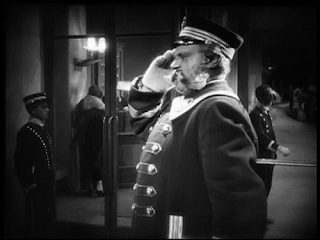
So there is nothing new or special about Renoir's and Welles's use of deep focus. Actually, in itself deep focus is not particularly special at all. It is how you use it that matters, not that you use it. Here is an image from Make Way For Tomorrow (Leo McCarey, 1937), with a lot of depth, but the depth has a different meaning than in the examples above. Here it is to emphasis her solitude, like if she was modelling for an Edward Hopper painting.

On the right in the frame there is a poster for another film from 1937, Souls at Sea, by Henry Hathaway. That is a film that has a more expressionistic visual style, and often dazzling use of depth, and perhaps an influence, among many others, for Welles and Toland when they made Citizen Kane, not least its use of cramped sets with visible inner ceilings and canted angles. Another master of deep focus was Raoul Walsh, all through his career, from 1915 and onwards. His use of it is a visual expression of his ideas, and remarkable both in its depth and in its meanings. One day, hopefully, it will seem as strange to write about deep focus without mentioning Walsh, and James Wong Howe, as it would be to write about post-war Swedish cinema without mentioning Ingmar Bergman.
Where these mistaken ideas come from is not clear, possibly with André Bazin's writings on deep focus in the late 1940s and early 1950s, for example the essay "The evolution of the language of cinema". It seems film scholars are more keen on reading books than watching films, and since most books write the same things the mistakes and errors continues. But by looking at films from the 1920s and 1930s it is easy to see how prevalent deep focus was, and in how many different ways it was being used. A film like Ford's Stagecoach (1939), that used expressive deep focus before Citizen Kane, is usually described as a rare precursor. Instead it should be seen as a good example of a rather common form of filmmaking. Often when film history gets distorted it is in order to simplify but that is not the case with the history of deep focus. It is not less simple to rightfully say "Deep focus has been a tool used by many filmmakers since the dawn of cinema." instead of wrongfully claim "Deep focus tentatively appeared in the 1930s and then became common after 1941."
Here, finally, is another marvellous Wyler shot. This is from Dodsworth (1936):

--------------------------------
Another thing to keep in mind is that what appears to be deep focus is sometimes an illusion, through matte paintings, set design or trick filming (such as splicing two different shots together through an optical printer), and not technically deep focus at all. This is the case with some of the most famous shots from Citizen Kane. Special effects has been used ever since the dawn of cinema, and that includes faking deep focus.
The eagerness to equate deep focus with Gregg Toland becomes comical in The Film Experience - An Introduction (2009). There his work on Wyler's The Heiress (1949) is mentioned (p. 102) which is peculiar because it was made after Toland's death. Leo Tover was its cinematographer.
Three earlier posts on problems with conventional film history:
http://fredrikonfilm.blogspot.se/2012/09/on-film-history-and-art-of-studying-it.html
http://fredrikonfilm.blogspot.se/2011/03/max-weber-goes-to-movies.html
http://fredrikonfilm.blogspot.se/2012/03/on-history-of-auteurs.html
At a lecture about Jean Renoir's The Rules of the Game (1939) at Stockholm University in the 1990s the lecturer was talking, among other things, about Renoir's "revolutionary" use of deep focus. The lecturer was bad, confused deep focus with deep space, and the central argument was very weak. Yet as I soon discovered this is how historians and scholars in general view deep focus, or depth of field. Here is typical quote taken from a standard textbook, David A. Cook's A History of Narrative Film (4th edition, 2004): "Renoir was the first major director of the sound film to compose his shots in depth." (p. 322)
Today almost all writing on deep focus is about Orson Welles, the cinematographer Gregg Toland and their work on Citizen Kane (1941). Here are some more quotes from textbooks that are often required readings for university students:
In the third edition of The Cinema Book (2007) it says: "Deep-focus cinematography, in which objects in several planes of depth are kept in equally sharp focus, is commonly associated with certain Hollywood films of the 1940s. Patrick Ogle dates its emergence at around 1941." (p. 149. Although the phrasing in the quote make it sound ambiguous there is no effort to question that association or Ogle.)
The above quoted Cook also writes that "the creative genius of Orson Welles and Gregg Toland, restored the cinema's physical capacity for deep focus". (p. 322)
In The Story of Film (2004, the book from which the series springs), Mark Cousins writes that in the 1940s "[t]he visual ideas of Welles and Toland started to influence John Huston and William Wyler" (p. 179).
Understanding Film Theory (2011) add this caveat to the section about deep focus in Citizen Kane: "This technique was not new and had been practised in France by Jean Renoir." (p. 47)
These quotes are just a few examples. A person who is reading a book or essay that mentions deep focus would almost certainly conclude that it was something that appeared in the 1930s in the films of Jean Renoir and then became common in the 1940s thanks to the innovations in Citizen Kane. What is puzzling is that this is transparently wrong. Despite these claims many major filmmakers such as Kenji Mizoguchi, Frank Borzage, Howard Hawks, Sadao Yamanaka, Alfred Hitchcock, Henry Hathaway, William Wyler and John Ford used deep focus all through the 1930s, and earlier. Another key player was cinematographer James Wong Howe. Contra Cousins's statement it should be said that Wyler's films in the 1940s look rather like the films he made in the 1930s, deep focus and all, but not really like Welles's films. Generally Welles is more baroque and expressionistic whereas Wyler is more calm and naturalistic. An exception perhaps is Wyler's Dead End (1937), which Toland shot, and which is rather expressionistic, both in its use of depth and lighting, more so than usual for Wyler. But that was of course several years before Citizen Kane. If anybody influenced anybody it was Wyler who influenced Welles.
Dead End

This is just after the wife has discovered that he has died.
F.W. Murnau was another master of deep focus compositions. Here is an example from The Last Laugh (1924).

So there is nothing new or special about Renoir's and Welles's use of deep focus. Actually, in itself deep focus is not particularly special at all. It is how you use it that matters, not that you use it. Here is an image from Make Way For Tomorrow (Leo McCarey, 1937), with a lot of depth, but the depth has a different meaning than in the examples above. Here it is to emphasis her solitude, like if she was modelling for an Edward Hopper painting.

Where these mistaken ideas come from is not clear, possibly with André Bazin's writings on deep focus in the late 1940s and early 1950s, for example the essay "The evolution of the language of cinema". It seems film scholars are more keen on reading books than watching films, and since most books write the same things the mistakes and errors continues. But by looking at films from the 1920s and 1930s it is easy to see how prevalent deep focus was, and in how many different ways it was being used. A film like Ford's Stagecoach (1939), that used expressive deep focus before Citizen Kane, is usually described as a rare precursor. Instead it should be seen as a good example of a rather common form of filmmaking. Often when film history gets distorted it is in order to simplify but that is not the case with the history of deep focus. It is not less simple to rightfully say "Deep focus has been a tool used by many filmmakers since the dawn of cinema." instead of wrongfully claim "Deep focus tentatively appeared in the 1930s and then became common after 1941."
Here, finally, is another marvellous Wyler shot. This is from Dodsworth (1936):

--------------------------------
Another thing to keep in mind is that what appears to be deep focus is sometimes an illusion, through matte paintings, set design or trick filming (such as splicing two different shots together through an optical printer), and not technically deep focus at all. This is the case with some of the most famous shots from Citizen Kane. Special effects has been used ever since the dawn of cinema, and that includes faking deep focus.
The eagerness to equate deep focus with Gregg Toland becomes comical in The Film Experience - An Introduction (2009). There his work on Wyler's The Heiress (1949) is mentioned (p. 102) which is peculiar because it was made after Toland's death. Leo Tover was its cinematographer.
Three earlier posts on problems with conventional film history:
http://fredrikonfilm.blogspot.se/2012/09/on-film-history-and-art-of-studying-it.html
http://fredrikonfilm.blogspot.se/2011/03/max-weber-goes-to-movies.html
http://fredrikonfilm.blogspot.se/2012/03/on-history-of-auteurs.html
Tuesday, 22 October 2013
David Attenborough
I have written before about my debt to filmmakers like Hitchcock, Ford, Truffaut, Hawks, Kurosawa, Bergman, Ekman and others for making me first a film enthusiast and then a film scholar. But David Attenborough also deserves to be mentioned among them because he has had an equally large impact upon me since at least 1984, when The Living Planet came out both as a TV-series and a book. I was actually using him even as an inspiration for the structure of my thesis. For its narrative drive to be more specific. Many filmmakers could learn a thing or two from him about structure and pacing, and so could scholars. This is not something I was conscious of back then as a precocious pre-teen, when it was the images and the fun of learning new things about animals and plants and Earth itself that were the reasons I was hooked. They contain enough thrills, sadness, humour and beauty to last a lifetime, and they are more satisfying than much of fictive narrative art. But later on, when re-watching for example Life on Earth (1979) and The Living Planet as an adult, I was struck by how carefully and skilfully they were told. The individual episodes in themselves and also how all of the episodes together form a whole, that they are not freestanding but intricately linked. The episodes tell a story that has a beginning and an end, and the sum total of each series becomes bigger than the individual episodes. So I had that in the back of my head when writing the thesis. (I should probably have mentioned him on the acknowledgement page.) Watching several series in a row is also a special experience, not least to see how the things one can do, both ethically and technically, change rapidly over the years.
Attenborough was (still is) a major player at BBC not least since he combined an academic and scientific foundation with a background as network controller and manager at BBC. He more or less created BBC Two, and among other things he brought colour, snooker and Monty Python's Flying Circus to British television. But as important as all of that was, it is in bringing the wildlife and the science of it into the homes and offices of people all over the world that is his unique importance in the history of television. Of course Attenborough was not alone in making these films and series; there were producers, directors and camera men, as well as the BBC. You need to distinguish between the series which he just narrated and the ones that were his own projects. Those are the ones that really matters, the Life series. All of those series mentioned in this post are part of that major undertaking, which has now been going on for some 35 years.
The series teach the viewers many things, such as how evolution works, the mating habits of crickets or the survival tactics of a giant bush in the desert. They also teach us how fragile the world is, how humans are threatening it through poaching, waste-dumping, deforestation and simply be becoming more and more plentiful for every year. They also remind us that we are one species among many, just another animal. We should not sentimentalize other animals, humans are not alone in our capacity for warfare and cruelty, but neither are we alone in being capable of feelings such as sorrow, affection, curiosity and joy. That is not a question of anthropomorphism, I would rather suggest that it is arrogant to assume that such feelings are uniquely human. But that is another discussion.
Attenborough is now 87 years old but he is still hard at work, and I am looking forward to his next series. Here are some clips from earlier years. The first one is from The Trials of Life (1990).
Here are some sea cows, from The Life of Mammals (2002):
And this extraordinary sequence with Attenborough and mountain gorillas from Life on Earth (1979):
These scenes emphasis the everyday life of animals, and Attenborough himself. The many wordless sequences of astonishing beauty and awe (or horror) you will have to find for yourself.
Thursday, 17 October 2013
Favourite films #2 (2013 version)
Last year Sight & Sound published their decennial list of "the best films" ever made. I published my top ten too. Since it was a pain to choose ten films I have now allowed myself to make a new list with films that might as well have ended up on last year's list. Here they are, in chronological order. I still enforce the rule that any director gets only one film. 15 films was the target this time but I failed...
Sherlock Jr. (Buster Keaton 1924, US)
Sunrise (F.W. Murnau 1927, US)
La grande illusion (Jean Renoir 1937, France)
The Shop Around the Corner (Ernst Lubitsch 1940, US)
They Were Expendable (John Ford 1945, US)
Letter From an Unknown Woman (Max Ophüls 1948, US)
The Red Shoes (Michael Powell & Emeric Pressburger 1948, UK)
Casque d'or (Jacques Becker 1952, France)
A Star is Born (George Cukor 1954, US)
Rio Bravo (Howard Hawks 1959, US)
The Apartment (Billy Wilder 1960, US)
Le doulos (Jean-Pierre Melville 1962, France)
Lawrence of Arabia (David Lean 1962, UK)
The Leopard (Luchino Visconti 1963, Italy)
Taxi Driver (Martin Scorsese 1976, US)
After Life (Hirokazu Koreeda 1998, Japan)
Here are the ten films that were on the previous list:
Holiday (George Cukor 1938, US)
The Rules of the Game (Jean Renoir 1939, France)
Laura (Otto Preminger 1944, US)
A Matter of Life and Death (Michael Powell and Emeric Pressburger 1946, UK)
My Darling Clementine (John Ford 1946, US)
The Big Sleep (Howard Hawks 1946, US)
Force of Evil (Abraham Polonsky 1948, US)
Journey to Italy (Viaggio in Italia, Roberto Rossellini 1954, Italy)
Le samouraï (Jean-Pierre Melville 1967, France)
The Day of the Jackal (Fred Zinnemann 1973, UK/France)
Subscribe to:
Posts (Atom)