Showing posts with label environment. Show all posts

Friday, 16 October 2020

What is the point of what we do?

The question that forms the title of this post is something I have often asked myself, for example when I am wasting my time listening to some pointless presentation at a conference, or reading an article that has nothing to say and spends 10 000 words on whatever it is that it has nothing to say about. But it is not just the lament of a fatigued film scholar. It is a fundamental question of everything we do, whether at home, or at work, or out exercising, or engaging in politics, or scrolling through the Twitter feed. Not as a criticism of whatever it is we do in the given situation, as a variation on "Is this not really pointless?" but as a genuine wonder. "Why am I doing this? What do I hope to achieve by doing it?" We often do things just from habit, without thinking about it, and often not even necessarily taking much pleasure out of doing it, and in such situations asking ourselves that question might be a good way of breaking those habits that, even if they are not bad, might be a waste of time; time which might instead be spent on doing something that would actually give us pleasure. But asking ourselves that question when doing something that does give us pleasure might also be worthwhile, for example by making us more aware of how much pleasure it does give us, or, if we do it with a specific goal in mind, come up with ways of reaching that goal more efficiently. There is another aspect of the question too, in certain circumstances. Is what I am doing contributing to the greater good of society, to the world at large? More specifically, given the growing climate crisis, or climate emergency, am I doing what I can to minimise my role in the unfolding disaster? I think we in general need to consider, and re-consider, all that we do.

***

The other week I was reading an article by a well-known critic, in a well-known online publication, about a well-known classic film. The article had nothing new to say about the film, which is not surprising since it has been written about thousands of times over the last 60 years. What was the point of writing this new article? And what was the point of me reading it? I felt cheated.

The other day I read another article, by another writer, for another publication, about westerns, which had the exact same problems as the article about the classic. It had nothing new to say, and, like the above article, it merely enforced the conventional wisdom, regardless of whether that conventional wisdom was accurate or not. And I think it is safe to say that this is the case for much of what is being published. It is the perpetual reinvention of the wheel.

If you have absolutely nothing to add to the conversation, is it perhaps not better to not say anything? The counterargument might be that the writers got paid for it, and that this is the point of the articles. (Content created solely for monetary gain.) But if that is the only point to them, why were they commissioned? Somebody must have thought it interesting enough to pay money for it, however difficult it is to understand why.

Two obvious reasons for why there are so many pointless, or bad, or exploitative, articles published online is that the space for them is seemingly unlimited and people need money, and I think that this is a problem. Likewise in academia where you have to publish regularly, regardless of whether you have anything to say, because if you do not publish you will not get a raise, or a promotion, or maybe not even keep your job. The goal is to publish for the sake of publishing, not because you have anything to add to the sum of human knowledge or any other similar goal. Hence, we are saturated with bad and/or unnecessary writing, which is not only a drain on our reading capacity, but also part of the degradation of public life, and, as the internet is a major source of CO2 emissions, it is also bad for the environment.

I am myself guilty of this. While I try to write about things others do not write about, and to add something new to whatever I write, even if it is on overwritten subjects like Bergman and Hitchcock, I do not always succeed (my post from 2018 about Bergman's films from the 1940s was a failure in that regard). I am also debating with myself how often I should publish something on the blog. There were two reasons why I cut back from posting every week (as I did for many years) to every second week. One was that by posing less frequently it became easier to choose subjects more carefully, and the second reason was that until server centres are powered with green energy, they are bad for the environment, and each new post adds to the CO2 emissions. Maybe I should publish something only once a month?

But why do I write the blog at all? What is the point? It is because I have an insatiable desire to write, and I have had it since my pre-teen years. Since film is my main interest, and what I work with for a living, it follows that if I also write about film, I combine my two biggest interests, i.e. writing and film history. When it comes to writing, I am like Boris Lermontov and Victoria Page in The Red Shoes (Powell & Pressburger 1948):
Lermontov: Why do you want to dance?
Page: Why do you want to live?
Lermontov: Well, I don't know exactly why... But I must.
Page: That's my answer too.

But it is a concern that the writing, the use of a computer, the streaming of films, and so on, is a strain on the environment. (On that subject, here is an article in Nature, here is one in Quartz, and here one from BBC.) Which leads to another situation when it is good to ask what the point is: while watching something on a streaming service.

Some time ago I was watching one of those reality shows on Netflix about homes, houses, interior design and whatnot, and suddenly I felt a combination of bewilderment, disgust, and frustration. There was no point in watching it. It was not strictly speaking bad; it was just nothing. There were so many things I could have done instead of watching that unnecessary series, and most of them would be better for me, and give me more pleasure. Even cleaning the kitchen would be a better use of my time. By watching that series on Netflix, I was belittling myself, and in a way showing my subordination to something that I should not give in to. Much of the output on Netflix, and many other of these streaming services, are like that. Netflix, and not least Disney, have projected a disingenuous idea of themselves as providing convenience, relatability, and progressive values, and made it seem hip, politically correct, and self-evidently obvious, that you should be home and watch yet another episode of Young Wallander or The Mandalorian.

If you take great pleasure in watching whichever series you are watching, it is not a problem. Carry on watching. But if you struggle with giving a satisfying answer to the question "What is the point of watching this?" then I would suggest you do something else. Unless physically unable to, a long walk would for example be a good thing to do instead. And even if you do enjoy the series, taking a long walk is probably still the right thing to do.

You may also ponder whether a company that thinks like this is to be trusted as an owner and gatekeeper of contemporary cinema:

“Given the incredible success of Disney+ and our plans to accelerate our direct-to-consumer business, we are strategically positioning our company to more effectively support our growth strategy and increase shareholder value,” Mr. Chapek, who succeeded Robert A. Iger as chief executive in February, said in a statement. “Managing content creation distinct from distribution will allow us to be more effective and nimble in making the content consumers want most, delivered in the way they prefer to consume it.”

***

Contemporary life is politically precarious and ugly, and we are living through a climate disaster. We are also living our lives surrounded by the superfluous, constantly bombarded by it, force-fed it by way of our phones, tablets and computers, but also at conferences, meetings, team-building exercises, and all kinds of events to have come to be a regular part of daily life. I think these three things (the politics, the climate disaster, the superfluous) are connected, and that they are mutually reinforcing each other.

Since some months, I do no longer use my mobile phone for anything other than calling, texting, and checking vital things like time tables or two-factor authentication. I have been cutting back drastically on my usage of Facebook. I have cleansed my Twitter feed. I have unsubscribed to almost every newsletter I ever signed up for (and some I have no recollection of having signed up for). I have stopped watching mindless Netflix shows. All from the perspective of the question "What is the point of this?" I do not any longer want to waste my time on the superfluous.

Whereas we may feel helpless against the onslaught of racism and fascism, and the disappearance of the rainforest, the coral reefs, the bees, the polar ice caps, we can still take some control of our own private lives, cut back on the superfluous, and use that time to instead do some good in this world. And if not in order to save the world, then at least to feel better about ourselves.

Friday, 3 April 2020

The Back of Beyond (1954)

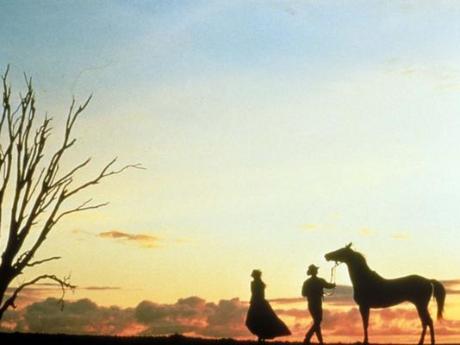
When I was a kid and played with Lego, I once built a truck that I intended to be for off-track driving in jungles or deserts and such. I was so proud of it that I put it on display and rarely played with it. It was black, with some spots of red and yellow. I do not know what the colour was of the truck (a Leyland Badger) that features in The Back of Beyond (John Heyer 1954), but it looked similar to my truck. I watched the film this week and it reminded me yet again of my very early fascination with Australia.

The Back of Beyond was conceived, co-written and directed by John Heyer, one of the foremost documentary filmmakers in Australia and an active film enthusiast. He was working for Ealing Studios in Australia, and participated on the making of The Overlanders (Harry Watt 1946), Ealing's most famous Australian film. (It is quite good.) In 1945 he become a producer at the Australian National Film Board, for which he produced a number of documentaries. But when he made The Back of Beyond he was working for Shell Film Unit, Australia. The Shell Film Unit had been established by Shell Oil in England in the early 1930s in order to make documentaries, not commercials, and among their consultants was John Grierson. Their first film, Airport, was made in England in 1934 and they soon became a prestigious production company, comparable to the GPO Film Unit. Now they wanted to make a film that captured the essence of Australia, and as John Heyer had the same ambition, it was a natural fit. He wrote it with his wife, Janet Heyer, Roland Robinson, and the esteemed poet Douglas Stewart. The result is spectacular.


The Back of Beyond is about the Birdsville track, which runs between Birdsville, Queensland and Marree, South Australia and is about 520 kilometres (or 320 miles) long, and the film follows a man named Tom Kruse (pronounced like Tom Cruise) who drives a truck back and forth between the two towns to deliver the mail and supplies from one place to the other, and the places in between. Calling them towns is an overstatement perhaps, rural communities might be more accurate, although Birdsville has a police station (“Where the policeman can close the door of his station at sunset and write in his diary: January 22, Thomas Crow appears out of his mind. Sub-inspector King shot himself on the police station verandah. Another hot day.”) and a hotel, to which Tom Kruse is seen walking in the last shot. He has well-earned a good rest, and maybe even a hot bath.

The film begins on Marree, and the dry, barren landscape upon which it is located. An older man, originally from Afghanistan, goes out in the desert to pray and the whole prayer is translated by the narrator, Kevin Brennan, into English. The prayer sets the tone of the film; this is a tale of hardship and suffering, but also of resilience and triumph. The idea of using a Muslim man and his prayer as the lead into the film is powerful, not least for how unusual it is, now and then. The man is treated as a genuine part of Australia, and as a worthy teller of Australian tales. This is not White Australia, but Australia as a mixture of all parts of the world.

Then Tom Kruse gathers the mail and packages and drives off. During the days and nights on the road he will encounter dead cows hanging from trees to dry; an old missionary station long abandoned and in ruins; a distress call from a lone woman who has suddenly become very ill and needs a flying doctor; an old white man who lives by himself in the desert and kills dingoes for a living. He sells their dead bodies and is looking forward to his own death.

The missionary station was founded by a man from Germany, a Lutheran priest, and he lived on his mission until he died, with a large group of Aboriginals. This tale is told but an Aboriginal, who walks among the ruins and up to the priest's grave.

There are several such interludes which deviate from the tale of Tom Kruse and his truck. Another tale is about two little girls who wandered off into the desert. They lived on a farm with their parents but one day, when the dad was away, the mother suddenly died. The two little girls did not know what to do so they walked out in the desert, presumably to look for help. They disappeared and were never found again.


All of these stories, and the landscape, are filmed in powerful, sometimes breathtaking, images. Striking compositions of cars, trees, houses, bones of dead animals, and a persistent emphasis on the cruel indifference of the land itself. The cinematographer was Ross Wood.

The Back of Beyond was a major undertaking. It took several years to do, and it combines scripted re-enactments and more documentary-like observations. It is perhaps an essay film, and it is definitely a work of art; 65 minutes of unforgettable moments and images. "Corrugated iron towns, shimmering in the corrugated air." is the film's narrator puts it.


------------------------------------
I have mentioned Shell Film Unit before on the blog because in 1991 they made Climate of Concern, about global warming and climate change. It is a film that they now pride themselves for having made but back in 1991 the mother company shelved it because the message of the film was both bleak and clear-headed: our persistent use of oil will be our doom. Not what an oil company wants to tell the world, even if it was their own film unit who was the messenger.

The Australian National Film Board has changed names repeatedly. In 1956 it was named Australian Commonwealth Film Unit. In 1973 it became Film Australia. I think it is now taken over by Screen Australia.

Link to a lengthy discussion about The Back of Beyond from 1986 with Tom O'Regan, Brian Shoesmith, Albert Moran, and Ross Gibson. Among the references they make are Patrick White and Luis Buñuel: http://wwwmcc.murdoch.edu.au/ReadingRoom/1.1/Gibson.html

Friday, 17 January 2020

Australia

Two significant things happened to me in the mid-1980s. One was my discovery of cinema, or film history, and the other was my discovery of Australia. They both became passions of a certain kind, both of which have stayed with me and never weakened their appeal. As you know, film is what I devoted my life to, professionally and privately, but Australia is never far from my mind.

There were two sources for this interest with Australia, two TV experiences. One was an interview on Swedish television with a Swedish family from Hässelby (a suburb to Stockholm) which had sold everything they had and moved to Coober Pedy in South Australia to begin a new life, looking for opals. Watching that as an impressionable boy of maybe ten, I felt strongly that this must be what I too will do when I grow up. (I did not; I have not even visited Coober Pedy on either of my visits to Australia. But it is a peculiar place.)

The other experience was an Australian TV-series called Five Mile Creek (1983-1985) that was set during the gold rush in Victoria in the 1860s, and this series, of which I watched all episodes, made a strong impression on me. While other Swedes watched (re-runs of) the American Western series like Bonanza (1959-1973) or The Little House on the Prairie (1974-1983) or How the West Was Won aka The Macahans (1976-1979), Five Mile Creek was how I got my idea of frontier lives and stagecoach rides. I still have vivid memories of it, although do not remember that Nicole Kidman acted in it.

There was another Australian TV-series at the time, also set in the past, All the Rivers Run (1983) but I was not old enough to watch that, or maybe I was old enough but somehow just did not do so. Either way, I was aware of it, and had caught glimpses of it. Those glimpses were enough to make a big impression too, and making me eager to one day watch the whole thing. It is slightly bizarre that it took me until Christmas of 2019 before I did so. It was exactly as I had expected it to be, during those 35 years of imagining it. I had put a small part of my childhood on hold for decades and now I finally completed it.

On both Five Mile Creek and All the River Runs, George Miller was setting director, and I even think they begin with the same opening shot of a ship in a storm outside the coast. It is however not the same George Miller that made the Mad Max films. This Miller mainly did TV-series but also one famous film: the mountain horseback riding classic The Man from Snowy River (1982), based on a poem by "Banjo" Paterson.

The Man from Snowy River

It is rare that Australian films travel abroad, and when they do it is often some kind of international production like Mad Max: Fury Road (George Miller 2015) or The Water Diviner (Russell Crowe 2014) or something by Baz Luhrmann. And Australia's home-grown cinema has usually struggled and has often been underwhelming. But there are plenty of good things there, much of which is unnecessarily unknown.

Before the early 1970s, when what is often called the Australian New Wave got started (I am not convinced it is a relevant term), most of the landmarks of Australian cinema were made by visiting European directors. Harry Watt made the cattle epic The Overlanders (1946); Michael Powell made two fine films, They're a Weird Mob (1966, with Emeric Pressburger) and Age of Consent (1969); Fred Zinnemann made the wonderful The Sundowners (1960) and later Nicolas Roeg made a great one, Walkabout (1971). Even Lasse Hallström flew down to make ABBA: The Movie (1977), which is quite lovely, although I would not call that an Australian film.

There had been homegrown talents such as Charles Chauvel, who, for example, made In the Wake of the Bounty (1933) where Errol Flynn played Fletcher Christian, Forty Thousand Horsemen (1940) and Jedda (1955), which was the first Australian feature film that was in colour, and the first Australian film to be in competition for a Palme d'Or in Cannes, and it also had Aboriginal characters, played by Aboriginals, in the leads. This too was new. Two other Australian filmmakers were Raymond Langford, in the silent era, and later Ken G. Hall. Hall made around 18 films in the 1930s and 1940s and was the first Australian filmmaker to win an Academy Award. That was for the documentary Kokoda Front Line! (1942), about a key battle between Australians and Japanese soldiers in New Guinea. Hall was producer and director and the camerawork was by newsreel photographer Damien Parer. It is a film to make sure the Australians at home, far from the front, do not forget the important fighting the Australian soldiers do in the mud and rain of the jungles. It is short on artistic merit but as a propaganda film in the midst of war I can imagine it being effective.

But these films, and many others, are almost without exception unknown or unseen outside Australia, even though many of them, especially Hall's films, were great successes at home. It remained the case that it was the foreigners who made the few Australian films that travelled abroad. It was a combination of political and creative changes in the late 1960s and early 1970s that changed things dramatically. Partly because the Labor government under Gough Whitlam (1972-1975) was particularly keen on supporting cinema, but the previous government had done so too. These changes (financial support, schools, institutions, infrastructure) led to a number of homegrown filmmakers suddenly appearing and they would make Australian cinema something to be reckoned with, regularly and globally. If we discount Wake in Fright (Ted Kotcheff 1971) and Walkabout, for being international productions made my foreign directors, in the same year (1971) there was the low budget film Stork, directed by local Tim Burstall and written by local David Williamson. The latter was a significant creative force in the renaissance, having written for example Don's Party (Bruce Beresford 1976), Gallipoli (Peter Weir 1981) and the superb The Year of Living Dangerously (Peter Weir 1983). Bruce Beresford's first film The Adventures of Barry McKenzie (1972) was another key film, and, like Burstall's early film(s), a crude and vulgar affair, what is known in Australia as "ocker" comedies. Another eccentricity is Weir's The Cars That Ate Paris (1974), a truly bonkers film. He followed it with the magnificent Picnic at Hanging Rock (1975).

But there were too many good and/or fascinating films made then to name them all here. That was part of the change. While very few Australian fiction feature films were made in the 1950s and 1960s (some years only one, other years none), the 1970s saw a dramatic increase where some 30 to 40 films could be made in one year alone.

I want to write more about Australian cinema, and I want to watch more of it too, including such TV-series as Whiplash (1960-1961) and Homicide (1964-1977). This is one of the things I will focus on in 2020, and possibly beyond. For now though I want to focus on something else…

***

There is one episode of All the Rivers Run where the heroine Philadelphia Gordon, affectionately played by Sigrid Thornton, and her partners on the paddle steamer Philadelphia are caught on a sandbank because a dry spell has depleted the river and made it too shallow for boats and ships. For months they are stranded in a dry, barren landscape, making brief visits to the house of two settlers, man and wife, who has seen their crops, animals, and two children die of starvation and dehydration. The episode has an almost post-apocalyptic feeling, with the empty eyes if the grieving wife taking on a depth and horror that the rest of the episodes do not come close to reaching.

Seeing that episode now, while following the raging bushfires that are destroying large parts of New South Wales and Victoria, gave it an extra level of resonance. The news are full of not post-apocalyptic but present-apocalyptic images, of forests, towns and farms turned into ashes.

The rivers on which All the Rivers Run take place, Campaspe and Murray, are even more depleted and un-useable today, thanks to us humans. We build dams, we water golf courses and we pollute the environment with coal and other greenhouse gases, and thereby destroy the earth. Global warming is our slow-moving apocalypse, that it may or may not be possible to stop or reverse. Doing so will take a lot more from us than it seems we are currently capable of, but if we do not want to end up like the wife and her dead children, we have to wise up. Australia might be the country on fire right now, but it will get worse and it will get more common and it will happen in many other countries.

back when all the rivers did run

Friday, 29 September 2017

Arne Sucksdorff

When André Bazin compared Arne Sucksdorff with Luchino Visconti's film La Terra Trema (1948) it was something of an exaggeration (and perhaps Roberto Rossellini would have been a more apt comparison). But it should be said that Sucksdorff was one of Sweden's great filmmakers, and also a filmmaker of some influence on Brazilian cinema and Cinema Novo. Born in 1917, he first made a series of lyrical and suggestive short films shot across Scandinavia during the 1940s and then he expanded, both length-wise and location-wise; making two short films in India and three long features (in Sweden, India and Brazil) that combined narrative storytelling and documentary. He also made one allegorical fiction film in 1961, Pojken i trädet / The Boy in the Tree, shot in Sweden. It is Sucksdorff's combination of beauty and symbolism that makes him one of the great visual poets in film history. In his documentaries he was not content with just recording the natural world, instead he used and shaped it according to his ideas or needs. Much depends on trick photography and props, and his films are often so scripted and directed that it is debatable whether they are documentaries or fiction. But this should not be taken as criticism. Sucksdorff was an artist who, as he put it, was looking for the balance between poetic truth and documentary truth. (Although that is probably true for most documentaries.) As time went by his narrative imagery became self-sufficient to the extent that in some films not a single word is spoken. Some of his short films are shot as if they were horror movies, but more typical are his images of hazy sunlight through blades of grass, mist over water and raindrops on asphalt.


The 14 short films he made in Scandinavia between 1940 and 1950 can be divided into four groups. Films made on commission for organisations or government agencies (in all five films and also his first Indian film), films made about minorities in Sweden (three films), impressionistic, light films about wildlife (four films), and expressionistic, dark films about wildlife (two films). By far the best one in the first category is Människor i stad / Rhythm of a City (1947 aka Symphony of a City), a city symphony about Stockholm that won an Academy Award for best short film in 1949, the first time a Swedish film won an Oscar. The three shorts about minorities, two about the Sami people and a rather questionable one (for its latent exoticism) about Roma people, are not among his best work. From the third category two stand out: En sommarsaga (A Summer's Tale) from 1941, about a fox, which can be seen as a precursor to his first feature-length film Det stora äventyret / The Great Adventure (1953), and Gryning (Dawn) from 1944, his first with no dialogue or voice-over, about a hunter who is unable to pull the trigger and lets the deer live. Skuggor över snön (Shadows over the snow) from 1944 is something of a hybrid, part dark tale of death and part light tale of surviving. The two dark, expressionistic shorts are Trut! / Gull! (1944), a tale of some peaceful birds terrorised by a bigger bird which some have interpreted as an allegory about the Nazis, and En kluven värld / A Divided World (1948). The last one is one of Sucksdorff's best, more a film noir, a nightmare by Fritz Lang, than a documentary. It is almost entirely staged and shot with models and fake sets, about a white stoat, a fox and an owl in a cruel tale of survival. Some of the shots are incredible in their use of depth, shadows and mist. It is close to a masterpiece.


Then Sucksdorff when to India for two films. The 25-minute-long Indisk by / Indian Village (1951), which is the commissioned one, a conventional documentary about a small village and the digging of a well, and Vinden och floden / The Wind and the River (1953). It is a ten-minute-long impressionistic, wordless, depiction of Kashmir, shot with long takes with a moving camera, creating the impression of it floating down the river and quietly observing what goes on along its banks. Some, including Sucksdorff himself, thinks this is his best short. At least it shares that honour with Rhythm of a City and A Divided World.

These films show Sucksdorff skills as an editor and cinematographer (he usually wrote, shot and edited his own films) and they also show his primary interest in the natural world and animals, with a pantheistic view of that nature. Even if he shows the brutality it can hold, it is still a beautiful and awe-inspiring space. The use of editing, not least the recurring shot/countershots of birds (preferably owls) watching over the world and all its animals (including humans) as if they were judging the behaviour of those they observe, is often extraordinary. All of these aspects continue in the 85-minutes-long films that would now follow. He had made most of his short films with funding from Svensk Filmindustri (SF), but now SF's boss Carl Anders Dymling for some reason was not interested anymore so Sucksdorff turned to Sandrews instead, and they helped fund his first two features The Great Adventure and En djungelsaga / The Flute and the Arrow (1957). The first was shot in Sweden and the second in India, but they are somewhat similar. The great adventure the title refers to is life itself, and it shows a year in the life of a fox, an otter and two young brothers. Initially there is a whole fox family but all but one are killed (there is a POV-shot of the last 30 seconds or so of a dying fox), and there are two otters to begin with but one is also killed. The brothers thus come face to face with both the cruelty of life, and the cruelty of humans. One strong scene is with the baby fox screaming beside its dead mother, killed by a human, and trying to wake her up before he gives up. In another sequence Sucksdorff cuts back and forth between humans in a church during Sunday mass and the two otters playing in a river in which a human has laid a trap, which kills one of the otters. (It is not shown, only alluded to.) Since the audience knows the trap is there the sequence is rather suspenseful, like some eco-thriller. While the humans are singing a hymn the animals are in mortal danger because of those very humans. Erik Barnouw has suggested that Sucksdorff makes a distinction between the killings by humans and the killings by other animals: "Both men and animals kill, but animals do so for survival. Only men kill for other reasons and camouflage their reasons, always regarding themselves as instruments of morality and justice." But it is not a simple dichotomy between good animals and bad humans. The one surviving otter becomes best friend with the two brothers, and they spend half of the film together. The surviving fox also comes and play with the otter. And there is also another dark force in the landscape, beside the human hunters. A lynx. The lynx is like an evil spirit, a disturbance in the force, and a threat to everyone else. But in the end it walks away, leaving the area, and harmony is restored.

The Flute and the Arrow is also focused on children, and their interactions with animals, and around the Indian village there too is a dark force, but here it is not a lynx but a leopard. They have a similar function in the two films, but the leopard plays a larger role than the lynx, and is deadlier. The Flute and the Arrow, which took three years to make, is set (and shot) in the region Bastar in central India and is about life in a Muria village. Their lives and rituals, and the coming of age of the boy in the picture below, Chendru. It was Sucksdorff's only film in colour and it is shot in AgaScope, a Swedish version of CinemaScope. It looks spectacular, and has a fine score by Ravi Shankar. It has a stronger, more focused narrative than The Great Adventure and is more about the humans than the animals. It also pushes the boundaries for how far a documentary might go towards pre-planned staging until it stops being a documentary. Whereas the first half is more traditionally like an anthropological documentary it then takes a turn towards fiction, albeit inspired by real events.


The Great Adventure had been a major success, both financially and with the critics, but The Flute and the Arrow was only a hit with the critics. It was also very expensive. Sucksdorff's next film would be his only work of pure fiction, The Boy in the Tree, which is about a teenage boy who prefers the animal world to the human world but gets mixed up with some juvenile delinquents during a few days one summer. It does not stray very far from Sucksdorff's other films, besides the fact that it has regular actors and stars and a jazz score especially written for the film by Quincy Jones. But the film did not do particular well and Sucksdorff would never again make a film in Sweden. Instead he moved to Sardinia, and then to Brazil, where he remained for some 20 years. In Brazil he taught at a film school connected with Rio de Janeiro's Museum of Modern Art, and this is where his connection with Cinema Novo appears because some filmmakers associated with that group had Sucksdorff as their teacher. Among them was Antonio Carlos da Fontoura, Joaquim Pedro de Andrade and Eduardo Escorel. The latter became a distinguished editor during the 1960s and in the 1970s began directing as well. (Nelson Pereira dos Santos's film Vidas Secas (1963) was edited on Sucksdorff's equipment.) Sucksdorff also made a documentary in Rio de Janeiro, his fourth feature-length film Mitt hem är Copacabana / My Home Is Copacabana (1965). It is a very moving, and uncomfortable, film about orphans living on the streets. The focus is on two of them, Jorginho and Rico, and their efforts to find food, earn some money and just stay alive. The most horrid sequence in the film is when Rico has a bad toothache. First he welcomes the ache. "It makes me forget how hungry I am." he says. But then the pain becomes so unbearable that a friend pulls out the tooth with pliers borrowed from a construction worker, while Rico screams and screams. The film, which might be Sucksdorff's best, did cause some upset since it did not portray Brazil or Rio in a flattering light. But it did get made and was shown around the world. It won several awards, although it got a mixed reception at the Cannes film festival.

Sucksdorff had won in Cannes before though. Skuggor över snön won for best documentary short in 1946, as did Rhythm of a City in 1947. An Indian Village won the Prix special de jury in 1952 and The Great Adventure won Cannes's International prize in 1954, as well as an honorary diploma. It also won the Silver Award in Berlin. He has also won several awards at the Venice film festival and other places. For a period of some 20 years he was one of the most celebrated of documentary filmmakers, comparable to Robert Flaherty. But still, after My Home is Copacabana he never made a film again. His style and some themes instead lived on in the films of Jan Troell and Stefan Jarl.

Sucksdorff instead got involved in local environmental issues, especially the struggle to save the Amazon rain forests, and he made a four-part television series for Swedish television which aired in 1972. (It seems most Swedes watched it.) For his environmental activism he was awarded a medal by the Brazilian government after the fall of the military dictatorship in the mid-1980s. During the previous years Sucksdorff had not only fought for the protection of the Brazilian wildlife, he also lived in it for several years, in the wetland Pantanal in Mato Grosso. That is also where he made the TV-series, På jordens baksida (On the far side of the world). It is not particularly good or educational, but it does have a certain appeal. The first two parts are mainly about him and his third wife, the Brazilian Maria Graça de Jesus, and their day-to-day life in the wild. The appeal of the episodes comes from the joy that stems from the fact that Sucksdorff has so clearly found his own paradise, living and working among the animals, and interacting with them as if they were all one big, happy family. To see him and his wife swim around with an otter (apparently a favourite animal for the Sucksdorff family) or a tapir, or feeding a baby jaguar whose mother was killed by a hunter, is immensely moving and satisfying, as it is a depiction of a man who has found his dream fulfilled.


-----------------------------------------
It was in his review of La Terra Trema that Bazin mentioned Sucksdorff. It had "a profoundly original style of image, unequaled anywhere (as far as I know) but in the short films which are being made in Sweden by Arne Sucksdorff." The review is reprinted both in What is Cinema 2 and André Bazin and Italian Neorealism.

The quote from Barnouw is from the 1993 edition of his book Documentary: A History of the Non-Fiction Film, page 189. Barnouw thinks The Great Adventure is a masterpiece, and is in general appreciative of Sucksdorff's films.

Sucksdorff was also involved in one additional film, a British from 1971 called Mr. Forbush and the Penguins (aka Cry of the Penguins). It seems Sucksdorff was only responsible for the penguins. Alfred Viola and Roy Boulting took care of Mr Forbush. John Hurt played him and Hurt claimed the penguins were "a real pain in the arse."

While Sucksdorff spent decades in Brazil, he did return to Sweden late in life and he died in Stockholm in 2001. But the longest Wikipedia entrance for him is the one in Portuguese.

Contemporaneous with Sucksdorff was another Swedish filmmaker with a particular interest in Brazil: Torgny Anderberg. He might appear in a later post.

Friday, 26 May 2017

Cinema and the environment

Made right after the end of the second world war, My Darling Clementine (John Ford 1946) is, among other things, about building a community and look fresh towards the future after a necessary exorcism of demons, internal as well as external. Part of that optimistic, forward-looking process is the building of a new church in Tombstone, and how the inauguration of that church, not even half-finished yet, is linked with the emotional development of Wyatt Earp, dancing with his lady fair, as the old-timer says. I have always been struck by how that scene corresponds to a scene in a film made 26 years later: Deliverance (John Boorman 1972). The scene is towards the end of that film where a graveyard is being evacuated because the whole area is being flooded after the building of a dam. These two films, put together, captures, by a huge ellipsis, the optimism and idealism of an early outpost, bringing civilisation to the wilderness (regardless of how loaded terms civilisation and wilderness are) and the appalling side effects of that optimism and idealism, leading to ecological destruction and desecration. The myth of the frontier comes to an end, and the American dream drowns in its own success.


Putting those two films together might not seem to be obvious but there are so many different ways in which to look at film, or study film history, and one such way is from an ecological, or environmental, perspective. My recent post about Wild River (Elia Kazan 1960) did not dwell that much about those aspects of it, but they are a central part of the film and it could easily have been discussed entirely from such an ecological angle. More films than one might think are actually in one way or another about ecological themes, explicitly or implicitly, and across genres. A science fiction film like Them! (Gordon Douglas 1954), one of those 1950s films that are routinely claimed to be about the fear of Communism, is actually about self-inflicted environmental disaster, a harbinger of things to come. Legal dramas such as A Civil Action (Steven Zaillian 1998) and Erin Brockovich (Steven Soderbergh 2000) are about that. Antonioni's Red Desert (1964) too. One central theme in Pale Rider (Clint Eastwood 1985) is how large-scale mining destroys the environment and the livelihood of ordinary people. Still Life (Jia Zhangke 2006) is about the devastating consequences of the building of the Three Gorges Dam.


Films on these topics became more common in the late 1960s, in line with the growth of modern day environmental concerns and organisations. (I say modern movements because environmental concerns are much older, and became widespread at least in the late 19th century, which is also when the first modern environmental laws were enacted.) Rachel Carson's book Silent Spring came out in 1962 and was a key development in the current movement, and it also brought new awareness to earlier books on the subject such as Sand County Almanac by Aldo Leopold, published in 1949. WWF was started, in Switzerland, in 1961, Greenpeace in 1971, in Canada. In the US Richard Nixon created EPA, the Environmental Protection Agency, in 1970. (The very same organisation the Trump administration, such as it is, wants to close down or at least de-fund.) In the early 1970s there were a series of science fiction films with an environmental horror story as their basis, like Silent Running (Douglas Trumbull 1972) and Soylent Green (Richard Fleischer 1973). The latter is interesting because it is an early example of a film that deals with the consequences of climate change and the greenhouse effect.

It is easy to get the feeling that climate change awareness is relatively new, for some beginning with the Al Gore documentary An Inconvenient Truth (Davis Guggenheim 2006). But that awareness, while not necessarily public knowledge, was established much earlier than that. Consider for example the report that climate scientists gave to president Lyndon Johnson in 1965, called "Restoring the Quality of our Environment," which Johnson made public due to the gravity of its content and conclusions, which are not that different from what the consensus is among climate scientists today. (Read the part about global warming here.) In the late 1990 scientists also presented the United Nations with a report, which later led to none other than Shell Oil to make a documentary, Climate of Concern (1991), to warn about climate change. It was never released because the conclusions of it were obviously not in alignment with Shell's business interests. (Watch it here.)

But fiction films about climate change are considerably rarer than films about environmental issues in general, and they are inevitably science fiction films. Waterworld (Kevin Reynolds 1995) A.I. (Steven Spielberg 2001), Snowpiercer (Bong Joon-ho 2013), Interstellar (Christopher Nolan 2014) and at least three by Roland Emmerich, the doomsday auteur. But there is no need for a film about climate change to be set in the future. Climate change is happening now, and it is happening faster and faster.

There is now a growing interest in academia about films and the environment, especially in relation to climate change. The other week I listened to a talk about that, focused on mountains, called "Filming the mountain: the moving image and deep time in the Anthropocene" by Anna Sofia Rossholm from Linneaeus University. She discussed various ways of looking at mountains, both now and in the past, but also about different contemporary approaches to theorising about film and climate change, and how films can capture climate change and also how the act of making films also contributes to climate change. (Although you can offset it by for example going carbon neutral.) Within film studies and other disciplines there is a field called ecocinema (and variations thereof), which focuses on these topics. Some issues that are discussed are: how does films and filmmakers address climate change; how might films depict our effect on and relationship with our environment; which ways are the most effective to influence people and increase awareness. Alas, for many it seems to be just another excuse to regurgitate the usual suspects such as Heidegger, Foucault and Deleuze.

As a film historian I am not particularly knowledgeable about current green cinema, especially not when it comes to documentaries, but I imagine fiction mostly focus on how it affects us humans while documentaries also look at how it affects nature and the earth itself. But an eco-perspective is interesting when looking at film history too, as one important way among many others of looking at films from the recent and distant past.


--------------------------------
At her talk, Rossholm mentioned the annoying habit of academics of constantly inventing new terms and then arguing about them rather than the actual reality of films (or the environment in this case). I am personally also not really on board with the term Anthropocene, as I feel it is too soon to baptise our present era. That should be for future scientists. But it is still better than other, more ideologically tendentious terms.

Here is a link to a recent article by Rossholm related to her talk (in Swedish only). Two edited collections on the subject: Ecocinema - Theory and Practice, edited by Stephen Rust, Salma Monani and Sean Cubitt (2012) and Framing the World: Explorations in Ecocriticism and Film, edited by Paula Willoquet-Maricondi (2010).

It is not just at universities that film and the environment are highlighted of course, there are many film festivals around the world with such a focus. Some are linked through the Green Film Network.