Showing posts with label books. Show all posts

Friday, 29 May 2020

Andrew Sarris and The American Cinema

Yet, anyone who loves the cinema must be moved by Daughter of Dr. Jekyll, a film with a scenario so atrocious that it takes forty minutes to establish that the daughter of Dr. Jekyll is indeed the daughter of Dr. Jekyll. (p. 143)
Andrew Sarris's book The American Cinema: Directors and Directions 1929-1968 is among the most influential and popular books within cinema studies and among cinephiles the world over. It is often said to be the birth place of the "auteur theory" (allegedly taking the critical writings in France, especially in Cahiers du Cinéma, and condensing their ideas into a theory), and it has been a central part in many people's cinematic lives; being used as a guide book to American cinema and what to look for in that rich cinematic history. It is also a book that has been criticised or ridiculed by film scholars who find the idea of authors and auteurs misguided, or romantic, or ideologically suspicious. Feminists have also criticised it for its lack of women filmmakers.

But like many books and articles of such influence, it has also taken on a life of its own, an almost mythical position, and, like Laura Mulvey once said about her own article "Visual Pleasure and Narrative Cinema": "it has acquired a balloon-like, free-floating quality." Both its friends and foes often seem to not necessarily pay that much attention to what Sarris is actually saying. They are talking about their ideas of the book, rather than the actual book. I have written before about how off-putting it can be when people base their judgement about films and directors entirely upon what Sarris has said about them, or what they think Sarris has said about them. He is one of those people whose followers do not always do him justice.

But while it is wrong to dismiss The American Cinema as some kind of romantic love song to towering geniuses (Sarris is appropriately aware of the constraints of filmmaking and its collaboratory nature), the book has its flaws and weaknesses. It is also a book of infectious enthusiasm and passion, and there are many wonderful sentences and insightful observations in each part of the book.

***

Films are not made by single individuals alone, they are made by a group of collaborators. But these collaborators do not all have the same impact on the film, and most are only concerned with a specific aspect of the film. It is usually only the director, whether or not she has a screenwriting credit, who has all aspect of the film as her responsibility. This is not a theory but a known, empirical fact about how films are made, and those who have written about films, at least from the 1910s, have as a rule taken this position. The great British critic Dilys Powell mused about the national, industrial and cooperative aspects of cinema in an article in 1946, and then asked the rhetorical question: “How can one man leave the mark of his personality and his talent on this hugger-mugger?” which she answered with “But he does.” This is the same question and answer Sarris gives, and he is also trying to provide an explanation as to how.

Raoul Walsh and Ernst Lubitsch

His definition of what he means by "auteur theory" is this: "The auteur critic is obsessed with the wholeness of art and the artist. He looks at a film as a whole, a director as a whole. The parts, however entertaining individually, most cohere meaningfully. This meaningful coherence is more likely when the director dominates the proceedings with skill and purpose." (p. 30) He then discusses various constraints, including studios and producers, and says "The strong director imposes his own personality on a film; a weak director allows the personalities of others to run rampant. But a movie is a movie, and if by chance Robert Z. Leonard should reign over a respectable production like Pride and Prejudice [1940], its merits are found elsewhere than in the director's personality, let us say in Jane Austen, Aldous Huxley, Laurence Olivier, Greer Garson, and a certain tradition of gentility at Metro-Goldwyn-Mayer." (p. 31)

I think it is unfortunate that he used the expression "auteur theory" in the book because there is no such thing, at least not as it is commonly understood. The idea that a director usually is the creative force behind a film is not a theory, any more than it would be a theory to say that Frida Kahlo or Hilma af Klint are the creative individuals behind their respective paintings, or that Anne Tyler is the author of Breathing Lessons. As there is no "painter theory" or "author theory," there is no "auteur theory." He does correct himself at one point by saying "the auteur theory is not so much a theory as an attitude" (p. 30) and on another page he says that it is "merely a system of tentative priorities" (p. 34) yet he continues to say "auteur theory."

Sometimes those who criticise him, or "auteur theory," will mention an important scriptwriter or cinematographer or editor and use their names as an argument for why Sarris is wrong. But he is not denying their presence or importance. Those who criticise him for romantic ideas about artistic geniuses should pause to consider that of all the directors he writes about in the book, few of them are said to be great, and even fewer geniuses. "Not all directors are auteurs. Indeed, most directors are virtually anonymous. Nor are all auteurs necessarily directors." (p. 37) He uses The Americanization of Emily (1964) as an example of a film in which the writer, Paddy Chayefsky, is more important than the director Arthur Hiller. Some of those who criticise Sarris claim that he ignores the production circumstances of filmmaking but he does not do that either, it is rather the opposite. It is precisely the modes of production, that others claim invalidate his arguments, that are the basis of his argument. He writes "The auteur theory derives its rationale from the fact that the cinema could not be a completely personal art under even the best of conditions. The purity of personal expression is a myth of the textbooks." (p. 32) and a little later: "To look at a film as the expression of a director's vision is not to credit the director with total creativity. All directors, and not just in Hollywood, are imprisoned by the conditions of their craft and their culture." (p. 36) Neither does he ignore filmmakers' weaknesses or how consistencies can be liabilities: "All that is meaningful is not necessarily successful. John Ford's sentimentality in The Informer [1935] is consistent with the personality he expresses throughout his career, but the film suffers from the sentimentality just the same." p. 35 He also mentions Hitchcock's Marnie (1964) and Hawks's Red Line 7000 (1965) as two other films that are clearly personal and consistent yet have, to him, obvious weaknesses.

Marnie

Almost all of what he has to say about auteurs and directors are widely accepted ideas and beliefs, and many of those who have criticise him probably feel the same way, unless they are of the belief that human agency and personal vision could never possibly appear in filmmaking. What he wants to do with the book is not to idealise directors or ignore the production circumstances. His main concern is to bring forward the riches of Hollywood cinema and say "Look, here are films and filmmakers as great as any from Europe or the rest of the world!" and the book is a polemic against a certain kind of criticism that sees American cinema as only mainstream trash, with a few serious-minded films. He makes an important distinction: everybody is a potential auteur, or is potentially great, and it is only after you have researched, investigated and analysed their work that you will be able to tell. "Welles is not superior to Zinnemann 'of course,' but only after an intensive analysis of all their respective films." (p. 32) That he himself is at times unable to live up to this ideal of "intensive analysis" is another matter.

He also criticises those who look at films only from the perspective of plot and story, and disregard the visual element. As a director will be explicitly concerned with the look of the film, its visual elements, even when somebody else wrote the script, it is only natural that directors are especially important to Sarris. There is nothing romantic or ideologically suspect about that, and there is nothing there that is revolutionary or remarkable, and no particular reason for anybody to get upset or provoked by it. Yet upset and provoked people were, and the kind of critics and scholars he was criticising are still prevalent today.

***

That was the first part of the book, the historical and theoretical groundwork. The next part, the largest part, are the brief entries about individual filmmakers. There is great writing in this section of the book, but here I will focus on what I think are its flaws, and the key weakness of the book: Sarris's judgements, ranking and his system of 11 different categories. The weakness is that they are often difficult to understand, and at times contradictory.

These are the categories:

Pantheon directors
The far side of paradise
Expressive esoterica
Fringe benefits
Less than meets the eye
Lightly likable
Strained seriousness
Oddities, one-shots, and newcomers
Subjects for further research
Make way for the clowns!
Miscellany

The first thing to note is that Fringe benefits consists of directors who are not Americans and have not made films in the United States, except one, René Clair. So why are they in this book? I have never understood it. If he felt compelled to add some European filmmakers he should at least have explained why, and why these 11 randomly chosen ones. It is a mystery. It is also a mystery why Clair is in this section. Jean Renoir and Max Ophüls has not made more American films than Clair, but both are included in Pantheon directors and not Fringe benefits. This seems arbitrary. Not that Clair should also be included in the pantheon, but if they can be included among American directors then Clair should be able to as well, in a suitable category; maybe Lightly likable.

The problem with the other categories, except Make way for the clowns!, is that it is rarely clear or obvious why a particular filmmaker is in one category and not in another. At times it feels like there has been an editorial oversight; as if Sarris had put the director in a different category but somebody got the categories and entries mixed up. Judging by what Sarris writes about Victor Fleming, why is he in Miscellany and not Lightly likable? Why are Jack Garfein and Leslie Stevens in Miscellany and not Oddities, one-shots, and newcomers? Some in the category Subjects for further research, like Rex Ingram, Sarris seems to not know much about and therefore they belong there, but he has as much to say about Henry King as he has about many others in other categories, so why is King there and not in Lightly likable or Miscellany? Although the category of Miscellany feels especially muddled, as most of the directors within it might as well have been included in other categories. In Pantheon directors, there is nothing in his entries about Flaherty, Lang and Renoir that explains why they are in that category and not in The far side of paradise or Expressive esoterica. On Chaplin, Ford, Griffith, Hawks, Hitchcock, Keaton, Lubitsch, Murnau, Ophüls, von Sternberg, and Welles he is better at emphasising what he thinks makes them special and great, and why they are in the pantheon.

On the other hand, his entry on George Cukor in The far side of paradise suggests that Cukor, rather than Lang or Renoir, belongs in the pantheon, whereas Anthony Mann might as well have been placed in Expressive esoterica as in The far side of paradise where he now is. (Personally, I think Mann belongs in the pantheon.) And what is George Stevens doing in The far side of paradise? It would have been more understandable, based on what Sarris has to say, if Stevens was to be found in Strained seriousness. Allan Dwan should clearly not be in Expressive esoterica but in Subjects for further research. And what exactly is the difference between Less than meets the eye and Strained seriousness, and why are there so many English directors in either category? Carol Reed and David Lean are in Less than meets the eye, yet Reed had made only two films that can be said to be American, and David Lean had not made any (although some had international funding), and neither had Jack Clayton, Bryan Forbes (except King Rat (1965)), Karel Reisz or John Schlesinger (all four in Strained seriousness). As with Fringe benefits, I do not understand why they are in the book at all. Sarris does mentions this in the preface, saying that "the doctrine of directorial continuity within the cultural marketplace of the English language takes precedence over ethnographic considerations" (p. 16), but I still do not understand why. Would he have included, say, Ernst Lubitsch, Howard Hawks, and George Cukor in a book called The British Cinema?

It is also peculiar that Richard Fleischer, John Sturges, and Robert Wise are in Strained seriousness. Neither of them, it seems to me, whatever their strengths and weaknesses, might be accused of "the mortal sin of pretentiousness. Their ambitious projects tend to inflate rather than expand." (p.189) which is how Sarris defined that category. He has not explained in what sense this is applicable on Fleischer, Sturges or Wise. An individual film here and there of either director maybe, but not their careers as a whole, which is what Sarris claims to be interested in.

I could give more examples, but I have mentioned too many directors already and I think I have made my point. In short, I find the disposition of the book confusing, and the logic and reason for the various categories, and the directors placed in them, to be lacking. Why have the categories at all, when it seems as if Sarris himself cannot really keep them apart? "One reason is to establish a system of priorities for the film student. Another is the absence of the most elementary academic tradition in cinema. /.../ The rankings, categories, and lists establish first of all the existence of my subject and then my attitude toward it." (p. 27) he says, but he sets a poor precedent for students by his bewildering system.

***

It is possible that the problem is not in the categories but in Sarris's writing. Maybe it is obvious to him why this director is in that category, and vice-versa, but he has not been able to explain this to the reader. Most entries are too short anyway to be of much help. The short entry on William Dieterle is almost offensive in its unthinking dismissal. William Wyler is barely discussed at all, despite being a formidable director of remarkable talents. It is clear Sarris does not think Wyler has much talent at all, but you will have to do a lot better work in explaining why than he does. Henry Hathaway (in Lightly likable) gets about as much space as Wyler, but Sarris goes into more depth. I do not agree with what he says, as I think Hathaway is one of the best, but unlike the entry for Wyler, I get what he is saying about Hathaway. Another I do not understand is the entry about Carol Reed. He begins by stating that the "decline of Carol Reed since Outcast of the Islands [1951] is too obvious to be belabored." (p. 163) but then he goes on to say that Reed's films before 1952 are bad as well, so does he mean that Reed declined from being a bad director to being a terrible director? He says that "Reed steadily lost control of his medium as his feigned objectivity disintegrated into imperviousness," (p. 164) I do not know what this means, but I have never associated Reed with being particularly objective. And Reed's decline is not at all obvious. The Man Between (1953) and Our Man in Havana (1959) are as good as his earlier films, and both A Kid for Two Farthings (1955) and Trapeze (1956) are fine films. I also like The Agony and the Ecstasy (1965) but that is admittedly a lesser film, even though it is an improvement on Reed's previous The Running Man (1963).

After mentioning some of Henry King's films that he finds better than average, he says they are "not quite forceful enough to compensate for the endless footage of studio-commissioned slop which King could never convert into anything personal" (p. 234). Compare this to what Sarris said about Ford: "Critics of the thirties always joked about the way that the Hollywood system compelled Ford to make three Wee Willie Winkie for every Informer. The joke, then as now, was on the critics." (p. 45) What is the difference between Sarris's view on King, and these alleged critics of the thirties' views on Ford? I think he makes the same mistake that those critics made.

***

It is a curious thing, but judging by the book his tastes are surprisingly narrow. I like both Phil Karlson and Joseph L. Mankiewicz, both Sam Fuller and William Wyler, but Sarris seems more binary. It is either one or the other. But the problems with the book is not that I often disagree with him, but that it too often is not much to agree or disagree with, as he is confusing and vague. This is probably inevitable for a book of this kind, but it also has the feeling of having been written and published in too great a haste. More time might also have given him the chance to include some noticeable omissions, such as Edward Dmytryk, John Farrow, Anatole Litvak, and the great George Sherman.

One might also ask why the subtitle of the book is Directors and Directions 1929-1968. Since many directors discussed in the book, such as Ingram, Griffith, Murnau, and Victor Sjöström, made almost all of their films before 1929, it would make more sense for the subtitle to be Directors and Directions 1915-1968.

***

I have been reading The American Cinema for maybe two decades. It is an important book for me, as it is for many others. "If you received The American Cinema at the right moment in your life, and many people including myself did, it came with the force of a divination, a cinematic Great Awakening. I suppose that makes Andrew Sarris, its author, the Jonathan Edwards of film criticism." is how Kent Jones put it in an article from 2005. It came to me later in life, and it was not a great awakening, but I treasure it, despite the issues I have raised in this article.

One of my favourite sentences in the book comes from his entry about Fred Zinnemann. "In cinema, as in all art, only those who risk the ridiculous have a real shot at the sublime." (p. 169) I do not agree with much of what he has to say about Zinnemann, as I would put Zinnemann in the pantheon if I was using Sarris's categories. But I do like that phrase, and I understand what he means, and how it relates to Zinnemann. Zinnemann's last film Five Days One Summer (1982), which unfortunately is not particularly liked by anyone, is a film in which I think he did risk the ridiculous, and reached the sublime. I am thinking in particular of the last half of the film, in which the mountains of Switzerland take on a life of their own. I am told that Sarris liked it when it came out, but I have not been able to locate any writings by him on it. I would be interested to know what he had to say.

Five Days One Summer

----------------------------------------
The quotes from Powell, Mulvey, and Jones are from:

Powell, Dilys, Dilys Powell Film Reader (1991), p. 37

Mulvey, Laura, Visual and Other Pleasures (1989), introduction

Jones, Kent, "Hail the Conquering Hero: Andrew Sarris" in Film Comment, May-June 2005

Link to a recent piece on Henry Hathaway: https://fredrikonfilm.blogspot.com/2018/06/summing-up-hathaway.html

Link to my argument for why Anthony Mann should be considered one of the best filmmakers of all time: https://fredrikonfilm.blogspot.com/2018/01/anthony-mann.html

Friday, 23 August 2019

The Collaboration by Ben Urwand

Something that has always bothered me within the humanities is the common idea that if you criticise someone it is only because you have a different interpretation, and that either we cannot know the truth or that there is no truth to know, all we have are just interpretations. While few, if any, are willing to persists in the belief that there are only interpretations if you push them on specific topics, it is still a frequent first response. Consider for example Ben Urwand and Harvard University Press's response when Urwand's book The Collaboration: Hollywood's Pact with Hitler was criticised by a few reviewers and scholars, most explicitly perhaps by David Denby in The New Yorker. "Though not all reviewers agree with Urwand’s interpretation of the actions he describes, nearly 60 pages of notes and documentation enable readers to judge for themselves the strength and validity of his presentation." was the publisher's response.

But the criticism was not so much about Urwand's interpretations as about factual errors and unsubstantiated claims. Urwand himself does not treat his writing as interpretations but facts. The publisher's use of the word "interpretation" becomes a way of avoiding responsibility.

Although Urwand's book was published in the autumn of 2013 I had reason to return to it this summer. Since it continues to be taken seriously, is referenced in new books, and is getting published in translations around the world (last year a Portuguese version was published in Brazil), it seems there is still cause to critique it. Since I have now somewhat moved my research focus from the 1940s to the 1930s, the book also fits within that focus. And, finally, there are some interesting thing about it that were not mentioned in any of the reviews and articles I read at the time, so I might perhaps add something new myself. The book gets worse the more you study it.

***

There are many questionable assumptions and claims in The Collaboration and I will not be able to discuss them all. I will instead focus on two things: the German consul in Los Angeles, Georg Gyssling, as he is a key figure in the book, and Urwand's conception of Hollywood films in general of the 1930s. But first the Prologue, and page seven, on which the basic problem with the book reveals itself.

The prologue begins with several pages discussing Hitler's enthusiasm for films, and that he liked to watch films made in Hollywood. Urwand then says that the "Nazis' fascination with King Kong does not fit neatly into the accepted account of Hollywood in the 1930s. In the popular imagination, this was the 'golden age' of American cinema" (p. 7). There is no reason why the fact that Hitler liked Hollywood films would contradict any "accepted account" unless the "accepted account" was that Hitler hated Hollywood films. It is like saying that "Hitler being a vegetarian does not fit neatly into the accepted account of vegetarianism." And what does Urwand mean by "accepted account"? He is more specific at the end of the page: "it seemed to shatter a common idea about Hollywood, one that has been recycled in dozens of books - namely that Hollywood was synonymous with anti-fascism during its golden age." (p. 7)

This is not "a common idea" and I do not understand why Urwand would think so. For as long as I have been studying film history, it has always been a recurring criticism from lecturers, articles and books that Hollywood was not actively engaging with, or attacking, Nazis and fascists during the 1930s, the period Urwand is referring to. When Confessions of a Nazi Spy (Anatole Litvak 1939) is mentioned, it is usually to emphasise that it was, to quote from Katz's Film Encyclopedia, "the first clear anti-Fascist stand in a film from a major studio." This is the "accepted account" and Urwand is wrong. Not doing a different interpretation but being wrong. He has an end-note where he lists several books that I assume he includes among the "dozens of books" that recycles "the common idea". I have read some of these books however and they all say that there was a lamentable lack of anti-fascist films in the 1930s. Besides, the titles of them, and the others too, show that they are not about the 1930s but the war years and the 1940s. It is possible that one of them might claim that 1930s Hollywood "was synonymous with anti-fascism" but that would make that book an outlier, as the consensus is the opposite, and the opposite of what Urwand claims it is. Even You Must Remember This - The Warner Bros. Story (2008), a glossy celebration of the history and legacy of Warner Bros., has this to say about the 1930s: "Even though Hollywood was largely founded and run by Jews, a blind eye was deliberately turned on events in Europe in the 1930s. Nazis and anti-Semitism were given no place in the cinema and Hitler was for the most part ignored." (p. 96) Something cannot reasonably be called a hidden secret if even the studios themselves bring it up in books meant to celebrate them.

Urwand also claims that his book "reveals for the first time the complex web of interactions between the American studios and the German government in the 1930s" (p. 7) It is unclear what he means by "for the first time" because Hollywood's relationship with Nazi Germany is well-documented. To take one 20-year old example, Mark Glancy's book When Hollywood Loved Britain: The Hollywood 'British' Film 1939-1945 has a chapter called "Hollywood's foreign policy" which documents much of the same things Urwand does in his book, with several of the same examples and the same figures, including the presence of the German consul, Gyssling. (See quote at the end of this article.) Glancy's book is not mentioned in The Collaboration.

All those problematic quotes from The Collaboration were from page seven. That is a lot of misleading information on one page. It does not improve from there. But before we go further, here is a notice from Hollywood Reporter, 14 November 1935, which clearly lay out the issue that Urwand claims to have discovered, yet in a more nuanced way than he does:
It is admitted that today, due to the political situation throughout Europe, censorship on pictures touching on topics considered dangerous to those in power is tougher than ever. The picture companies are through with their former stand, ‘We’ll make it anyway’. They will now listen to foreign departments whose business it is to keep closely in touch with problems confronting the sales departments abroad. 
***

Now I will focus on the activities of Gyssling, the German consul, and what Urwand has to say about him. He is a key figure in the book.

Gyssling makes his first appearance on page 55. He is sent to Los Angeles in 1933 to be the Nazis' official representative in Hollywood and try to ensure that films that are critical of Germany were not made. Germany could deny the screening, in Germany and German-controlled territory, of any film they disapproved of, so they had influence.

The first meeting in which Gyssling appears, according to Urwand, was about Warner's film Captured! (Roy Del Ruth 1933) and Gyssling did not approve of it. The studio did not care and released it anyway. "It is uncertain what happened at this point, but in all likelihood Gyssling sent one of his warnings to Warner Brothers." (p. 56) Urwand speculates.

In January 1934 Warner Brothers held another screening before what, I assume, would be the international release of Captured! and this time they had made some cuts. Another German, Gustav Müller, saw this version and approved it. But Warner Bros. would still leave Germany in 1934. It is unclear why exactly and Urwand does not say. (As far as I know, Warner Bros. had already decided to leave although they were contractually required to remain until early 1934. Then they were free of Germany.)

Urwand does however say this in an end-note: "Warner Brothers went even further in order not to get into trouble. In late 1933, the company released a picture entitled Ever in My Heart, which told the story of a German immigrant who experienced discrimination in America during the World War /.../ In other words, when the persecutions of the Jews was beginning in Germany, Warner Brothers released a picture about the persecution of the German minority in the United States." (p. 267-268n64) Urwand is suggesting that Warner Bros. made a film to endear themselves with the Germans, but it must have been made before they even knew they would be in trouble, and Urwand does not tell the entire plot and what he leaves out is rather important. When the war begins the man, the German immigrant, returns to Europe, enlists in Germany and becomes a spy against the Americans. As he becomes a threat to the United States he is killed by his former wife. Why does Urwand think that such a story would please the Germans?

Urwand says that this event with Captured! marked the beginning of Hollywood's pact and collaboration: "Every time they embarked on a potentially threatening production, they received one of [Gyssling's] letters /.../ In response /.../ they did not make the same mistake as Warner Brothers. They simply invited Gyssling to the studio lot to preview the film in question, and they made all the cuts that he suggested." (p. 58) As we shall see, Urwand is not able to substantiate this claim.

The next time Gyssling appears is in relation to a film project of 1935, The Mad Dog of Europe. The film was never made and Urwand blames Gyssling for this; saying that Gyssling's only chance to stop the film was to threaten the Hays Office (the censor board, of which an important part was The Production Code Administration) with a complete ban on all American films in Germany if The Mad Dog of Europe was released. Then Urwand somewhat unexpectedly says "It is uncertain whether Gyssling actually did this at this particular point in time - the evidence in inconclusive - but he probably did" (p. 68) Or maybe not.

A couple of months later Gyssling did contact the Hays office about The Mad Dog of Europe, Urwand has conclusive evidence this time. But judging by his book, almost everybody, except a couple of producers, thought it was a bad idea to make the film. That included Jewish organisations and the Anti-Defamation League. It seems unfair to blame any one individual for the cancelling of the film when hardly anybody seemed to have liked the idea of making it.

Next time Gyssling appears is when Darryl F. Zanuck is told to send him the script for Zanuck's upcoming production The House of Rothschild. According to Urwand, Zanuck declined. (p. 78)

Then there is a discussion about the cancelled adaptation of Sinclair Lewis's anti-fascist novel It Can't Happen Here. About this Urwand says that "there is no evidence to suggest that Gyssling issued any complaint about" it (p. 178) and adds "[w]ether Gyssling was involved in the cancellation of It Can't Happen Here will probably never be known." (p. 179)

The next film discussed is Warner Bros The Life of Emile Zola (William Dieterle 1937). Gyssling called the studio on several occasions during the making of it and finally talked with Henry Blanke, an associated producer. He apparently told Gyssling that he need not worry about the film, saying "that the Dreyfus case plays a very small part". (p. 179) Since the Dreyfus case take up most of the film this was obviously a lie to get rid of Gyssling. That however is not Urwand's interpretation of it. He mentioned how Jack Warner asked that the film should not emphasise in dialogue that Dreyfus was a Jew, and says this "unfortunate episode revealed what an aggressive figure Georg Gyssling had become." (p. 180). That Gyssling was aggressive is obvious but this example does not reveal anything about his influence. What it does reveal is that the studios continued to be sensitive about being seen as advocating explicitly on behalf of the Jews. (More on this later.) But at the same time, The Life of Emile Zola does show that Dreyfus is a Jew and that this is the reason for why he is mistreated; that he was innocent and a victim of antisemitism.

Further, The Private Lives of Emile Zola dealt with a subject matter that was delicate in France, and they would also have been keeping an eye on the production of the film. It is more probable that Warner Bros. would listen to French concerns than German concerns in this case and it is possible that the French asked for the removal of the word "Jew" or other concessions. I do not know if they did, but it is a possibility that Urwand has not considered at all.

Then Gyssling is mentioned in relation to the film The Road Back (James Whale 1937), where he was so aggressive against the cast and crew that it became a general scandal and led to a reprimand from the U.S. State Department in Washington. The film was released, and, according to Urwand, its release led to Universal Pictures not being allowed to continue operations in Germany (p. 184). I would like to suggest that the reason Gyssling threatened the cast and crew was that Universal ignored him, as they were no longer working in Germany. There were cuts in the film, and the reasons for this has been explored and discussed at great length in James Curtis's book James Whale - A New World of Gods and Monsters (1998), especially on pages 292-309. Suffice to say it is a lot more complex than Urwand suggests.

The same year, the release of Twentieth Century-Fox's Lancer Spy (Gregory Ratoff 1937) also met with Gyssling's disapproval but it did not lead to Fox being banned. (p. 185)

The production of Three Comrades (Frank Borzage 1937) was one where Gyssling was involved by way of letters written early in the production. There is a quote in the book from Budd Schulberg, which Urwand treats like a revelation. "Mayer read the paper from Breen and understood the problem immediately. According to Budd Schulberg, here is what happened next: 'When they tried to make some, I think there was Three Comrades, there were some films that Louis B. Mayer of MGM would actually run those films with the Nazi German consul and was willing to take out things that the consul, that the Nazis, objected to.'" (p. 189) According to Urwand's interpretation, Mayer held a screening for Gyssling and then made a list of changes that he gave to Breen who then gave it to the film's producer Joseph L. Mankiewicz. That quote from Schulberg is one reason Urwand has given (here for example) for why he wrote the book, and what made him learn German and research the archives. He wanted to know if Schulberg's quote was correct.

But the chronology in his telling of the event is off. How could Mayer arrange a screening for the film when it only existed on paper yet? And if Mayer had the screening why would he give a list to Breen instead of directly to his producer Mankiewicz? This is too muddled to make sense. Then Urwand speaks of "a second screening" for which he has evidence. But it is unclear why make that the second screening when it is more plausibly the first, and the only one. Why cannot this be the screening that Schulberg spoke of? When the film's script was published in 1978 it is stated in the afterword to the script that "a private screening was arranged for the German consul in Los Angeles" (p. 265) so it clearly happened, but probably only once. The case is also discussed in depth in Hervé Dumont's book Frank Borzage: The Life and Films of a Hollywood Romantic, first published in France in 1993 and then in an English translation in 2006. There too only one screening for Gyssling is mentioned. In Scott Eyman's book about Louis B. Mayer Lion of Hollywood: The Life and Legend of Louis B. Mayer (2005), there is also only one screening mentioned.

As we have seen, many previous scholars have addressed the very thing Urwand claims he has discovered, and the only new thing Urwand brings up is that there were two screenings instead of one, but it seems he is wrong about that too. It is worth reflecting over the fact that Urwand claims he learned German and spent ten years in archives to find out about something that any book about the subject could have told him immediately, if he had bothered to look.

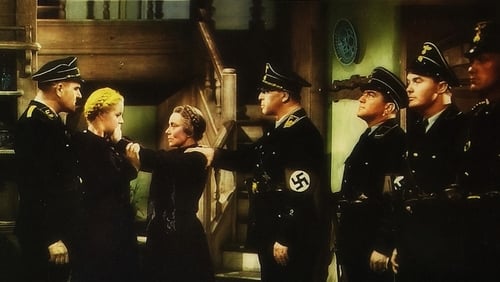
After Three Comrades, Gyssling is mentioned in reference to Four Sons (Archie Mayo 1940). According to Urwand, it "greatly annoyed Georg Gyssling" (p. 212). The significance of this anecdote is unclear since the film was made and released, on 14 June, 1940, and Gyssling's annoyance had no effect. Urwand dismisses it as "a relatively minor film set in Czechoslovakia that ignored the specific dangers of Nazism." (p. 212). That is not true. The film is about a family in Czechoslovakia that is destroyed when the Nazis take over their country. The Nazis are portrayed, in no uncertain terms, as the enemy of democracy, decency, and humanity as a whole. They kill innocent civilians, they deport people, they send people to camps, they teach young children to kill. In the end the main character, the old woman who once had four sons, escapes to the United States with her grandson. For a film of 1940 it is remarkably explicit about what the Nazis were doing. It is puzzling that when a film finally comes along that is doing what Urwand has repeatedly asked for, he dismisses it and deliberately misrepresents its content.

Four Sons, although the film is in black and white.

***

Towards the end of the 1930s Gyssling was no longer in the same position he once was. He was considered a threat by the FBI, at least since 1937, and according to Urwand, by 1939 the Hays Office had "ceased all communication with him." (p. 198) By now explicitly anti-Nazi films were being made by the major studios, even MGM.

It is clearly the case, and this has been known and documented by film historians for decades, that Gyssling for a few years was a powerful man in Hollywood by his position as a representative of Nazi Germany. But there were hundreds of films made each year and Urwand mentions few, and even those few he mentions it is often unclear what, if any, Gyssling's involvement was. And if there was a pact and a collaboration, why did Hollywood repeatedly try to make films that would upset the Germans? You could read Urwand's book and come away with the feeling that rather than a collaboration there was a constant battle.

But why deal with the Nazis at all, in the form of Gyssling? Because it was standard procedure to do so with many nations. Hollywood was in general conscious about the reactions of other countries and engaged with them, whether friends or enemies. Italy, France, Spain, Britain, Japan were among other countries that demanded cuts and changes, and got them. This wider context is only briefly mentioned by Urwand in an end-note (p. 257n26), but without this context the book becomes lopsided. The most influential country was Britain, to which Breen and the Hays Office often aligned themselves. But most countries to which American films were exported were consulted. MGM's convoluted efforts to make Idiot's Delight (Clarence Brown 1939) against the wishes of the Italian consul is an interesting tale, but it is not mentioned in Urwand's book.

Something else Urwand does not mention is that after Hollywood, Gyssling appeared in Sweden during the war, pestering the Foreign Office about film issues. That is perhaps not relevant for Urwand's purposes, but what is relevant is that, unknown to Urwand apparently, Gyssling was not a loyal Nazi but instead provided secret information about Germany to a Jewish friend in the United States, who then passed it on to higher American authorities. This gives a new meaning to his role in Hollywood, and was brought to light a few years ago by Stephen J. Ross at University of Southern California. See here.)

In short, Urwand mentions nine films in relation with Gyssling. On some of them Gyssling's involvement is unclear, on some he had no impact at all, on others Urwand speculates. Only for two of the films, Three Comrades and The Road Back, has Urwand established an active engagement between Gyssling and a studio, which resulted in changes. And these were already known cases.

Urwand also insists that the only reason that the studios acted like they did was because of their greed and business concerns, even though his book is filled with examples of other concerns. One such concern that was very real for the studios' bosses and many of the cast and crew members was the rampant antisemitism in the United States, and the real threat from local Nazis. This is something, on what might be the most outrageous page in the book, Urwand completely brush off as insignificant and probably not even true. "There is no evidence, at this point or later on, that they were actually afraid of the potential anti-Semitic reaction that an anti-Nazi film might provoke." (p. 75) How can he be so tone-deaf? If he wanted proof, and there is a lot of that, he would not have to look far. Maybe turn to page 208 of his own book where he describes what happened when Confessions of a Nazi Spy was released: "Theaters were vandalized, critics in the Midwest were urged to write negative reviews, and Hollywood was denounced as a Jewish conspiracy." (For more information about the genuine threat from local Nazis, and the fears among the Jews in Hollywood, see this article.)

***

In order for Urwand to strengthen his argument, he also talks in more general terms about Hollywood films of the 1930s, but here he is also misguided and wrong.

"For three years, Hollywood had avoided making movies that draw attention to the economic depression and the horrendous conditions under which people lived." (p. 107) Urwand writes, and the three years are 1930 to 1932. But one thing those years are famous for is films dealing with the depression and the "horrendous conditions" of the time. Urwand himself has mentioned one, I Was a Fugitive from a Chain Gang (Mervyn LeRoy 1932), so he must be aware that they exist. Five other examples he could have mentioned had he known about them are City Girl (F.W. Murnau 1930), The Cabin in the Cotton (Michael Curtiz 1932), American Madness (Frank Capra 1932), Faithless (Harry Beaumont 1932) and Employees' Entrance (Roy Del Ruth 1933).

The film he erroneously claims was the first one to address the economic conditions of the time is Gabriel Over the White House (Gregory La Cava 1933). A notorious film which has, since it came out, usually been considered a fascist film, as it seems to be in favour of rule by a strong leader with dictatorial power. Although there are other interpretations to be done, Urwand agrees with those who says it is fascist, but he goes further than that and says that "ever since MGM's Gabriel over the White House, the Hollywood studios had themselves released 'one pro-Fascist film after another'" (p. 175) and that "a film advocating liberal democracy over fascism - could not have been made in the United States at this time" (p. 175) That is not true.

Which are these "pro-Fascist" films Urwand talks about? "In a sense, the most successful Nazi propaganda film of the 1930s was not Triumph of the Will /.../ but The Lives of a Bengal Lancer" (p. 116) he declares. "The next Hollywood movie that delivered a National Socialist message /.../ would set a new standard for future German production. The film was called Our Daily Bread." (p. 121) But Our Daily Bread (1934) was not a Hollywood production but an independent production by King Vidor and made the year before The Lives of a Bengal Lancer, not the year afterOur Daily Bread is usually considered a working class, left-wing film, and if you watch it you will understand why. It is also a cheaply made, naturalistic film with no stars. Exactly which German productions are Urwand thinking of as following that standard? I do not know much about German filmmaking from the Nazi era, but what I have seen does not give the impression that they were keen on producing films about poverty and rural depravation. The Lives of a Bengal Lancer (Henry Hathaway 1935) is a pro-British film and a hymn to its rule over India, in the spirit of Rudyard Kipling. (It was banned in Italy for its pro-British sentiments.) This one might find distasteful, but it does not make it Nazi propaganda. But for Urwand it is and, he says, there was "a whole series of American films just like it." (p. 125) He mentions the following titles:

Looking Forward (Clarence Brown 1933)
Night Flight (Clarence Brown 1933)
Queen Christina (Rouben Mamoulian 1933)
Mutiny on the Bounty (Frank Lloyd 1935)
West Point of the Air (Richard Rosson 1935)
Mr Deeds Goes to Town (Frank Capra 1936)
Souls at Sea (Henry Hathaway 1937)
Captains Courageous (Victor Fleming 1937)
Mr. Smith Goes to Washington (Frank Capra 1939)

"This list went on. This was the high point in Hollywood's relationship with Nazi Germany." (p. 127)

I do not know Looking Forward or West Point at the Air but the others I have seen. There is not space enough here to discuss each of them in depth and explain why it is strange, not to say incomprehensible, to talk about them as being some kind of Nazi propaganda, but you have probably seen some of them and can vouch for yourself. It is possible there were some random films made in Hollywood that could be considered Nazi propaganda in some way, but those films are not among them. Urwand provides a quote regarding Mutiny on the Bounty, it "showed how an ordinary man could rise up against the tyranny of a corrupt power" (p. 126). If this is his idea of Nazi propaganda then that might explain why he thinks there was so much of it in Hollywood cinema.

Souls at Sea, about the fight to end the transatlantic slave trade.

When Urwand discusses The Mad Dog of Europe, he claims that the fact that it was not made led to the complete erasure of Jewish characters in Hollywood films. After describing their vivid presence in previous Hollywood films he says, "The decision not to make The Mad Dog of Europe changed all this." (p. 76) However, a few pages later, at the end of his discussion about The House of Rothschild, Urwand says that "the Jew, once so prominent in American culture, was suddenly nowhere to be found /.../ More than any other single factor, The House of Rothschild was responsible for this disappearance." (p. 90) How can The House of Rothschild be the single most important factor if two years earlier The Mad Dog of Europe had already "changed all this"? Either way, this change was not because of any one film but a wide-reaching reform which did not just involve Jewish characters but many kinds of ethnicities, sexualities, languages and other things that could cause offence among some part of society. It also involved dress codes, level of violence and so on. It was the tightening of the Production Code, and its enforcement is well-known. It was this (gradual) change that has given us the term "pre-Code cinema" today to refer to the films between, roughly, 1930 and 1934. Urwand seems to be unaware of this. Jews where still to be found though, and other minorities too, albeit less frequent and often in coded form.

Another issue is what is missing from the book, such as all those films that, on terms acceptable by the Production Code, did try to address problems with fascism and/or racism, at home and abroad. "What's better work for an American than helping to fight for democracy?" O'Hara (played by Gary Cooper), rhetorically asks in The General Died at Dawn (Lewis Milestone 1936 Paramount), one such film. Other films one could mention are Fury (Fritz Lang 1936, MGM)They Won't Forget (Mervyn LeRoy 1937, Warner Bros.), Black Legion (Archie Mayo, Michael Curtiz 1937 Warner Bros.), The Last Train from Madrid (James P. Hogan 1937 Paramount), Blockade (William Dieterle 1938 Walter Wanger), The Adventures of Robin Hood (William Keighley Michael Curtiz 1938 Warner Bros.), Juarez (William Dieterle 1939 Warner Bros.). Then there are B-movies, including Westerns such as those about the Three Mesquiteers, in which anti-fascist messages sometimes appear and other political issues are brought to attention. Since their existence would undermine Urwand's argument it is understandable that he does not mention any of this. For those who want to get an idea of the tremendous difficulties Hollywood filmmakers had to deal with when making a film with a political subject, I suggest the introduction to the published (1983) script of Juarez. It was difficult to make these films, yet many tried.

Another factor that adds context is the Hollywood Anti-Nazi League (HANL), for a while one of America's most prominent organisations for opposing Nazis and Fascists. Many members of the Hollywood community were members, including some that Urwand talks about, but while he mentions the organisation briefly he does not describe their importance or their members. He does say that "it had avoided all criticism of the Hollywood executives' dealings with Georg Gyssling." (p. 199) but since he does not provide any reference or source for this claim it is relevant to ask how he would know this. Maybe it was raised in several meetings at the time. Or maybe the League knew that Gyssling was not the real problem.

***

That was an overview of some key aspects of the book. It is time to sum it up. As the full title of the book is The Collaboration: Hollywood's Pact with Hitler, and because Urwand has persistently said, in the book and in interviews, that he has uncovered completely new information, one way of evaluating the book should therefore be by asking three questions:

Has Urwand shown that there was a pact?
Has Urwand shown that there was a collaboration?
Is there any new information in the book?

The answer to all three questions is unfortunately no, at least based on Urwand's book. He has not provided any examples of any written agreements between Hollywood and Hitler, although this is not surprising for how would such agreement have been possible? Hollywood is not a unity or corporate entity with the capacity to engage in such pacts with anyone. Of all of Hollywood's studios only three were actively working in Germany up until the war, the others left or were kicked out in the early days of the Nazis, so it was not the case that the whole of Hollywood was in on it. Urwand instead focuses only on Twentieth Century-Fox and MGM, and he has provided examples of local agreements in Germany between the studios and the local authorities. But that is not the same as a pact, and definitely not a pact between Hollywood and Hitler, and Urwand has not shown that there was any.

Was there a collaboration? Urwand claims that he used that word because, he says, that is the word that was used in written correspondence between the Germans, but they did not. They wrote in German and not English, and there is a German word for collaboration, Kollaboration. This is not the word they used in their correspondence. The word they used was Zusammenarbeit. Urwand has instead made a conscious decision to translate Zusammenarbeit into collaboration. I am not saying that it is necessarily a false translation, but I am saying that he cannot hide behind the Germans. He made that choice, not them. He could have chosen cooperation for example, or liaisons. (The word in effect means together-work.) But is it accurate to describe what happened between some of the studios and Germany as collaboration? It depends on your own definition of collaboration. If by collaboration you mean two, or more, parties with sinister motives working together for a common cause, then there was no collaboration and Urwand has not shown any proof of such an arrangement. The case of The Road Back is a good example of the reality. If there had been a pact or collaboration, the film would not even have been planned. Instead Gyssling had to threaten and bully the cast and crew to get his way. Is there not something unpleasant about telling these poor people that they were collaborating with Hitler?

Finally, is there anything new? If by "new" we mean relevant information that we did not have before about the historical situation being discussed, then the answer would be no. Over the last decades there have been several books and articles making the same arguments and telling the same story. It is perhaps the case that Urwand has looked at more materials in the German archives than previous English-speaking scholars have done, but even so he has not brought forward any new information.

There is one thing that some commentators of the book have mentioned as being new and shocking information. It is Urwand's claim that "the largest American motion picture company [MGM] helped to finance the German war machine." (p. 147) Is this true? I do not know. Urwand's reference is to "Stephenson, 'Special Report 53,' December 30, 1938." so I cannot double-check it. In Urwand's summary of Stephenson's report he says that Stephenson "explained the process" (p. 147). What is unclear is to whom he described it. If he described it to MGM, then it does not follow that they did as he suggested. But it could be the case that Stephenson explained to someone else what MGM had done. Considering the importance of the issue it is a pity that Urwand is unclear. But MGM's affairs have been discussed before, it is for example mentioned in Dumont's earlier book about Borzage, and in slightly different terms. Dumont says MGM had money in Germany that had been frozen by the Nazis. They could not remove it and instead invested that money and then sold their shares to American banks, with the approval of the US State Department. (p. 260) I do not know what this means, what the ethics involved were or whether it is fair to say MGM helped "finance the German war machine" as Urwand claims. But he has shown that he is not reliable.

Whatever the case is with MGM and its money, based on the evidence that Urwand provides in his book, a more accurate title for The Collaboration would be, for example, Dealing with the Enemy: How Some Hollywood Studios Negotiated with Nazi Germany. And that was already the "accepted account" of the period. The only things Urwand adds are inventions, hyperbole and confused interpretations.
***

The final page of The Collaboration briefly touches upon films made after the war, and Urwand writes "Decades would pass before any reference to [the Holocaust] appeared in American feature films." (p. 253) This is not true. It was mentioned in several films during the war, and it took barely a year after the war until it was referenced again. It features for example in Orson Welles's The Stranger (1946), where newsreel footage is included. Sword in the Desert (George Sherman 1949) and The Juggler (Edward Dmytryk 1953) are explicitly about Holocaust survivors. Hedy Lamarr plays a survivor from Buchenwald in A Lady Without Passport (Joseph H. Lewis 1950).

It is fitting for The Collaboration that even the penultimate paragraph gets the basic facts wrong.

--------------------------------------------------------------------
Selected bibliography:

F. Scott Fitzgerald's Screenplay for Three Comrades (1978)

Jan Olsson Svensk spelfilm under andra världskriget (1979)

Colin Shindler Hollywood Goes to War: Films and American Society, 1939-1952 (1979)

Juarez - Edited and With an Introduction by Paul J. Vanderwood (1983)

Gregory D. Black, Clayton R. Koppes Hollywood Goes to War: How Politics, Profit and Propaganda Shaped World War II Movies (1987)

Ephraim Katz The Film Encyclopedia (1994)

James Curtis James Whale - A New World of Gods and Monsters (1998)

Mark Glancy When Hollywood Loved Britain: The Hollywood 'British' film 1939-45 (1999)

Michael E. Birdwell Celluloid Soldiers: The Warner Bros. Campaign Against Nazism (1999)

Scott Eyman Lion of Hollywood: The Life and Legend of Louis B. Mayer (2005)

Hervé Dumont Frank Borzage: The Life and Films of a Hollywood Romantic (2006)

George C. Perry, Richard Schickel You Must Remember This - The Warner Bros. Story (2008)

Thomas Doherty Hitler and Hollywood 1933-1939 (2013)

Here is a relevant quote from Glancy's book:
Gyssling was determined to prevent films which cast a negative light on Germany, whether related to Nazi Germany or to Germany's past, and he was well versed in the means with which to deal with the industry. For example, even before Twentieth Century-Fox began filming the First World War spy drama Lancer Spy (1937), which centres on a British double agent, Gyssling informed Breen that he heard that there would be 'several scenes apparently objectionable from the German standpoint'" He also reminded Breen that 'many Fox films are being shown in Germany at this time'. This was only one of many references made to the link between film content and the studios' ability to operate in Germany. There were also numerous references to the 'National Feelings' clause. Gyssling apparently had read the Production Code, and was determined to see that this clause was applied to Germany. (p. 44) 
If you want to get a coherent and accurate overview of the topic of Urwand's book, I suggest you just read the chapter from which the above quote comes instead of reading The Collaboration.

Friday, 11 January 2019

Reading in films

A light start to the new year. Among the many things that intrigue me in films is what books characters are reading and what it might mean and what the books are like. Sometimes they can be real books that were popular at the time, sometimes they are self-referential, sometimes they are jokes and sometimes they are fake, just a title and a cover created for the film. I can also be fascinated by books being written by fictional characters that are authors. In Finding Forrester (Gus Van Sant 2000), the character played by Sean Connery wrote one novel once upon a time, which was considered a masterpiece and won the Pulitzer Prize, but he has written nothing since. It is called Avalon Landing and I am desperate to read it, even though I know it does not exist outside the frame of the film. To add to its allure, the book is briefly shown in the film and it is in the same style as Penguin Books of the 1950s, a design I find irresistible. I even have a small collection of Penguin books from that series, such as this one (which was adapted into a film by George Cukor in 1956):


But back to books being read. Here are five examples that have always excited me for one reason or another:

Grace Kelly in Rear Window (Alfred Hitchcock 1954)

Jayne Mansfield in Will Success Spoil Rock Hunter? (Frank Tashlin 1957)

Audrey Hepburn in How to Steal a Million (William Wyler 1966)

Claude Jade and Jean-Pierre Léaud in Bed & Board (François Truffaut 1970)

Chris Eigeman and Allison Parisi in Metropolitan (Whit Stillman 1990)

That was just a small collection; a starting point for a conversation, for further research and for the year of 2019. Let's get going! 

Friday, 27 October 2017

Recent readings

Finally, my article about Richard Quine has gone live so you can read it now over at La Furia Umana:

http://www.lafuriaumana.it/?id=706
The two best scenes in It Happened to Jane are set in the kitchen of her home. Her house is not shown in its entirety, only the living room and the kitchen, which is below the living room, but they inhabit these spaces with a wonderful ease and spontaneity. In the first scene Jane and George have a sweet conversation, and it becomes clear that he loves her but feels intimidated by her late husband. In the second they have an unpleasant conversation, and a turning point in George’s life. Having looked after her children and cooked for them for two days, his housewife moment in the apron, while she is in New York wining and dining with an attractive journalist, he now snaps, which unfortunately leads him, because of his frustration and jealousy, to stop just one word short of calling her a slut or whore. She asks him to leave, not so much upset as sad that he has sunk so low.
The last two weeks I have read several books and articles and instead of writing something new I will restrict myself for now to recommend some things others have written.

First the essay collection Durgnat on Film (1976), which consist of selected parts of Raymond Durgnat's previous books Films and Feelings (1967) and The Crazy Mirror (1969). The topics covered are many, such as style, realism, authorship, adaptations and discussions of specific films, filmmakers and comedians. It is very good, combining intelligent writing and a wide-ranging taste, with engaging criticism of the ideas of other critics and academics.
Suppose a film ends with the camera tracking back from the lovers embracing alone on the beach. This may mean 'how tiny and unprotected they are' or 'how frail and futile their love' or 'the whole wide world is theirs' or 'this is the moment of their destiny' (for plan views can suggest a 'God's-eye-view') or 'Good-bye, good-bye,' depending on which emotions are floating about in the spectator's mind as a result of the rest of the film. Hence style is essentially a matter of intuition. There is no possibility whatsoever of an 'objective', 'scientific' analysis of film style - or of 'film' content. It is worse than useless to attempt to watch a film with one's intellect alone, trying to explain its effects in terms of one or two points of style. Few films yield any worthwhile meaning unless watched with a genuine interest in the range of feelings and meanings it suggests. (p. 27)
To over-simplify, perhaps, Ophuls' camera movements suggest a mellow 'fatalism'. Everything ends where it begins. The world is a maze of ironies, of impermanence, of nostalgias. If Ophuls' camera moves, it is à la recherche du temps perdu. But it isn't possible to separate the camera movements from the décor through which it moves, and which it shows to us, or the dramatic context in which it occurs. (p. 55)
We do not agree on Howard Hawks though, whom he do not seem to get. He says for example of "pain, or waste" that it is something "which Hawks, more sentimentally ignores" (p. 80) but I do not agree with that at all. Pain is almost always there in Hawks, sometimes acute physical pain and often equally acute psychological pain, from the death of a loved friend or from some other loss, or from having to experience the downfall of a friend.

Durgnat has written several books and I can also recommend King Vidor: American, co-written with Scott Simmon. A good recent collection is The Essential Raymond Durgnat, edited by Henry K. Miller (which to some extent overlaps with Durgnat on Film).

Jennifer Jones in Vidor's incredible Ruby Gentry (1952)

A great contemporary film writer/video essayist who is strongly influenced by Durgnat is Adrian Martin and his collected work is to be found here: http://www.filmcritic.com.au/index.html (Well, eventually it will all be there, it is updated regularly.)

The next recommendation is a long article from earlier this year in The Paris Review. It is by Noah Gallagher Shannon and about Roger Deakins:

https://www.theparisreview.org/blog/2017/05/09/master-light/
A strange but beautiful thing you will hear cinematographers say is that they conceive of each frame as, at first, completely black. The creative act lies in what to light and how—where to send viewers’ eyes, using each beam like a stroke or word. And Deakins thinks about this canvas of blackness not unlike the way blues guitarists—I’m thinking of the Keith Richards quote here—do the beats between notes: “The lighting of a film makes the pauses speak as eloquently as the words.”
Then two pieces from Bordwell and Thompson's extensive blog, both a few years old but which I read last week. One is about the style of Sidney Lumet, covering his whole career:

http://www.davidbordwell.net/blog/2011/04/21/endurance-survival-lessons-from-lumet/

The mid-1970s was the Great Barrier Reef of American cinema. Virtually no members of Hollywood’s accumulated older generations, from Hitchcock and Hawks through the 1940s debutantes (Wilder, Dmytryk, Fuller, Siegel) and the 1950s tough guys (Aldrich, Brooks) to the TV émigrés, made it through to 1980. Many careers just petered out. The future belonged to the youngsters, the so-called Movie Brats. In this unfriendly milieu, Lumet fared better than most. He tried a semifarcical heist film (The Anderson Tapes, 1971) that mocked the rise of the surveillance society, with everybody wiretapping and taping and videoing everybody else. He mounted a classic mystery (Murder on the Orient Express, 1974), a musical (The Wiz, 1978), and a free-love romance (Lovin’ Molly, 1974). Of the items I’ve seen from these years, the most daring is The Offence (1972). This study of a sadistic British police inspector’s vendetta against a child molester offers a sort of seedy expressionism. In another gesture toward psychodrama, long conversations with the perpetrator reveal that the copper is a bit of a perv himself.
The other piece is about journalistic reportage from film sets, whether for an article or a book, and the many problems with them. From Lillian Ross's famous tale of the making of The Red Badge of Courage (John Huston 1951) to an article about the making of Lady in the Water (M. Night Shyamalan 2006).

http://www.davidbordwell.net/essays/hearing.php
Still, you have to wonder what a book laying bare decision-making at Microsoft or Enron or the Oval Office would look and sound like. Would you meet epitomes of mature, moral, thoughtful behavior? Would you witness activity bereft of any hubris or self-regard? It’s doubtful, but anyhow we’ll never find out. No executives or politicians in their right minds would let an outsider into the suites when the deals are done. They know that uncontrolled publicity is bad publicity. By comparison, our moviemakers’ egotism seems touchingly naïve. Confronted with the opportunity to have a name journalist track a production, they must think: If people could only understand the process, they’d really appreciate what we do. Anyhow, how could the publicity hurt? (Answer: See previous paragraphs.) Insiders regularly forget that middlebrow journalism will always highlight every act of show-business venality it can find. Peter Biskind has made a career out of treating contemporary American cinema as a circus of lunacy and petty spite.
And last, a very fine article I read some time ago and now re-visited. It is by Sarah Berry and about the films of Jean Negulesco, with a particular focus on gender and women characters:

https://contrappassomag.wordpress.com/2015/05/12/writers-at-the-movies-sarah-berry-on-jean-negulesco/
Negulesco’s characterization of marriage is interesting in three ways, however. Firstly, he retains a Depression-era sympathy for women’s economic struggles and the practical necessity of marriage in a world of very limited options. Secondly, he presents women’s desire for a companionate marriage of equals in an entirely sympathetic light. Thirdly, women’s sexual desires are never condemned or presented as whorish by contrast with a virginal ideal (one could claim that Sophia Loren’s breasts are the star of Boy on a Dolphin, but she is also a three-dimensional character fighting for her impoverished village, as she points out to her “rich American” love interest).
That should keep you occupied for quite some time!