It is often said that critics and scholars who work on auteurs are being romantic, propagating the myth of the artist as a lone genius even though that is not how most auteur scholars look at filmmakers. But it has many times struck me that those who write about, and eulogise, new waves, of which there were quite a few in the 1960s and 1970s, are often the most romantic of scholars, combining a love of radical Marxist politics with an admiration of angry young men. Geoffrey Nowell-Smith's book Making Waves: New Cinemas of the 1960s from 2007 is a good example of this romanticism. It is the kind of book that has extravagant sentences like "The cinema of the 1950s had been on the whole apolitical." which is not true at all. It is not even clear what it means. There are also bold statements like "The first person to blend realism and fantasy in a convincing way was Roman Polanski.", which is a meaningless statement when there is no explanation as to why, to mention a few, Luis Buñuel or Michael Powell or Henry Hathaway's Peter Ibbetson (1935) or William Dieterle's Portrait of Jennie (1948) are disqualified. It also has a chapter called "Technological Innovations: Colour, Wide Screen, the Zoom Lens", as if colour and wide screen were invented in the 60s.

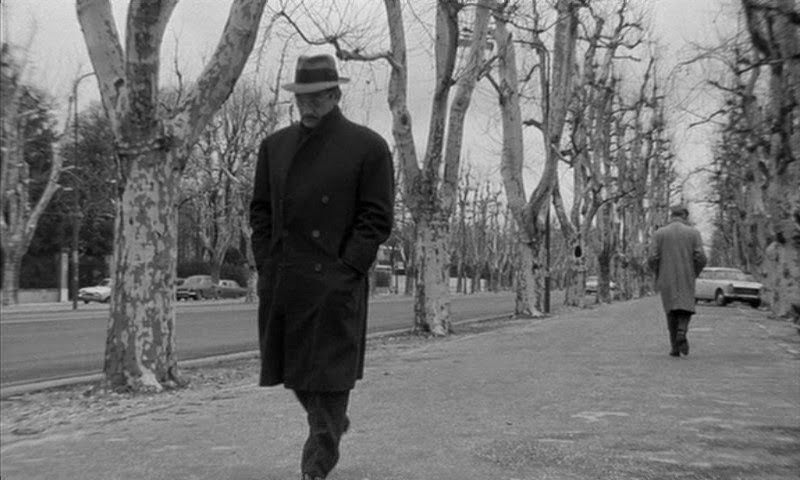
Portrait of Jennie
There are many new waves, often vaguely defined, but the most famous is of course the French New Wave. Yet even it is hard to define. Even to say when it began is hard. The most conventional starting point is François Truffaut's The 400 Blows (1959), which is fine if the definition of a New Wave-film is a film by Truffaut or Jean-Luc Godard. But if the definition is a film by a first-time filmmaker who was formerly a critic as Cahiers du Cinéma, which is a common definition, it then at least follows that Claude Chabrol's Le beau Serge and Les cousins (both from 1958), must be counted. That is the starting point for David Bordwell and Kristin Thompson in Film History: An Introduction.
But if the French New Wave is to be defined not by the background of the filmmakers but from the style and vision of the actual films, then it would seem that Louis Malle's Lift to the Scaffold (1957) deserves to be included, and his follow-up The Lovers (1958), both with Jeanne Moreau. Why should Malle be disqualified only because he was not a writer at Cahiers du Cinéma when his films, visually, temporally, thematically, aurally, and actor-wise, are just as much New Wave as Chabrol, Truffaut or Godard? Sometimes it feels like snobbery and nothing else, which is not a valid criterion when doing film history. Peter Cowie, in Revolution! The Explosion if World Cinema (2004), a title which clearly signals the romanticism, wholeheartedly embraces Malle whereas Nowell-Smith does not include Malle (he calls him "uninterpretable and contradictory"). Bordwell and Thompson do not include Malle either, and call him "commercial", although it is not clear that he is more commercial than, for example, Chabrol. Bordwell and Thompson do on the other hand include Georges Franju as a New Wave director (as part of the so-called "Left Bank"-group of the New Wave, which also includes Alain Resnais and Agnès Varda), but there they might be in a minority. In A History of the French New Wave (2002), Richard Neupert wrestles, on several pages, with whether Malle is New Wave or not. But Franju is never mentioned by him at all. Naomi Greene in The French New Wave: A New Look (2007) regards Malle as separate from the New Wave but important, and she puts him together with Jacques Demy. Most however like to include Agnès Varda and her film Cleo from 5 to 7 (1962), but that was not her first film, she made her first feature in 1955, La pointe courte, and consequently it is sometimes called the first New Wave film. The same year, 1955, Alexandre Astruc made Bad Liaisons, which some want to claim as part of the New Wave too. An interesting case is Roger Vadim. His first film And God Created Woman... (1956), in alluring widescreen and colour, with Brigitte Bardot and Jean-Louis Trintignant, has the youthfulness, rebelliousness and movement of Truffaut, albeit with less depth, and as it was very successful it made it easier for the later New Wave directors to get funding, Vadim's later film Les liaisons dangereuses (1959), with Trintignant, Jeanne Moreau and Gérard Philipe could easily be counted as New Wave, where it not for its director.

Those mentioned so far have all been full-length feature films. If short films are to be included, and why not, 1956 is also an important year. To quote from Jean Douchet's book French New Wave (1998):
So it is a debatable point when it specifically began, and an unnecessary one. French New Wave was part of a general movement within French culture and the term itself was coined 1957, at the newspaper L'Express, so it prefigures Godard's and Truffaut's first feature films and was originally not even about films at all. It is much larger than that. Suffice to say that the French New Wave was a general change in the cultural atmosphere in France when those who were children during the war, or were born during the war, came of age. Film was part of that, and there was no decisive moment or specific film when it all began, it was a long process that snowballed. One important thing though, which can be specified in time, was 1959 when the Minister of Culture, under André Malraux, changed the funding situation for films and decided to give money to first-time directors. What happened next was the shock when over 100 new filmmakers got to make their first features during a few years. That was the explosion that put the term French New Wave on everybody's lips. More specific than that we need not be. The French New Wave should not be slimmed down to be about certain themes or a certain style (the films vary considerably), and it is not about a handful of famous directors or any particular journal. Better to say that the French New Wave was the sum total of the hundreds of new filmmakers who made their first films during a handful of years, and everybody is included, from Vadim to Rivette.
Jeanne Moreau in The Lovers
Those mentioned so far have all been full-length feature films. If short films are to be included, and why not, 1956 is also an important year. To quote from Jean Douchet's book French New Wave (1998):
We can date the birth of the New Wave itself to 1956, the year when Coup du berger, a short by Jacques Rivette, produced by Pierre Braunberger, was filmed. The role played by Films de la Pléiade - de small production studio run by Braunberger, a former producer of Renoir, Buñuel, Clair, and others - was central to the renewal of French cinema.Le coup du berger (available here) is 28 minutes long and Rivette made it together with Chabrol and Jean-Marie Straub. Worth to add though is that Truffaut made his first short, Une visite, a year earlier, in 1955, working together with Resnais and Rivette.
So it is a debatable point when it specifically began, and an unnecessary one. French New Wave was part of a general movement within French culture and the term itself was coined 1957, at the newspaper L'Express, so it prefigures Godard's and Truffaut's first feature films and was originally not even about films at all. It is much larger than that. Suffice to say that the French New Wave was a general change in the cultural atmosphere in France when those who were children during the war, or were born during the war, came of age. Film was part of that, and there was no decisive moment or specific film when it all began, it was a long process that snowballed. One important thing though, which can be specified in time, was 1959 when the Minister of Culture, under André Malraux, changed the funding situation for films and decided to give money to first-time directors. What happened next was the shock when over 100 new filmmakers got to make their first features during a few years. That was the explosion that put the term French New Wave on everybody's lips. More specific than that we need not be. The French New Wave should not be slimmed down to be about certain themes or a certain style (the films vary considerably), and it is not about a handful of famous directors or any particular journal. Better to say that the French New Wave was the sum total of the hundreds of new filmmakers who made their first films during a handful of years, and everybody is included, from Vadim to Rivette.
So while the beginnings of the French New Wave are vague, it is also the case that what proceeded it has often been unfairly dismissed, as suggested by Nowell-Smith's claim that the 1950s was "apolitical" when it was not, or by Peter Cowie ridiculing the hypocrisy of 1950s Hollywood. I am not convinced that the 50s were more hypocritical than any other decade, and in Italy, Japan and the US, the 1950s was an exceptional decade in terms of the quality and daring of the films made. But even French cinema was frequently impressive. It was after all the decade that had new films by Jean-Pierre Melville, Max Ophüls, Jacques Becker, Jean Renoir, Robert Bresson, Jacques Tati, René Clément, Henri-Georges Clouzet, as well as others. The last two are among those dismissed by Truffaut but why should we trust him? Truffaut's article "A Certain Tendency in French Cinema" (1954) is often mentioned, where the scriptwriting duo of Jean Aurenche and Pierre Bost is seen as an example of all that was wrong with French cinema prior to 1959. But what exactly are their flaws, as far as Truffaut is concerned? It is two things. First that the adaptations they have made are not faithful to the books they have adapted and that they are against religion and the bourgeoisie. But if those are the flaws of Aurenche and Bost, they have done nothing wrong, It might even be said that they are true to the later spirit of the New Wave. So that side of Truffaut's argument is not particularly strong. But Truffaut had another concern too, that Aurenche and Bost were too literary, that they did not think in images and movements but in words, and perhaps even looked down upon cinema. Truffaut then suggested what to him was the opposite of that:

I mean Jean Renoir, Robert Bresson, Jean Cocteau, Jacques Becker, Abel Gance, Max Ophuls, Jacques Tati and Roger Leenhardt; these are French cinéastes, and it so happens — curious coincidence — that they are auteurs who often write their dialogue and some of them themselves invent the stories they direct.But it is not obvious that a film like Devil in the Flesh (1947), directed by Claude Autant-Lara and written by Aurenche and Bost, is less cinematic than a film by Bresson or Becker. This is not to compare the quality of the films, just to point out that Truffaut might not have an obvious case. Neither was it the case that the critics at Cahiers du Cinéma were in agreement. Truffaut liked Becker, but Rivette hated him. Both Truffaut and Rivette disliked Clément but Pierre Kast thought Clément was the best French director working in the 1950s. These are debatable points, but what is important is that French cinema prior to the French New Wave was rich, varied, interesting and filled with greatness. The best French films made in the 1950s by, for example, Melville, Becker, Bresson and Ophüls, are equal to the best films made during the 1960s, at the height of the Wave. There is no reason to diminish what came before just to emphasis the New Wave, however you define it, because the New Wave can take care of itself.
Godard's Contempt - Le Mépris (1963)
---------------------------
Truffaut's article can be found in Movies and Methods: Vol. 1 (edited by Bill Nichols, 1976), among other places.