Showing posts with label film critics. Show all posts

Friday, 9 December 2022

Dilys Powell

 One of my favourite quotes from a film critic is the following: 

To explain to a sophisticated taste why The Sun Shines Bright is so good a film strikes me as nearly impossible. A sophisticated literary taste, that is. In the cinema sophistication wears strange colours, and the most austere judge will admire a piece which to a reading man may appear tearful tosh. Nothing sadder than to watch some devoted film critic trying to explain to a dramatic or a literary critic - or even an art critic, for artists outside their own field are ruled more than they think by literary ideas - that to appreciate a film you have to look at it, not just listen to it. Human desperation can go no further.

That was Dilys Powell in her review of John Ford's The Sun Shines Bright (1953) in the Sunday Times. Powell, whose writing has been collected in, for example, The Golden Screen - Fifty Years of Film (1989) and The Dilys Powell Film Reader (1991), is someone I always enjoy reading, and often have reason to return to. I share with her a love of westerns for example ("There are no bad Westerns. There are superb Westerns; there are good Westerns. And there are Westerns." she wrote in 1964), and of Vincente Minnelli.

She did not only love Minnelli's famous musicals of the 1940s and 1950s, which it is common to love, but his more challenging and lesser-known films too, which often only Minnelli auteurists like. An example is her review of Two Weeks in Another Town (1962). An excerpt: "Return to form by a brilliant director: something to celebrate. The director is Vincente Minnelli/.../The story deals with extravagances which in the hands of another director might be merely absurd. Not in Minnelli's hands./.../This time the frenzies of the film studio and the desperate dolce vita of Americans working abroad are rightly set in their period; the result may be a fantasy world, but it is a fantasy which this director understands and makes his own and into which he can breathe an intense, feverish life."

Something that often shines through in her writing is a defensive position vis-à-vis a certain kind of people, of which she most certainly had had many encounters, who take a belittling view of her chosen artform; literary types for whom film is mere entertainment. As part of her efforts to emphasise the artistic value of cinema she early on highlighted the director. In 1946, for example, she gave a talk about the role of the director in relation to the national, industrial and cooperative aspects of cinema. She asked the rhetorical question: “How can one man leave the mark of his personality and his talent on this hugger-mugger?” and answered, “But he does.” She also wrote that the visual language of a great filmmaker is the equivalent of the written language of a novelist. In her reviews of Antonioni's films of the 1960s, which she loved, she writes as much about the buildings and architecture as she does about the actors. Speaking of Antonioni, I love this sentence from her review of Bullitt (1968): "And outside the work of Antonioni I haven't seen such effective narrative and emotional use of an urban background."

One of the joys of reading collections like these is that you can see how her views evolve, as from the opening paragraph of her review of Nashville (1975), "Robert Altman has never been among my idols." to the last paragraph of her review of Quintet (1979), "And once again you are reminded of the astonishing range of Altman's work. M.A.S.H. and Images, Brewster McCloud and Three Women, Buffalo Bill and the Indians, Nashville, and Quintet - one never knows what this extraordinary director will do next. And thank heaven for that."

Another treat is when there are several reviews in a row of exuberant excitement, as from 1955, where she shares her joyful pleasure of experiencing the greatness of Seven Samurai (1954), A Star is Born (1954), and, slightly less great, Buñuel's The Criminal Life of Archibaldo de la Cruz (1955). She also liked the first Bond film, Dr. No (1962), and she was an eager fan of Miklos Jancsó. She called Henry Hathaway an "old-time spellbinder" and referred to Fritz Lang's "cold, savage skill." This is another thing I like about her, the range of what she likes. She is open to almost anything, except a certain kind of violence, like Sam Peckinpah's Straw Dogs (1971) which she hated even though she liked many of his other films. At times she wrestles with a film, where the reviews move back and forth between what she likes and what she dislikes in the film under consideration, weighing the good and the bad against each other as she writes.

Powell was born in 1901 and after studying at Oxford she began working at the Sunday Times in 1928. She became their film critic in 1939, and in 1946 she was elected president of Fipresci, The International Federation of Film Critics. She stayed at Sunday Times until 1979 after which she spent 13 years writing criticism for Punch. She also returned to Sunday Times, writing about films on television up until the day she died, in 1995. That shows how committed she was to both films and film criticism. 

Beside films, her great love was Greece, a country where she spent a lot of time during her life. First as part of her first husband's archaeology expeditions in the 1920s and 1930s, then doing war service during World War 2, and then as a friend and lover of the country. She also wrote several books about Greece, which I have not read but am curious about, in particular An Affair of the Heart (1957).

***

The London Film Critics' Circle has (or at least had until 2019?) an annual award called the Dilys Powell Award for Excellence in Film, and its first winner was Dirk Bogarde. He wrote a beautiful introduction to The Golden Screen, about his friendship with Powell. Here is a sample from it: "Playing a small part in a not very remarkable French film she said of me tartly, but not unkindly, 'Given too little to do Mr Bogarde does far too much.' Which was precisely what I did. And how I learned from that phrase." They became friends and remained so for life it seems.

Another connection between Bogarde, Powell, and Greece too, is that she was a friend of fellow philhellenist Patrick Leigh Fermor, whom Bogarde played in Powell/Pressburger's lovely Ill Met by Moonlight (1957). It is set on Crete, although due to lingering fighting there after the Greek civil war, filming took place in southern France. I do not know how she felt about that film, but she did love the films of Powell and Pressburger in general. The one exception was Peeping Tom (1960), which she, like many other British critics, eviscerated in her review. But she regretted this later and wrote an apology, in Sunday Times of course. I can quote it in full I think, and notice that this second review is prefiguring the contemporary idea of the "elevated horror film":

Michael Powell has long been known as one of this country's most distinguished film-makers. But when, in 1960, he made a horror film, I hated the piece and, together with a great many other British critics, said so. Today, I find I am convinced that it is a masterpiece. If in some afterlife conversation is permitted, I shall think it my duty to seek out Michael Powell and apologise. Something more than a change of taste must exist. The original story and screenplay come from Leo Marks; at their centre is a cameraman (played by Carl Boehm) whose scientist father used him in childhood in a study of fear. The boy grows up obsessed by images of the human face frozen in extremes of terror. He multiplies them by himself photographing death, and, in fact, becoming a multiple killer.

With so gifted a director this can hardly be anything but a frightening movie, but its object is the examination of emotion and not titillation. Interesting that it should be revived now when there has been much concern about the influence of cinema. All the more reason to distinguish between the serious and the merely sensational horror. Reading now what I wrote in 1960 I find that, despite my efforts to express revulsion, nearly everything I said conceals the extraordinary quality of Peeping Tom. See it, and spare a moment to respect the camerawork of Otto Heller.


Link to my Substack

Friday, 7 January 2022

A year of interviews - and one with Stig Björkman

2021 was a year when I started a new project: doing interviews with film critics. I have done eight so far, seven with Swedish critics past the age of retirement (even though some of them are still working) and one with Nick Pinkerton from the United States. They are all published in Swedish though, either for the Swedish Film Critics Association, of which I am a board member, or in the case of Nick for the Swedish film journal Flm. But I wanted to share something on the blog as well, so I have translated the interview with Stig Björkman into English. I choose him because, for a Swedish film critic, he has an unusual international reach as he has written in several European publications from different countries, including in Cahiers du Cinéma. So that felt like the one to go with.

The interview with Björkman is primarily about him and his career, but also a passage about Howard Hawks, whom Björkman was treating as a serious film artist already in the early 1960s when hardly anyone else in Sweden did. Links to all my other interviews (in Swedish) are also provided at the end. Enjoy!

Interview with Stig Björkman

Were you particularly interested in film already as a child or teenager?

When I was ten years old [in 1948] my parents took me to a cinema on Kungsgatan in Stockholm and we saw Luxury Liner with Jane Powell. I was completely taken by it. Powell often appeared in such MGM musicals, and I fell in love with her. I became a regular visitor and lied at home that I was studying with a friend when I actually went to the cinema. I saw everything, without distinction. My first film that was forbidden for children was Hitchcock's Strangers on a Train. I was only 13 years old then, but the usher looked the other way, a sold ticket is after all a sold ticket…

I had a weekly allowance, but it was not enough for all cinema visits, so I started working extra at my dad's office. He had a small publishing house on Vasagatan 38 and there I did small jobs that I got paid for and it helped to finance my cinema visits.

After Jane Powell, Piper Laurie was my next movie fiancée, but after I reached puberty I caught sight of Gloria Grahame, a slightly more dangerous lover. I saw her in, for example, In a Lonely Place.

I was diligent and read about movies in various magazines. I also wrote down all the movies I saw in notebooks and gave them ratings and reviews. Thanks to my father's job, I got the journal Filmjournalen for free, and of course I read it. I was so well-read I competed in the very first season of the game show Kvitt eller dubbelt on the subject of film, in 1957.

I reached the level of SEK 2,500, but then I got a question about Hasse Ekman. I was shown five stills and asked which of Hasse Ekman's films they came from. I had not seen any of these movies but managed to get four right, but I missed Som folk är mest. As a consolation prize, I received some film books written by Rune Waldekranz and a trip to visit the studio Filmstaden in Råsunda.

Did you ever think that you would like to become a film reviewer or was it more of a coincidence?

It was a pure coincidence. I actually studied to become an architect, and then worked as that for two years. The second year as an assistant to Peter Celsing who later designed Filmhuset.

When and where did you start film criticism professionally, and how did your career develop?

Bengt Forslund, who was the head of Stockholm University’s student film club, called me after he had seen me in Kvitt eller Dubbelt and asked if I wanted to join the film club. There I soon became his successor as chairman. This included the tasks of presenting the film screenings that the film club arranged in Stockholm, 12 screenings per semester, and also of writing introductory texts.

In 1959, Forslund started the film magazine Chaplin, and after five issues he called me and asked if I wanted to join, as co-editor. It was 1960 and I was 21 years old. I had never written any film reviews of any kind, but now, as co-editor of a film journal, I just had to get on with it.

In 1961 I was at the Venice Film Festival for the first time. I have always been curious about other countries and cultures, and I also knew Italian fluently.

Since then, I have been a full-time film critic and writer.

What other publications have you written for?

The Italian Cineforum, Sight & Sound and Movie in England, Filmrutan in Sweden, the Danish Levende billeder, Cahiers du Cinéma, and the Swedish daily newspapers Dagens Nyheter and Svenska Dagbladet. I was a film reviewer for SvD 1962 to 1964, and then for DN for a few years.

Being a film reviewer could be stressful because at that time there were no press screenings. You saw a film at the evening screening of the opening night and then you had to take a taxi to the editorial office and quickly write a review that must be ready no later than 10 pm, in order for it to make it into the morning edition. So often I only had an hour to do it.

This was a time of changes in what was considered good or interesting films, partly due to the influence from Cahiers du Cinéma, so I was wondering about my favourite filmmaker, Howard Hawks. What kind of status did he have in Sweden at the time?

That is an interesting question. I wrote a positive, and long, review of Hatari! in Chaplin. The other critics and editors at the journal were wondering why I put so much emphasis on that kind of film, just a run-of-the-mill adventure film. But that view soon began to change. We did profiles of various important filmmakers and a few years later Hawks was considered important enough by the others, so he got a profile too. Maybe 1964.

I better search for that review, I love Hatari! Maybe your review was the push that changed Hawks’s status in Sweden? Is the review included in your new essay collection?

No, but two other of his films, Only Angels Have Wings and El Dorado. I should maybe have included Rio Bravo instead?

Yeah, it’s the best of those three late westerns, but I love them all, even Rio Lobo.

I haven’t seen it in a very long time.

It’s an interesting film. It feels like it started out to be darker and more tragic, but it changes its tone to be more relaxed and playful. Not a masterpiece but a worthy end to his career, as there is so much Hawks in it.

Sure. Hawks is a major favourite. And his comedies too. Some will have to be included in the next essay collection. But what are some of your favourites, other than Rio Bravo?

Oh, there are so many. Only Angels Have Wings, The Big Sleep, His Girl Friday, Red River. But all of his sound films are good, A Song is Born and Land of the Pharaohs too, but a bit weaker than the others. I don’t think he has made a bad film.

I watched Land of the Pharaohs recently and it was fun but no… But Faulkner co-wrote it, that’s interesting.

Oh yes, Hawks and Faulkner is a fascinating collaboration. But I have so many thoughts on this. I would need to write a whole book.

Well, do it. I think you should.

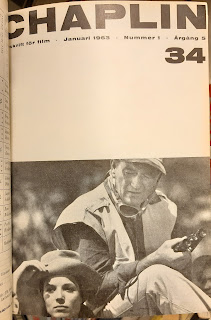
(Despite resistance from his colleagues, Hatari! made it to the front cover.)

But back to you. Have you done film criticism in other formats than written texts, for example via radio, TV, film, video essays, or something else?

No.

Have you had any particular role models among other film critics, Swedish or foreign?

I read Robin Hood [Bengt Idestam-Almquist] diligently, and we often met. Not least on Saturdays when Filmhistoriska samlingarna had film screenings at the Regina cinema. He used to present them. He was a nice man. I also read Rune Waldekranz. Then I started reading Sight & Sound, Cahiers du Cinéma, Movie. My two co-editors at Chaplin, Forslund and Torsten Manns, teased me for my love for Cahiers.

Were they more Positif guys?

No, but Sight & Sound. But there were many who inspired me, such as Ian Cameron and Victor Perkins on Movie, their way of conducting film analysis.

Did you have a mentor or other person who helped you at the beginning of your career?

Bengt Forslund. But mostly I'm self-taught. The ones who shaped me the most are probably Cameron and Perkins at Movie. They also became good friends, and Mark Shivas. Their way of analysing and describing films influenced me the most. I also liked Jean Douchet a lot.

What do you think characterizes a good critic?

Curiosity, knowledge, and love. To really like what you do, that it's not just a job.

Are there any particular reviews that you have read over the years that have inspired you, or that you like to read again?

No, I can't say that.

Is there any particular review, article, or other form of film criticism you have written / produced yourself that you are particularly pleased with?

No, not really. But I recently re-read a review of Carnal Knowledge that I wrote for Chaplin, and there I think I managed to nail it. I'm very fond of Mike Nichols and his films in general.

What are you doing right now?

I and my publisher are proofreading the manuscript for my new book, a collection of essays about 200 films. The book will be called Uppenbarelseboken, and I have already started writing a sequel to it.

In addition, I have finished two films, one is a portrait of Joyce Carol Oates, and the other is a film by Stina Gardell, a documentary of me and my film acquaintances around the world, it’s called Corona Film Club.


-----------------------------------

Links to all interviews with the Swedish critics: https://news.filmkritiker.se/tag/svenska-filmkritiker/

Or individual links: Jens Peterson, Monika Tunbäck-Hanson, C-G Karlsson, Jannike Åhlund, Eva af Geijerstam, and Bernt Eklund.

Link to the interview with Nick Pinkerton: https://flm.nu/2021/12/kritiska-utsikter-med-nick-pinkerton/