Showing posts with label Ukraine. Show all posts

Friday, 11 November 2022

Little Vera (1988)

Not that long ago, the Ukrainian city of Mariupol had approximately 430 000 inhabitants. That was before Russia began its invasion and initiated its genocidal campaign against Ukraine. (Is it genocide? Some links to discussions below.) Now nobody knows how many people are still left in that city, but because of the Russian method of war, the wholesale destruction of civilian areas and infrastructure and mass killings of young and old left behind, it is a fact that many, maybe most people, have either fled or been killed; some estimate that up to 30 000 might have been killed in the city, which is now occupied by the Russians, but it could be more and in any event it is not over and people continues to be killed.

Mariupol has a special place within film history as it is where Little Vera (1988) was shot, and where it is set, although the city was called Zhdanov then. It was directed by Vasili Pichul, who was born in Mariupol, and written by his wife Mariya Khmelik. I do not expect many of you to have heard of this film, but while I was too young to watch it when it came out, I remember that occasion well because it was a sensation. Little Vera was a hip, topical film from the Soviet Union about young people giving the finger to the system, to the older generation, to communism. Such films were rare in Soviet at the time, although there had been a few earlier examples such as Courier/Messenger Boy (1986) or Assa (1987). There was a new trend with a type of films, dark and even nihilistic films sometimes referred to as chernukha, about family breakdowns and societal malaise, and Little Vera can be included in this tradition. It broke box office records in the Soviet Union, over 50 million saw Little Vera during its first release, and was popular in Sweden as well. I remember the trailer, and the excitement around the film, even though I never saw it then. It also has nudity and sex scenes, unheard of in Soviet cinema, and no doubt that was also helpful at the box office.

Vera, wonderfully played by Natalya Negoda, is a teenage girl who lives with her brother and their parents. The father is an alcoholic who can get nasty and violent when he is drunk. Vera has her friend Chistyakova, and she is dating Andrei. Then he is called up and she meets Sergei. They decide to get married, on rather flimsy grounds. It is not much fun. Life is hard, the apartments are small, and the neighbourhood is worn down and ugly. Her family consists of four people who can barely stand each other but they are forced to live together because they depend on the money the father earns. But Vera has a fierce personality and an explosive laughter. In one scene, when an outdoor party is broken up by the police, she kicks one of the policemen in the crotch, several times, in order to get away. Escaping the police is one thing though, the dreariness of a life under a communist state on its last leg can break the spirit of anyone, even a fighter like Vera. 
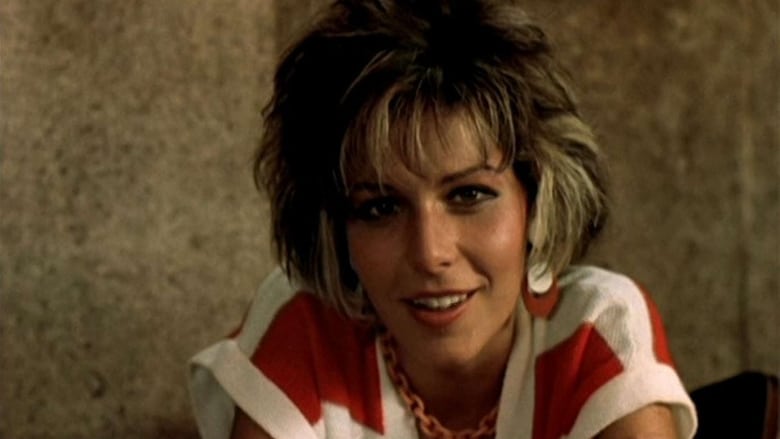
The narrative is a bit awkward and clumsy, it lacks a good rhythm, but the film is powerful just the same. The story is interspersed by shots of the Azovstal steelworks, that the current war made famous in March and April of 2022, and these shots have an eerie poetry to them, which is quite striking. 

The film's relation to sex and nudity is interesting. Here for example is a poster that was used in the marketing campaign:
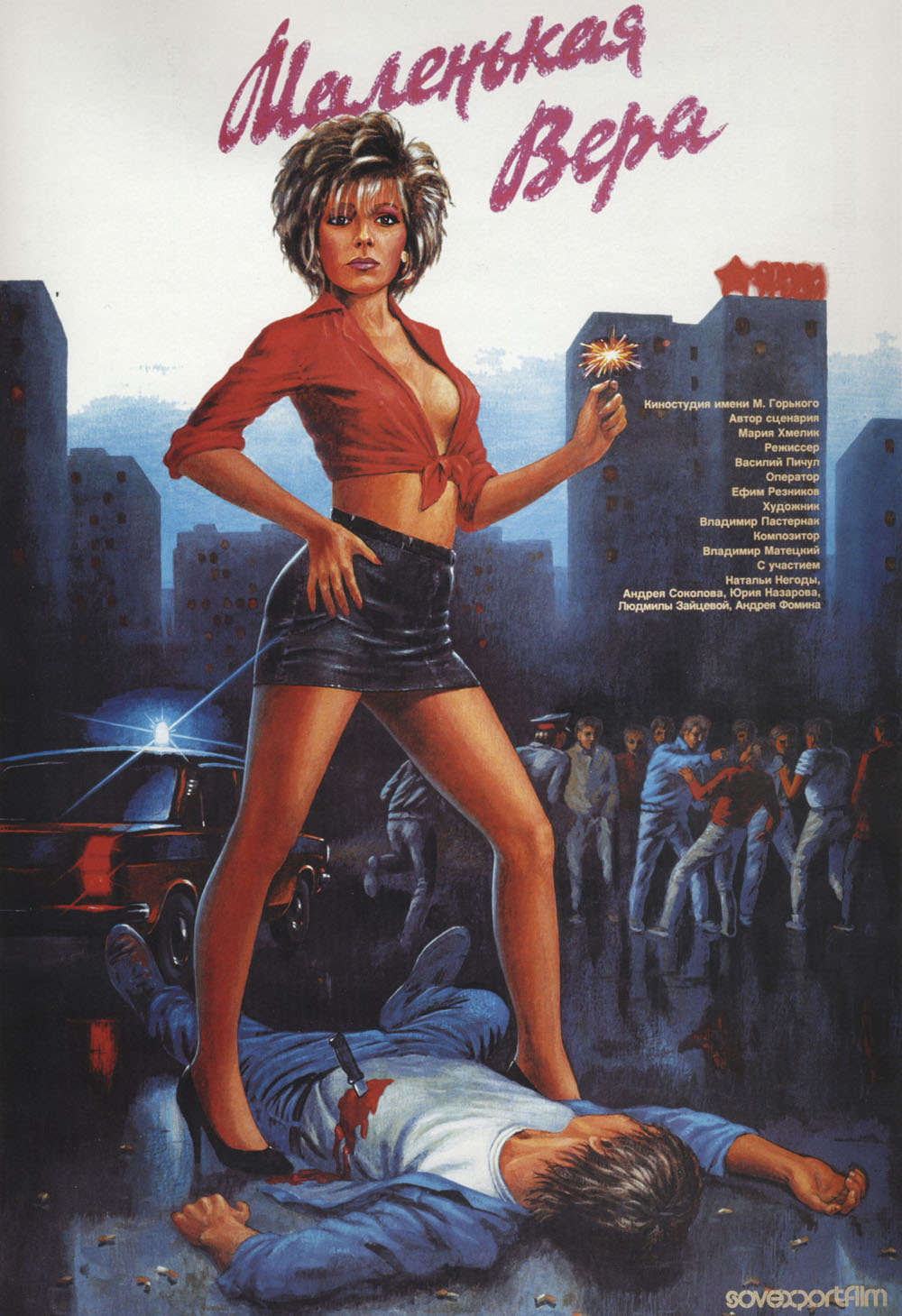

As Vera is a sad, struggling teenager and not an avenging action hero, and the film resembles Ken Loach and not Paul Verhoeven, the poster has nothing to do with the style and content of the actual film. It does however say a lot about distributors' focus, and their, probably accurate, idea of what would sell. But most people seeing that poster, and expecting something like it, would be certain to be disappointed. Natalya Negoda was however able to trade on that sexual angle, as she got to appear on the cover of Playboy magazine. And the Soviet women did take notice, and appreciate, the fact that in the sex scenes, Vera was on top of her boyfriend, showing yet again that she was a new kind of woman. She became emblematic of the rapid changes in the Soviet Union during the years of reformist chairman Mikhail Gorbachev. 

Little Vera was made little over a year after Gorbachev had announced the new policy of openness, glasnost and perestroika (these are terms that are synonymous with my childhood), which also affected Soviet cinema culture. It meant that older films that had been censored and banned could now be shown, sometimes for the first time, and dark and rebellious films like Little Vera could be made. It has its flaws but it is a powerful film; you should definitely search for it. 

***

Today the film has a certain urgency to it, as most of what is seen in it has been destroyed by Russian artillery and missiles. The whole city has become a crime scene, a crime against humanity. 

Pichul never got to experience the demolition of his hometown; he died from lung cancer in 2015. Now the whole city is dying. Although knowing about Ukrainian resilience and resourcefulness, I do not doubt that as soon as the Russians are defeated, the locals will make the city flourish again. The human spirit lives on, even if it sometimes must do battle with the dark forces of fascism and vicious drunken madness.


------------------------------------------------------

On the question of genocide:

https://www.bbc.com/news/world-europe-61017352 

https://www.usip.org/publications/2022/09/russia-committing-genocide-ukraine

https://www.politico.eu/article/russia-to-start-mass-deportation-from-southern-occupied-territories-as-moscow-prepares-kherson-surrender/

https://www.icj-cij.org/en/case/182

Friday, 29 April 2022

Wings (1966)

In a previous post I briefly mentioned Ukrainian cinema. I had seen very little of it, and knew even less. But I have been educating myself, and I have also watched several films now. The favourite so far is Larisa Shepitko's Wings from 1966. Maya Bulgakova plays Nadezhda Petrukhina, called Nadia, a former fighter pilot who was part of the Soviet air force during World War II, and now she works as a principal at a high school. The film combines impressionistic vignettes of her current life with flashbacks to her time as a pilot. The film opens with a scene of her at the tailor, getting fitted for some new clothes, and then in the next scene her excited students, at least the girls are excited, the boys are more blasé, watch her receive some kind of award or diploma. Next she intervenes after a male student has slapped a female student, and this intervention will have repercussions throughout the film. Here, after a few minutes of these vignettes, several themes of the film have been established, such as her alienation, the violence and discrimination against women, and the clashes between generations. Another example of this is her estrangement from her adopted daughter. Nadia's life has become stale and dull. Once, when she has decided that she cannot eat all her meals at home but needs to get out and eat at restaurants, she is denied a table as single women are not welcomed. 

Nadia is often passive, pushed around by men, whether male students or adults. At the tailor's in the opening scene she is hardly moving and she is not speaking, the tailor is the active one. Despite her official status as a war hero, all of that seems to have drained from her now, for various reasons which are revealed and explored throughout the film.

Wings is a quiet, sad, and beautifully shot film, which feels spontaneous and improvised but is not. Bulgakova, who plays the lead, and Shepitko rehearsed for a month together before filming even began. It is set and shot in Sevastopol, Crimea, which at the time was part of Ukraine (it was forcibly taken over by Russia in 2014) and there are some scenes in the film in which Nadia wanders around the city, looking at things. In one particularly fine scene she goes to an exhibition about World War 2, and there she discovers that she is herself part of that exhibition, as one of the heroic pilots of the war. It is as if both society at large, and she herself, has made her a being with only a past, not much of a present or a future existence. The Ukrainian-born Maya Bulgakova is wonderful in her performance, expressive despite being withdrawn, and it feels like she and Shepitko are completely in sync with one another, and with the character. The film's visual style, editing and use of music feels of its time. When watching it one might at times think of Miloš Forman's Czech films and sometimes Agnès Varda, not least in the way the characters are presented and the attitude of the filmmaker towards them.

***

It has been surprisingly difficult to find exact information about Shepitko. Even the year of her birth has there been some confusion about, but it seems she was born in 1938 in Bakhmut, present-day Ukraine, although when she was born the city was called Artyomovsk. When she was still just a teenager she went to Moscow, and there she eventually graduated from VGIK, Gerasimov Institute of Cinematography. She was the only female student at the time (I think), and she had Alexander Dovzhenko as her tutor, until his death in 1956. She graduated in 1963, with the feature film Znoy. Before that she had made some fine short films, of which I have seen Zhivaya voda, a poetic evocation of life around a river (or is it a sea?) running through a city.

She made few films. After Wings came The Homeland of Electricity, an austere, yet remarkable, episode in the portmanteau film Beginnings of an Unknown Era (1967), which was banned at the time. In the Thirteenth Hour of the Night or 13PM (1969) is some kind of fantasy musical made for Soviet TV. You and Me (1971) is a drama which I have unfortunately not been able to watch. The Ascent (1977) is a cruel tale about soldiers suffering in deep snow during World War II. It seems to be her most famous film, and it is impressive, although I prefer Wings. Tragically, it would be the last film she finished, as she died in a car accident, together with some team members, while she was making Farewell, in 1979. Her husband Elem Klimov, also a prominent filmmaker, finished the film in 1981, and it was released in 1983. Considering her remarkable talents and vision, her early death, barely 40 years old, was a terrible loss for cinema.

------------------------

Three other filmmakers from the Soviet era with Ukrainian credentials:

Alexander Dovzhenko, or Oleksandr Dovzhenko with Ukrainian spelling, was born in Ukraine and made his films there. I wrote about him here.

Grigory Chukhray, famous for writing and directing The Ballad of a Soldier (1959), was from Ukraine. I wrote about it here.

Kira Muratova was born in present-day Moldova but lived and worked in Ukraine. I am curious about her films, but have not seen any of them yet.

A good recent podcast about Ukrainian cinema: https://www.filmcomment.com/blog/the-film-comment-podcast-ukrainian-cinema

A link to the film archive in Kyiv: https://dovzhenkocentre.org/ The centre did a survey among Ukrainian critics, curators, and others about the best Ukrainian films of all time, and this is their top five:

Shadows of Forgotten Ancestors (1964)

Earth (1930)

Man With a Movie Camera (1929)

The Tribe (2014)

The Stone Cross (1968)